


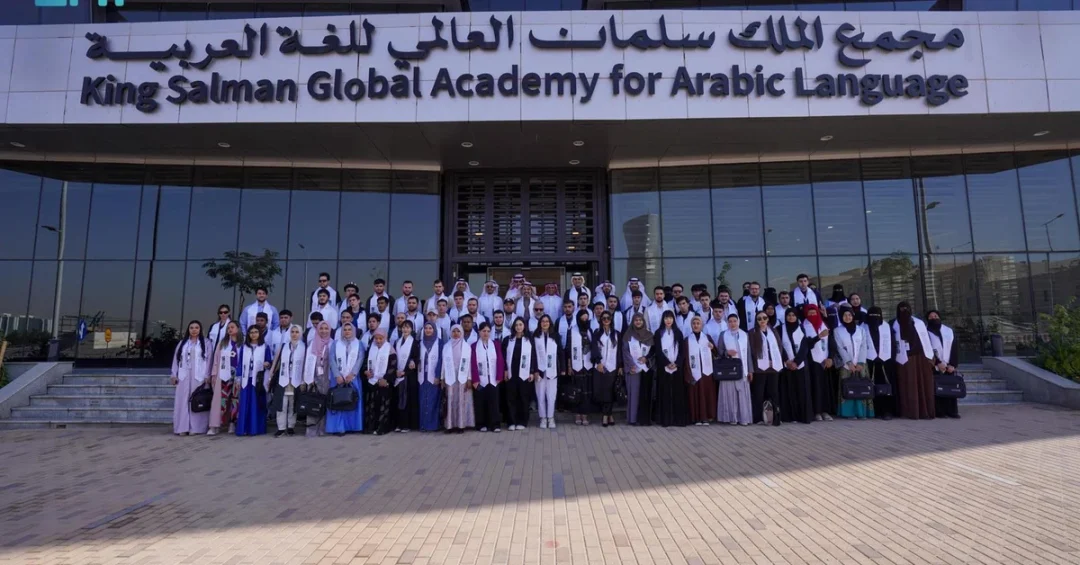
The King Salman Global Academy for Arabic Language (KSGAAL) will celebrate the graduation of the first group of students from the Abjad Center for Teaching Arabic Language on Wednesday, September 4, 2024. The ceremony marks a milestone in the Kingdom of Saudi Arabia’s efforts to promote Arabic language and culture worldwide, as announced by the Saudi Press Agency (SPA). The inaugural cohort, which began an in-person Arabic learning program on January 15, 2024, comprises 130 male and female students representing 34 countries, including the United States, China, Germany, France, India, Japan, and Brazil.
Context and Background
The Abjad Center for Teaching Arabic Language was established under the auspices of KSGAAL to provide high-quality Arabic language education that integrates linguistic instruction with cultural immersion. The center’s launch aligns with the Kingdom’s broader Vision 2030 objectives, which emphasize cultural exchange, educational excellence, and global engagement. By offering a structured and immersive learning environment, the center aims to equip non-native speakers with the skills needed to communicate effectively in Arabic while fostering a deeper appreciation for Saudi culture and heritage.
Key Details
The program consisted of four levels aligned with the Common European Framework of Reference for Languages (CEFR): A1, A2, B1, and B2. Each level spanned two months and included 160 instructional hours, blending Arabic learning with Saudi culture in an engaging environment. The curriculum was supplemented by a variety of enriching cultural and tourist activities at several destinations throughout Saudi Arabia, allowing students to practice their language skills in real-world settings. The diverse student body, drawn from nations such as Albania, Argentina, Azerbaijan, Belgium, Brazil, Canada, China, Colombia, Denmark, Ecuador, France, Germany, Georgia, India, Indonesia, Italy, Japan, Kazakhstan, Kyrgyzstan, Malaysia, Mexico, Mauritius, the Netherlands, Pakistan, Russia, Republic of Korea, Spain, Tajikistan, Thailand, Türkiye, Ukraine, the United Kingdom, the United States, and Uzbekistan, underscores the global interest in Arabic language learning.
Implications and Impact
The graduation of the first cohort from the Abjad Center demonstrates Saudi Arabia’s commitment to cultural diplomacy and educational leadership. By providing a comprehensive program that combines language acquisition with cultural experiences, the Kingdom is fostering cross-cultural understanding and building bridges with nations around the world. This initiative supports the global spread of the Arabic language, enhancing Saudi Arabia’s soft power and reinforcing its role as a hub for education and culture in the Middle East.
Vision 2030 Alignment
The success of the Abjad Center’s first program reflects Saudi Arabia’s Vision 2030 goal of promoting cultural exchange and human capital development. Through initiatives like the Abjad Center, the Kingdom is investing in education as a tool for economic diversification and international collaboration. As Saudi Arabia continues to open its doors to the world, programs that teach Arabic language and culture will play a key role in strengthening ties with global partners and positioning the Kingdom as a leading destination for learning and cultural tourism.
20 Questions
Q1. What is the Abjad Center for Teaching Arabic Language?
A1. The Abjad Center is an institution under KSGAAL that provides high-quality Arabic language education to non-native speakers, integrating language learning with Saudi cultural immersion in an engaging environment.
Q2. Who organized the graduation ceremony for the first group of students?
A2. The King Salman Global Academy for Arabic Language (KSGAAL) organized the graduation ceremony, which will take place on Wednesday, September 4, 2024, in Riyadh.
Q3. How many students are graduating from the first cohort?
A3. The inaugural cohort consists of 130 male and female students who completed the program, representing a diverse group from 34 countries around the world.
Q4. When did the program for these students begin?
A4. The students began an in-person Arabic learning program on January 15, 2024, and the program lasted approximately eight months, culminating in the graduation ceremony.
Q5. From how many countries are the graduating students?
A5. The graduating students come from 34 countries, including the United States, China, Germany, France, India, Japan, Brazil, and many others from different continents.
Q6. What are the CEFR levels taught in the program?
A6. The program taught four levels aligned with the Common European Framework of Reference for Languages: A1, A2, B1, and B2, covering beginner to upper-intermediate proficiency.
Q7. How many instructional hours did each level include?
A7. Each level of the program included 160 instructional hours, with the entire course spanning eight months of intensive language study and cultural activities.
Q8. What cultural activities were part of the program?
A8. The program featured enriching cultural and tourist activities at several destinations throughout Saudi Arabia, allowing students to practice Arabic in real-world settings and explore Saudi heritage.
Q9. What is the main goal of the Abjad Center?
A9. The Abjad Center aims to highlight the Kingdom’s commitment to promoting the Arabic language and its culture worldwide by providing quality education that integrates language and culture.
Q10. How does this program support Vision 2030?
A10. The program supports Vision 2030 by promoting cultural exchange, educational excellence, and global engagement, positioning Saudi Arabia as a hub for learning and cultural tourism.
Q11. Which countries are represented in the graduating class?
A11. Countries represented include Albania, Argentina, Azerbaijan, Belgium, Brazil, Canada, China, Colombia, Denmark, Ecuador, France, Germany, Georgia, India, Indonesia, Italy, Japan, Kazakhstan, Kyrgyzstan, Malaysia, Mexico, Mauritius, the Netherlands, Pakistan, Russia, Republic of Korea, Spain, Tajikistan, Thailand, Türkiye, Ukraine, the United Kingdom, the United States, and Uzbekistan.
Q12. How long did the entire program last for these students?
A12. The program lasted from January 15, 2024, to early September 2024, covering eight months of instruction divided into four two-month levels with cultural activities.
Q13. What is the role of KSGAAL in this initiative?
A13. KSGAAL, the King Salman Global Academy for Arabic Language, oversees the Abjad Center and its programs, promoting Arabic language education and cultural understanding worldwide as part of Saudi Arabia’s cultural diplomacy.
Q14. Why is this graduation significant for Saudi Arabia?
A14. The graduation marks a milestone in Saudi Arabia’s efforts to promote Arabic language and culture globally, demonstrating the Kingdom’s commitment to educational leadership and cross-cultural exchange.
Q15. What skills do students gain from the program?
A15. Students gain the skills to actively participate in conversations and interact with others in Arabic, supported by a curriculum that blends language learning with cultural immersion.
Q16. How does the Abjad Center ensure a quality learning experience?
A16. The center offers a structured curriculum aligned with CEFR standards, experienced instructors, and an engaging environment that combines classroom learning with real-world cultural activities.
Q17. What is the international impact of this program?
A17. The program fosters cross-cultural understanding and builds bridges with nations worldwide, enhancing Saudi Arabia’s soft power and its role as a leader in education and culture.
Q18. Will the Abjad Center offer future programs?
A18. Yes, the success of this pilot program sets the stage for future cohorts, as the Abjad Center aims to continue promoting Arabic language and culture through quality education.
Q19. How does the program integrate Saudi culture?
A19. The program integrates Saudi culture through cultural and tourist activities at various destinations, allowing students to experience Saudi traditions, history, and hospitality firsthand.
Q20. Where can more information about KSGAAL be found?
A20. More information about KSGAAL and its initiatives, including the Abjad Center, can be found through official Saudi channels such as the Saudi Press Agency (SPA) and KSGAAL’s official communications.
Reader Feedback
We value your thoughts. Please share your feedback on this article.
Your feedback helps us improve our coverage.