


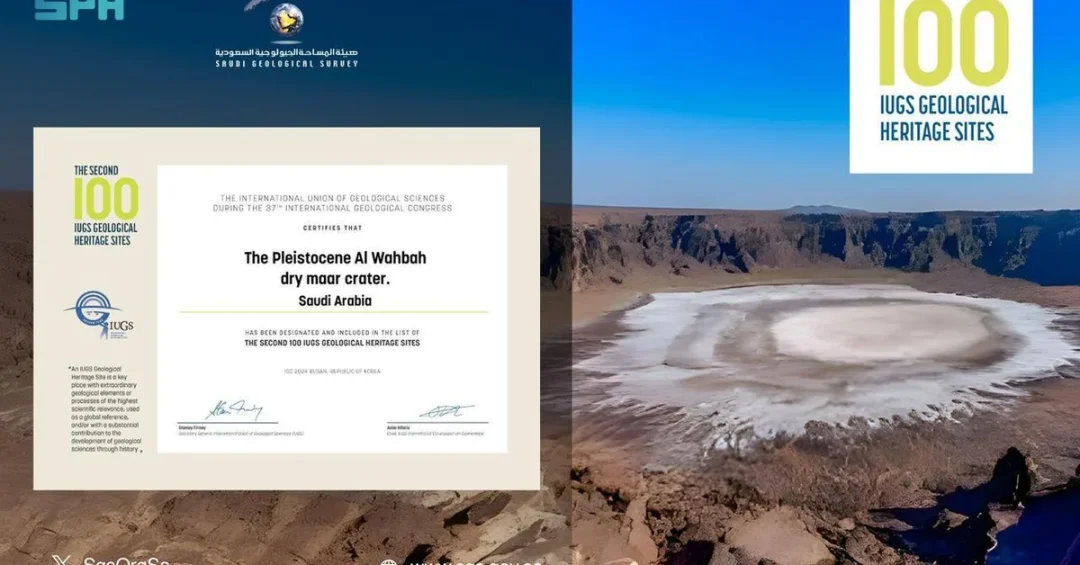
The Saudi Geological Survey (SGS) announced that the Waba Crater, a volcanic landmark located approximately 270 kilometers northeast of Jeddah, has been selected among the top 100 geological heritage sites worldwide for 2024. This recognition was granted by the International Union of Geological Sciences (IUGS) and the United Nations Educational, Scientific, and Cultural Organization (UNESCO), underscoring Saudi Arabia’s growing prominence in the field of earth sciences and geological preservation.
Context and Background
Waba Crater, also known as the Tamiya Quarry or scientifically as the Al-Mar Volcano, lies within the Harrat Khishb volcanic field, a monogenetic field containing 175 small volcanoes spanning an area of approximately 6,000 square kilometers. The crater was formed about 1.1 million years ago and stands as one of the largest and most magnificent volcanic craters in the world, with a depth of around 250 meters and a diameter of 2.3 kilometers—approximately three times the average diameter of other volcanoes. A shallow, saline lake formed by accumulated rainwater rests at its base, adding to the site’s unique geological and ecological value.
Key Details
SGS official spokesperson Tariq Abaalkhail confirmed that the selection followed a rigorous evaluation by a committee of 89 global experts. The Waba Crater was chosen from among 174 nominated sites submitted by 64 countries, including Saudi Arabia, the United States, Italy, Canada, New Zealand, China, Iceland, Egypt, and Finland. Abaalkhail emphasized that this recognition highlights the crater’s scientific importance and its role as an inspiring destination that promotes geological tourism and advances the development of geological sciences, offering unique opportunities for knowledge dissemination in earth sciences.
Implications and Impact
This international recognition positions Waba Crater as a key site for geotourism within Saudi Arabia, aligning with the Kingdom’s broader efforts to diversify its economy and attract global visitors under Vision 2030. By showcasing its natural wonders on a world stage, Saudi Arabia reinforces its commitment to preserving geological heritage and fostering international scientific collaboration. The listing also enhances the Kingdom’s profile in geoscience research and sustainable tourism, providing a model for the integration of natural landmarks into national development strategies.
Vision 2030 Alignment
The inclusion of Waba Crater among the top 100 geological landmarks directly supports Saudi Arabia’s Vision 2030 goals of promoting tourism, preserving natural heritage, and advancing scientific knowledge. As the Kingdom opens its doors to international visitors, sites like this offer compelling destinations for eco-tourists, researchers, and educators. This recognition reflects a forward-looking approach, where the Kingdom’s geological treasures serve as bridges to global understanding and sustainable development, contributing to a prosperous future under Vision 2030.
20 Questions
Q1. What is the Waba Crater?
A1. The Waba Crater is a large volcanic crater located in Saudi Arabia, known scientifically as the Al-Mar Volcano. It is one of the world’s most magnificent volcanic craters, recognized for its size and geological significance.
Q2. Where is Waba Crater located?
A2. It is situated in the Harrat Khishb volcanic field, approximately 270 kilometers northeast of Jeddah, Saudi Arabia. The area is part of a monogenetic volcanic field with 175 small volcanoes spanning around 6,000 square kilometers.
Q3. How was Waba Crater formed?
A3. The crater was formed about 1.1 million years ago due to volcanic activity. It is a dry maar volcano, created by explosive interactions between magma and groundwater, leaving a large depression.
Q4. What are the key dimensions of Waba Crater?
A4. The crater has a depth of approximately 250 meters and a diameter of 2.3 kilometers, which is about three times the average diameter of other volcanoes worldwide.
Q5. Why is Waba Crater considered geologically significant?
A5. It is one of the largest and most magnificent volcanic craters globally, featuring a shallow saline lake and being part of a large volcanic field. Its formation provides insights into monogenetic volcanism.
Q6. Who recognized Waba Crater as a top geological landmark?
A6. The International Union of Geological Sciences (IUGS) and UNESCO selected it among the top 100 geological heritage sites in the world for 2024, based on expert evaluation.
Q7. How many sites were nominated for this list?
A7. A total of 174 sites were nominated from 64 countries, including Saudi Arabia, the United States, Italy, Canada, and China. The Waba Crater was chosen after a rigorous evaluation by 89 experts.
Q8. What is the role of the Saudi Geological Survey (SGS) in this?
A8. The SGS announced the selection and nomination of the Waba Crater. It manages geological heritage preservation in Saudi Arabia and promotes the site for scientific and tourism purposes.
Q9. What is a monogenetic volcanic field?
A9. A monogenetic volcanic field is an area where volcanoes erupt only once, forming small, short-lived cones and craters. Harrat Khishb is one such field with 175 volcanoes.
Q10. Does Waba Crater have a lake?
A10. Yes, the crater contains a shallow saline basin or lake formed by the accumulation of rainwater at its base, adding to its unique ecological and geological characteristics.
Q11. How does this recognition benefit Saudi Arabia’s tourism?
A11. The listing enhances the Waba Crater’s appeal as a geotourism destination, attracting international visitors interested in geology and natural wonders, supporting Saudi Arabia’s tourism diversification goals under Vision 2030.
Q12. What is the age of the volcanic field around Waba Crater?
A12. The Harrat Khishb volcanic field has volcanoes with ages ranging from 2 million to a few hundred thousand years, making it a significant site for studying volcanic history.
Q13. Who is Tariq Abaalkhail in this context?
A13. Tariq Abaalkhail is the official spokesperson for the Saudi Geological Survey (SGS), who confirmed the selection and highlighted the crater’s scientific and tourism value.
Q14. What does the IUGS do?
A14. The International Union of Geological Sciences (IUGS) is a global organization that promotes Earth science research and cooperation. It collaborates with UNESCO to identify geological heritage sites.
Q15. How does this align with Vision 2030?
A15. It supports Vision 2030 by promoting sustainable tourism, preserving natural heritage, and fostering scientific knowledge, all key pillars for diversifying Saudi Arabia’s economy and global engagement.
Q16. What is the crater’s scientific name?
A16. The scientific name for the Waba Crater is the Al-Mar Volcano. It is also known locally as the Tamiya Quarry, reflecting its multiple identities in the region.
Q17. Can visitors explore the Waba Crater?
A17. Yes, the Waba Crater is an inspiring destination that promotes geological tourism. It offers unique opportunities for education and exploration, though access may require coordination with local authorities.
Q18. What other countries had nominated sites?
A18. Other nominating countries included the United States, Italy, Canada, New Zealand, China, Iceland, Egypt, and Finland, among 64 total, highlighting the competitive nature of the selection.
Q19. What is the significance of the saline basin?
A19. The shallow saline lake at the crater’s base, formed by rainwater accumulation, provides a unique habitat and offers insights into arid-zone hydrology and volcanic lake ecology.
Q20. How does this recognition promote earth sciences?
A20. By being among the top 100 sites, the Waba Crater inspires research and education, allowing scientists and the public to learn about volcanic processes, geological history, and environmental dynamics.
Reader Feedback
We value your thoughts. Please share your feedback on this article.
Your feedback helps us improve our coverage.