


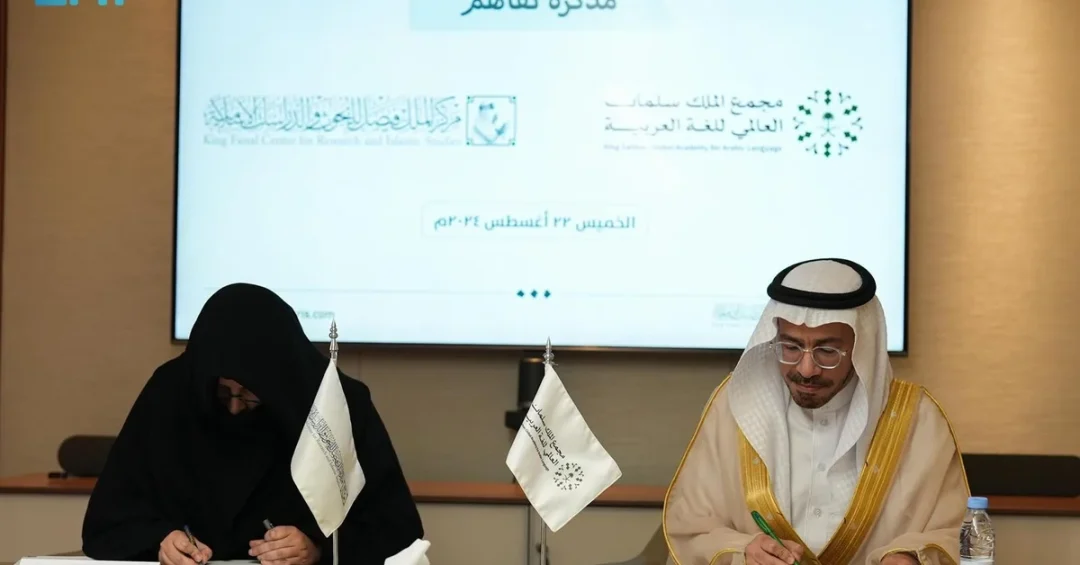
Riyadh, August 26, 2024 — The King Salman Global Academy for Arabic Language and the King Faisal Center for Research and Islamic Studies have signed a memorandum of understanding (MoU) to bolster cooperation and share expertise in the teaching and learning of Arabic as a second language. The agreement was formalized at a ceremony in Riyadh, attended by senior officials from both institutions. The King Faisal Center was represented by its Secretary General, Princess Maha bint Mohamed bin Faisal, while the Academy was represented by its Secretary General, Dr. Abdullah bin Saleh Al-Washmi. The signing marks a strategic step in the Academy’s ongoing efforts to serve the Arabic language and enhance its global reach.
Context and Background
The King Salman Global Academy for Arabic Language, established to support the Arabic language’s role in culture, science, and international communication, operates under the umbrella of Saudi Arabia’s Vision 2030. This vision emphasizes cultural exchange and the promotion of the Arabic language as a key pillar of national identity. The MoU aligns with the Academy’s core objectives, including preserving the integrity of the Arabic language in both speech and writing, focusing on its eloquence, rules, and origins. By partnering with the King Faisal Center for Research and Islamic Studies—a leading research institution dedicated to Islamic studies and cultural heritage—the Academy leverages deep scholarly resources and research capabilities to achieve these goals.
Key Details of the MoU
The memorandum outlines seven specific areas of cooperation designed to advance the Arabic language. A primary focus is enhancing Arabic language capabilities among native speakers through targeted programs. The agreement also includes the development and publication of general and specialized dictionaries. Furthermore, the MoU calls for the collection, preservation, and analysis of text and audio data to support linguistic research. Other cooperative activities include exchanging academic and professional experiences, organizing visits between the two institutions, and holding forums, seminars, and panel discussions on topics of mutual interest. Princess Maha bint Mohamed bin Faisal emphasized that the partnership reflects a shared commitment to fostering linguistic scholarship and cultural understanding.
Implications for Arabic Language Education
This agreement is expected to significantly impact Arabic language education both within Saudi Arabia and internationally. By combining the Academy’s strategic focus on language instruction with the Center’s extensive research archives and scholarly network, the partnership aims to create innovative teaching methodologies and resources. The focus on data collection and analysis will support empirical studies on language acquisition, which can inform more effective curricula. Additionally, the exchange of expertise and regular academic events will foster a vibrant community of linguists and educators, contributing to a broader understanding of Arabic’s role in a globalized world. This collaboration reinforces Saudi Arabia’s leadership in promoting cross-cultural dialogue and educational advancement.
Vision 2030 Alignment
The MoU between the King Salman Global Academy for Arabic Language and the King Faisal Center for Research and Islamic Studies exemplifies Saudi Arabia’s commitment to enriching cultural and educational initiatives as part of Vision 2030. By investing in language preservation and international cooperation, the Kingdom advances its goal of building a vibrant society with deep-rooted cultural values. This partnership not only strengthens the global position of the Arabic language but also supports the broader objectives of economic diversification and human capital development. As Saudi Arabia continues to open its doors to the world, such collaborations ensure that its cultural assets are shared and celebrated, reinforcing the Kingdom’s role as a global hub for knowledge and dialogue.
20 Questions
Q1. What is the purpose of the MoU signed between the King Salman Global Academy for Arabic Language and the King Faisal Center for Research and Islamic Studies?
A1. The MoU aims to enhance cooperation and jointly benefit from experiences in teaching and learning Arabic as a second language, supporting the Academy’s mission to serve the Arabic language.
Q2. Who signed the memorandum of understanding on behalf of the two institutions?
A2. Princess Maha bint Mohamed bin Faisal, Secretary General of the King Faisal Center, and Dr. Abdullah bin Saleh Al-Washmi, Secretary General of the King Salman Global Academy, signed the MoU.
Q3. When was the MoU signed?
A3. The memorandum was signed on August 26, 2024, in Riyadh, Saudi Arabia.
Q4. What are the main objectives of the King Salman Global Academy for Arabic Language?
A4. The Academy aims to serve the Arabic language, maintain its integrity in speaking and writing, focus on its eloquence, rules, and origins, and facilitate learning both inside and outside Saudi Arabia.
Q5. How many areas of cooperation are included in the MoU?
A5. The MoU includes seven areas of cooperation covering language development, dictionary publishing, data collection, and academic exchanges.
Q6. What specific language-related activities are covered in the cooperation?
A6. Cooperation includes enhancing Arabic capabilities of native speakers, developing programs, issuing dictionaries, and collecting, preserving, and analyzing text and audio data.
Q7. Does the partnership include the organization of academic events?
A7. Yes, the MoU provides for exchanging experiences, visits, and organizing forums, seminars, and panel discussions on topics of mutual interest.
Q8. What is the role of the King Faisal Center for Research and Islamic Studies in this partnership?
A8. The Center contributes its scholarly resources and research expertise in Islamic studies and cultural heritage to support the Academy’s language objectives.
Q9. How does this MoU align with Saudi Arabia’s Vision 2030?
A9. It supports Vision 2030 by promoting cultural identity, education, and international cooperation, contributing to a vibrant society and diversified economy.
Q10. Is the focus of the MoU limited to teaching Arabic to non-native speakers?
A10. No, it also enhances Arabic language capabilities for native speakers through specialized programs and resources.
Q11. What types of data will be collected and analyzed under the MoU?
A11. Text and audio data relevant to Arabic language will be collected, preserved, and analyzed to support linguistic research and curriculum development.
Q12. Will the MoU lead to new publications?
A12. Yes, the agreement includes issuing general and specialized dictionaries as part of the cooperative efforts.
Q13. How does the partnership benefit Arabic language education internationally?
A13. By combining expertise, it develops innovative teaching methodologies, curricula, and resources that can be used globally to teach Arabic as a second language.
Q14. Are there any specific programs mentioned for native speakers?
A14. The MoU includes enhancing the Arabic language capabilities of native speakers through targeted program development.
Q15. How does the MoU support the Academy’s goal of preserving Arabic integrity?
A15. By focusing on eloquence, rules, and origins through research and education, the partnership helps maintain the purity and correct usage of Arabic.
Q16. Is this the first partnership between the two institutions?
A16. The news release does not specify previous partnerships, but this MoU formalizes a new area of strategic cooperation.
A17. The Academy, established to serve Arabic, benefits from the Center’s research archives and scholarly network for deeper linguistic studies.
Q17. What does the King Faisal Center bring to this partnership?
Q18. Who represented the King Salman Global Academy at the signing ceremony?
A18. The Academy was represented by its Secretary General, Dr. Abdullah bin Saleh Al-Washmi.
Q19. How might this cooperation influence Arabic language policies in Saudi Arabia?
A19. It could lead to informed policies based on research and data analysis, strengthening Arabic language initiatives nationally and internationally.
Q20. What is the expected long-term impact of this MoU?
A20. The partnership aims to advance Arabic language education, preserve linguistic heritage, and position Saudi Arabia as a leader in cultural and academic exchange.
Reader Feedback
We value your thoughts. Please share your feedback on this article.
Your feedback helps us improve our coverage.