


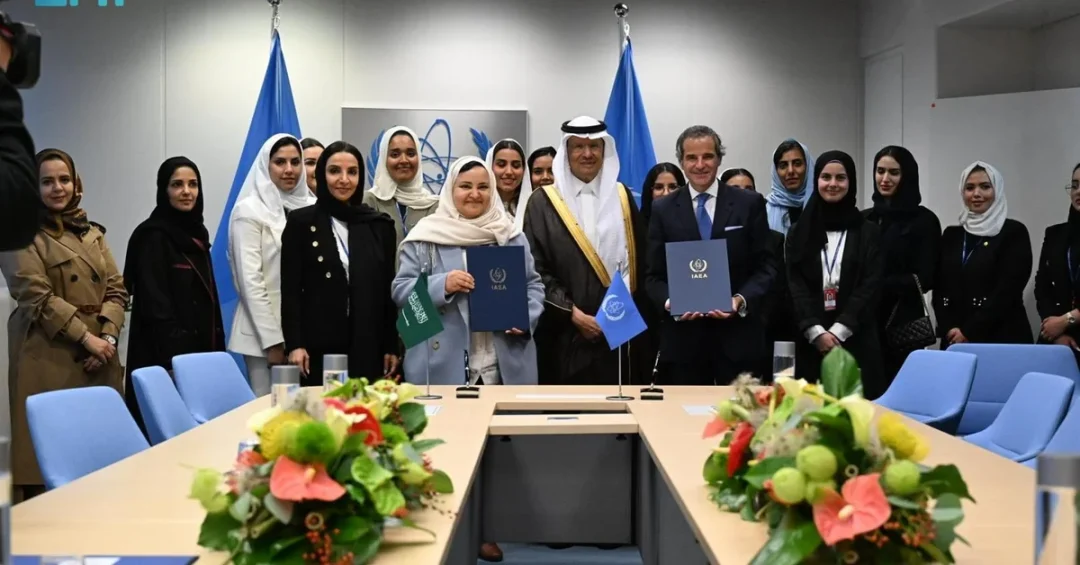
In a significant step toward enhancing women’s participation in advanced technology sectors, a memorandum of understanding was signed in Riyadh on September 16, 2024, between the International Atomic Energy Agency (IAEA) and the Women and Energy Association. The signing took place in the presence of His Royal Highness Prince Abdulaziz bin Salman bin Abdulaziz, Saudi Arabia’s Minister of Energy, underscoring the Kingdom’s commitment to capacity building and innovation. The agreement was signed by IAEA Director General Rafael Mariano Grossi and Princess Mishaal bint Saud AlShalan, Chairwoman of the Board of the Women and Energy Association.
Context and Background
This memorandum of understanding aligns with the Kingdom of Saudi Arabia’s broader efforts under Vision 2030 to diversify the economy and empower women in science, technology, engineering, and mathematics (STEM). The agreement focuses on fostering cooperation in capacity building and supporting innovation in nuclear sciences, positioning women at the forefront of sustainable development. Saudi Arabia has increasingly partnered with international organizations like the IAEA to advance peaceful nuclear technology, reinforcing its role as a regional leader in energy innovation.
Key Details
The agreement aims to develop women’s skills in STEM fields, with a particular emphasis on nuclear sciences. It emphasizes practical training, knowledge exchange, and collaborative projects, supporting the Kingdom’s goal of enabling women to contribute to a sustainable future. Princess Mishaal bint Saud AlShalan has been a vocal advocate for gender parity in energy sectors, and this MoU represents a formal mechanism to translate those goals into tangible outcomes. The IAEA’s involvement ensures access to global expertise and best practices in nuclear technology and safety.
Implications
This partnership is expected to create new opportunities for Saudi women in emerging energy fields, including nuclear and renewable technologies. By leveraging the IAEA’s international network, Saudi Arabia can accelerate its human capital development, which is critical for achieving energy security and sustainability targets. The MoU also strengthens the Kingdom’s diplomatic ties with the IAEA, showcasing its proactive approach to fostering inclusive innovation. For the region, it sets a precedent for integrating women into high-tech industries, potentially inspiring similar initiatives across the Middle East.
Vision 2030 Alignment
The signing of this memorandum of understanding directly supports Vision 2030’s objectives of economic diversification, human capital development, and gender empowerment. By equipping women with advanced skills in nuclear sciences and STEM, Saudi Arabia is building a knowledge-based workforce ready to lead in the energy transition. This initiative reflects the Kingdom’s steadfast commitment to sustainable development and its role as a global partner in peaceful nuclear applications, paving the way for future innovation and prosperity.
20 Questions
Q1. What was the main purpose of the MoU signed between the IAEA and the Women and Energy Association?
A1. The main purpose is to enhance cooperation in capacity building, focusing on developing women’s roles in STEM fields and supporting innovation in nuclear sciences for a sustainable future.
Q2. Who represented the International Atomic Energy Agency during the signing?
A2. The IAEA was represented by its Director General, Rafael Mariano Grossi, who signed the memorandum of understanding on behalf of the organization.
Q3. Who represented the Women and Energy Association at the signing ceremony?
A3. The Women and Energy Association was represented by Princess Mishaal bint Saud AlShalan, the Chairwoman of its Board of Directors.
Q4. Which Saudi official was present during the signing of this MoU?
A4. His Royal Highness Prince Abdulaziz bin Salman bin Abdulaziz, the Minister of Energy of Saudi Arabia, was present to witness the signing.
Q5. Where did the signing ceremony take place?
A5. The signing ceremony took place in Riyadh, the capital city of the Kingdom of Saudi Arabia.
Q6. What date was the memorandum of understanding signed?
A6. The memorandum of understanding was signed on September 16, 2024.
Q7. What does STEM stand for in the context of this agreement?
A7. STEM stands for Science, Technology, Engineering, and Mathematics, which are the key fields targeted for women’s development under the agreement.
Q8. How does this MoU align with Saudi Arabia’s Vision 2030?
A8. It aligns by promoting economic diversification, empowering women in technology sectors, and building a skilled workforce to support sustainable energy and innovation.
Q9. What role does the IAEA play in this partnership?
A9. The IAEA provides global expertise, best practices, and international networks in nuclear science and safety to support capacity building and training initiatives.
Q10. Why is focusing on women in nuclear sciences significant for Saudi Arabia?
A10. It is significant because it enhances gender diversity in high-tech fields, supports the Kingdom’s energy transition, and strengthens its human capital base for future technologies.
Q11. What types of activities are expected under this MoU?
A11. Expected activities include practical training programs, knowledge exchange workshops, collaborative research projects, and initiatives to promote innovation in nuclear applications.
Q12. How does this agreement benefit the Women and Energy Association?
A12. It benefits the association by providing access to IAEA resources, international partnerships, and structured programs to advance its mission of empowering women in energy and technology.
Q13. What is the broader impact of this MoU on the Middle East region?
A13. It sets a positive example for other Middle Eastern countries by showcasing how to integrate women into high-tech industries, potentially inspiring regional capacity-building efforts.
For the full article, refer to the Saudi Press Agency (SPA) report.
Reader Feedback
We value your thoughts. Please share your feedback on this article.
Your feedback helps us improve our coverage.