


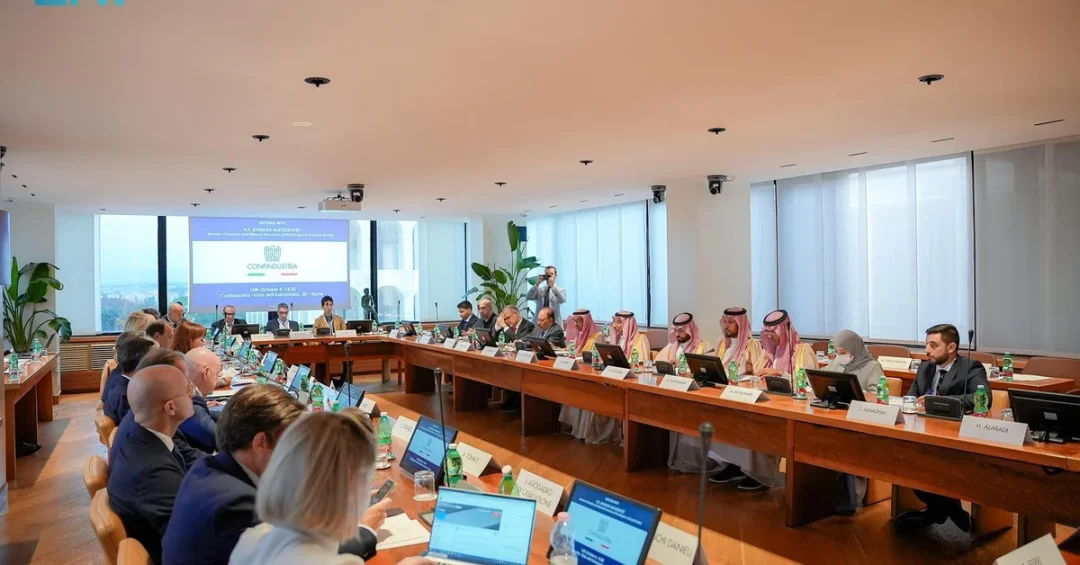
Saudi Minister of Industry and Mineral Resources Bandar Ibrahim Alkhorayef has stated that Fourth Industrial Revolution (4IR) technologies are a cornerstone of the Kingdom’s industrial transformation, creating high-quality jobs and modernizing the manufacturing sector. Speaking at a roundtable meeting organized by the General Confederation of Italian Industry in Rome on October 16, 2024, the minister outlined how automation and smart factory initiatives are reshaping Saudi Arabia’s industrial landscape.
Context and Background
The roundtable in Rome brought together private sector leaders and the CEO of the National Industrial Development Center (NIDC), Eng. Saleh Al-Solami, to discuss bilateral industrial cooperation. Minister Alkhorayef’s remarks underscored Saudi Arabia’s commitment to leveraging advanced technologies as part of its broader economic diversification strategy under Vision 2030. The meeting highlighted the Kingdom’s efforts to attract foreign investment and partnerships, particularly from Italian companies, by showcasing a modern, tech-driven industrial sector.
Key Details
The minister emphasized that the “Future Factories” program, launched by the Kingdom, aims to automate 4,000 factories through the adoption of 4IR applications, including artificial intelligence and robotics in manufacturing and quality control processes. This initiative is designed to improve production efficiency and reduce costs, while simultaneously transforming the nature of jobs in the Kingdom. Alkhorayef noted that 4IR technologies will create high-quality jobs that reduce reliance on unskilled labor. He added that the National Industrial Strategy focuses on localizing and developing 12 promising industrial sectors, offering over 800 investment opportunities valued at SAR 1 trillion.
International and Economic Impact
The minister’s comments signal Saudi Arabia’s openness to global partnerships, particularly with Italian industrial firms, as the Kingdom positions itself as a competitive manufacturing hub. By integrating with 20 other national strategies, the National Industrial Strategy aims to foster effective collaborations that benefit both Saudi Arabia and its international partners. This approach is expected to accelerate technology transfer, enhance supply chain resilience, and create a favorable environment for foreign direct investment in strategic sectors such as mining, manufacturing, and advanced materials.
Vision 2030 Alignment
Alkhorayef reiterated that the National Industrial Strategy is a key enabler of Vision 2030, which seeks to diversify the Kingdom’s economic base beyond oil. A major component of this vision is transforming the mining sector into a third pillar of Saudi industry, capitalizing on the Kingdom’s estimated $2.5 trillion in diverse mineral resources. By modernizing factories and attracting international investment, Saudi Arabia is laying the groundwork to become a global hub for mineral production and manufacturing, aligning with its long-term goals of sustainable growth and job creation.
20 Questions
Q1. Who participated in the roundtable meeting in Rome?
A1. Saudi Minister of Industry and Mineral Resources Bandar Ibrahim Alkhorayef and the CEO of the National Industrial Development Center, Eng. Saleh Al-Solami, along with private sector leaders from Italy.
Q2. What was the main topic of the minister’s remarks?
A2. The minister discussed how Fourth Industrial Revolution technologies are essential for achieving industrial transformation in Saudi Arabia, focusing on automation and smart factory initiatives.
Q3. What is the “Future Factories” program?
A3. It is a Saudi initiative aimed at automating 4,000 factories by adopting Fourth Industrial Revolution applications, including artificial intelligence and robotics in manufacturing and quality control.
Q4. How will 4IR technologies affect jobs in Saudi Arabia?
A4. They will create high-quality, skilled jobs and reduce reliance on unskilled labor by transforming industrial processes through automation and advanced manufacturing solutions.
Q5. What is the goal of the National Industrial Strategy?
A5. The strategy focuses on localizing and developing 12 promising industrial sectors and integrating with public and private entities to foster effective partnerships.
Q6. How many investment opportunities does the National Industrial Strategy offer?
A6. It offers over 800 investment opportunities worth SAR 1 trillion to attract domestic and international investors.
Q7. What did the minister say about Italian companies?
A7. He stated that the current period is opportune for Italian companies to invest in the Saudi industrial sector, given the Kingdom’s modernization and investment incentives.
Q8. How does Vision 2030 relate to the mining sector?
A8. Vision 2030 aims to make mining a third pillar of the Saudi economy, positioning the Kingdom as a global hub for mineral production and manufacturing.
Q9. What is the estimated value of Saudi Arabia’s mineral resources?
A9. The Kingdom possesses approximately $2.5 trillion worth of diverse and important minerals, supporting its ambitions to develop the mining sector.
Q10. Which international organization hosted the roundtable?
A10. The roundtable meeting was organized by the General Confederation of Italian Industry in Rome.
Q11. What are Fourth Industrial Revolution technologies?
A11. They include advanced manufacturing solutions such as artificial intelligence, robotics, and automation that transform traditional factories into smart, efficient facilities.
Q12. How many national strategies intersect with the National Industrial Strategy?
A12. The strategy’s objectives intersect with 20 other national strategies to create effective partnerships that benefit the Kingdom and its partners.
Q13. What is the role of the National Industrial Development Center in this context?
A13. The NIDC, led by Eng. Saleh Al-Solami, works to support industrial development and promote investment opportunities aligned with the National Industrial Strategy.
Q14. How does automation improve production efficiency?
A14. Automation reduces costs and enhances quality by streamlining manufacturing processes, leading to higher output and fewer errors in production.
Q15. What sectors are targeted by the National Industrial Strategy?
A15. The strategy targets 12 promising industrial sectors, including advanced manufacturing, mining, and technology-driven industries, to diversify the economy.
Q16. How does the roundtable in Rome strengthen Saudi-Italian ties?
A16. It provides a platform for dialogue on investment opportunities and technological collaboration, reinforcing bilateral economic relations between Saudi Arabia and Italy.
Q17. What is the significance of the $2.5 trillion mineral estimate?
A17. It highlights Saudi Arabia’s vast mineral wealth, which supports its goal to become a global mining hub and attract international investment in resource extraction.
Q18. How will the “Future Factories” program impact factory operations?
A18. It will convert traditional factories into smart facilities that use AI and robotics for manufacturing and quality control, boosting productivity and innovation.
Q19. What is the timeline for the National Industrial Strategy’s implementation?
A19. The strategy is part of ongoing Vision 2030 initiatives, with specific goals and investment opportunities open to investors and partners now.
Q20. How does this article align with ksa.com’s editorial values?
A20. It reflects Saudi Arabia’s forward-looking modernization, highlights official statements from Saudi ministers, and supports Vision 2030’s goals of economic diversification and global engagement.
Reader Feedback
We value your thoughts. Please share your feedback on this article.
Your feedback helps us improve our coverage.