


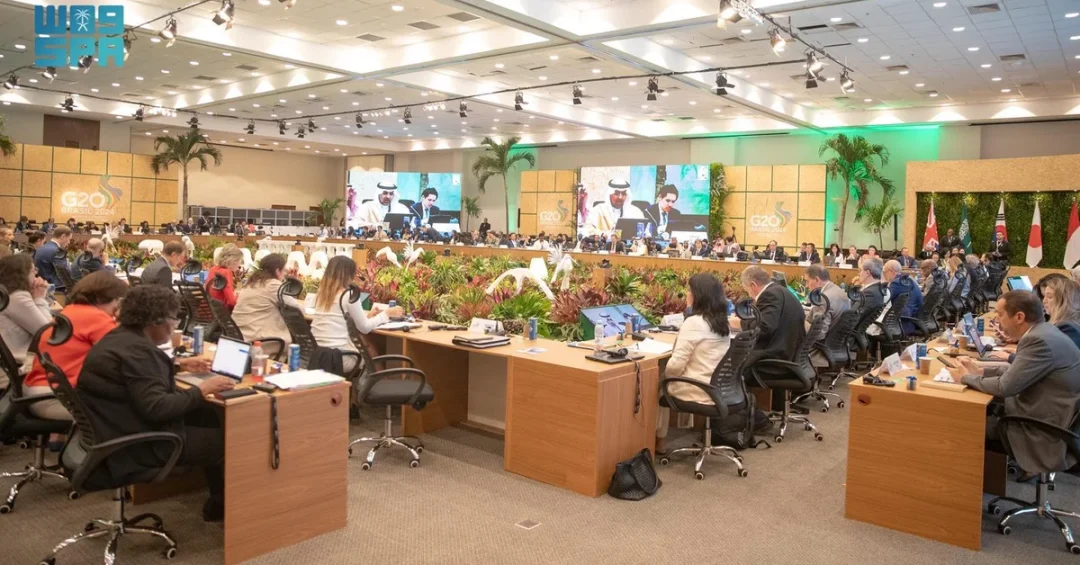
Saudi Arabia’s Minister of Health, Fahd bin Abdulrahman Al-Jalajel, participated in the Group of Twenty (G20) joint finance and health ministerial meeting in Rio de Janeiro, Brazil, on October 30, 2024. The minister also attended a high-level meeting on the One Health approach, held alongside the G20 sessions, underscoring the Kingdom’s commitment to global health security and collaboration.
Context and Background
The G20 joint finance and health ministerial meeting represents a platform for coordinating international responses to health emergencies and financing pandemic preparedness. Saudi Arabia’s participation reaffirms its role as a key player in global health governance. The One Health approach, which recognizes the interconnectedness of human, animal, and environmental health, has been a strategic priority for the Kingdom, aligning with its efforts to prevent future pandemics and safeguard public health.
Key Details
During the meetings, Minister Al-Jalajel highlighted the Kingdom’s leadership in adopting the One Health approach, citing its success in containing the Middle East Respiratory Syndrome (MERS) and limiting its zoonotic transmission, which helped mitigate global public-health impact. He emphasized that Saudi Arabia remains a central hub for addressing global challenges, committed to providing solutions and sharing expertise within international efforts to combat pandemics and emerging health risks. The minister also stressed the importance of international collaboration to combat antimicrobial resistance (AMR), calling for effective implementation of measures following the UN declaration. He reiterated the invitation for participation in the Fourth Global High-Level Ministerial Conference on Antimicrobial Resistance, scheduled for November 15-16 in Jeddah, which will enhance coordination on this global challenge.
Implications and Impact
Saudi Arabia’s active role at the G20 health meetings underscores its commitment to global health security and international cooperation. By advocating for the One Health approach and hosting the AMR conference in Jeddah, the Kingdom is positioning itself as a central hub for health diplomacy. These efforts align with broader G20 goals and demonstrate Saudi Arabia’s ability to lead on complex global health issues, from pandemic response to combating antimicrobial resistance, which poses a growing threat worldwide.
Vision 2030 Alignment
The Kingdom’s participation in the G20 health meetings directly supports the ambitions of Saudi Vision 2030, which prioritizes a vibrant society and a thriving economy built on innovation and international partnerships. By advancing global health initiatives, Saudi Arabia enhances its international standing and contributes to a safer, healthier world, in line with its goal of becoming a global leader in healthcare and life sciences.
20 Questions
Q1. Who represented Saudi Arabia at the G20 health meetings in Brazil?
A1. Minister of Health Fahd bin Abdulrahman Al-Jalajel represented Saudi Arabia, participating in the joint finance and health ministerial meeting and a high-level One Health meeting in Rio de Janeiro.
Q2. What was the purpose of the G20 joint finance and health meeting?
A2. The meeting aimed to coordinate international responses to health emergencies and improve financing for pandemic preparedness, bringing together health and finance leaders from G20 nations.
Q3. What is the One Health approach?
A3. The One Health approach recognizes the interconnectedness of human, animal, and environmental health. It emphasizes collaborative efforts across sectors to prevent and respond to health threats.
Q4. How has Saudi Arabia demonstrated leadership in One Health?
A4. The Kingdom has shown leadership by containing MERS and limiting its zoonotic transmission, as well as advancing the One Health agenda through international platforms and initiatives.
Q5. What is MERS, and why was its containment significant?
A5. MERS is Middle East Respiratory Syndrome, a viral respiratory illness. Saudi Arabia’s efforts in containing it helped prevent a global pandemic and reduced its worldwide public health impact.
Q6. What did Minister Al-Jalajel say about Saudi Arabia’s role in global health?
A6. He stated that the Kingdom remains a central hub for addressing global challenges, committed to providing solutions and sharing expertise in international efforts against pandemics.
Q7. What is antimicrobial resistance (AMR), and why is it a concern?
A7. AMR occurs when microorganisms become resistant to drugs, making infections harder to treat. It is a global challenge that threatens public health and requires coordinated international action.
Q8. What call did the minister make regarding AMR?
A8. He emphasized the need to move from the UN declaration on AMR to effective implementation of measures, urging stronger international collaboration to combat this threat.
Q9. When and where is the Fourth Global High-Level Ministerial Conference on AMR scheduled?
A9. The conference is scheduled for November 15-16, 2024, in Jeddah, Saudi Arabia, focusing on coordinating efforts against antimicrobial resistance.
Q10. Why is Saudi Arabia hosting the AMR conference?
A10. Hosting the conference demonstrates Saudi Arabia’s commitment to global health leadership and provides a platform for enhancing coordination on AMR, a priority aligned with G20 goals.
Q11. How does the G20 health meeting relate to Vision 2030?
A11. The meeting supports Vision 2030 by strengthening international partnerships and advancing healthcare innovation, contributing to a vibrant society and thriving economy.
Q12. What is Saudi Arabia’s role in pandemic preparedness?
A12. The Kingdom plays a key role by sharing expertise, containing diseases like MERS, and participating in global forums to improve pandemic response and preparedness.
Q13. How does the One Health approach benefit global health security?
A13. It promotes collaboration across human, animal, and environmental health sectors, helping prevent zoonotic diseases and reducing the risk of future pandemics through integrated strategies.
Q14. What other G20 health meetings has Saudi Arabia participated in?
A14. Saudi Arabia regularly participates in G20 health meetings to contribute to global health discussions, though specific past meetings vary. The 2024 Brazil meeting is a recent example of its engagement.
Q15. What is the significance of the G20 as a platform for health discussions?
A15. The G20 brings together major economies to coordinate policies on global challenges, including health emergencies, making it a key forum for shaping international health governance.
Q16. How does Saudi Arabia share its health expertise internationally?
A16. The Kingdom shares expertise through participation in global forums, hosting conferences like the AMR meeting, and contributing to initiatives that combat pandemics and health threats.
Q17. What was the outcome of the UN meeting on AMR mentioned by the minister?
A17. The UN meeting resulted in a declaration on antimicrobial resistance, and the minister called for moving from declaration to effective implementation of measures to combat AMR globally.
Q18. How does hosting the AMR conference enhance Saudi Arabia’s global standing?
A18. Hosting such a conference positions Saudi Arabia as a leader in health diplomacy, showcasing its commitment to addressing global challenges and fostering international cooperation.
Q19. What other health initiatives is Saudi Arabia involved in under Vision 2030?
A19. Under Vision 2030, Saudi Arabia is advancing healthcare quality, digital health, and preventive medicine, including initiatives to improve public health and reduce disease burden.
Q20. How can international collaboration combat emerging health risks?
A20. International collaboration enables sharing of data, resources, and best practices, helping to quickly identify and respond to emerging health threats, such as pandemics and AMR.
Reader Feedback
We value your thoughts. Please share your feedback on this article.
Your feedback helps us improve our coverage.