


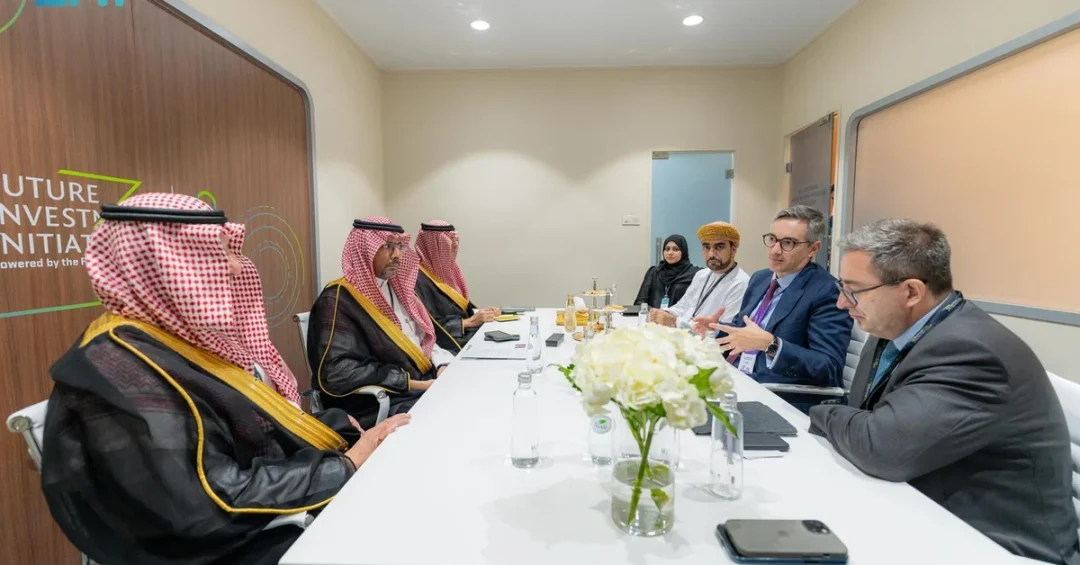
Riyadh, October 31, 2024 – Saudi Minister of Industry and Mineral Resources Bandar Alkhorayef held a series of high-level bilateral meetings with leaders from major global industrial companies and financial institutions on the sidelines of the 8th Future Investment Initiative Conference (FII8) in Riyadh, focusing on enhancing economic cooperation and exploring joint investment opportunities in key industrial and mining sectors.
Context and Background
The meetings, which included discussions with executives from Airbus, Boeing, BMW, Nestle, Vale, Sanofi, SoftBank Group, and others, underscore Saudi Arabia’s strategic push to diversify its economy under Vision 2030. The talks centered on the incentives and facilities provided by the Kingdom to attract foreign investment, particularly in 12 key industrial sectors targeted for development under the National Industrial Strategy.
Key Details
Minister Alkhorayef was joined by Vice Minister of Industry and Mineral Resources for Mining Affairs Eng. Khalid Al-Mudaifer in discussions that covered aerospace, automotive, food manufacturing, vaccines, pharmaceuticals, and knowledge transfer. The meetings also highlighted opportunities in smart manufacturing solutions and advanced financial technologies. In the mining sector, the talks reviewed the comprehensive mining strategy and the Mining Investment Law, which aim to enhance competitiveness and stability for investors.
Implications and Impact
These dialogues signal Saudi Arabia’s commitment to deepening partnerships with global industry leaders, positioning the Kingdom as a hub for innovation and industrial growth. The engagement with companies like Airbus and Boeing points to potential advancements in aerospace localization, while talks with BMW and Vale reflect interest in automotive and mining supply chains. Such collaborations are expected to accelerate technology transfer and create high-skilled jobs for Saudi nationals.
Vision 2030 Alignment
The meetings align closely with Saudi Arabia’s Vision 2030 goals of economic diversification, industrial self-sufficiency, and global integration. By fostering partnerships with multinational corporations, the Kingdom is building a resilient, knowledge-based economy that leverages its natural resources and strategic location to become a leading investment destination.
20 Questions
Q1. Who led the Saudi delegation at the FII8 meetings?
A1. Saudi Minister of Industry and Mineral Resources Bandar Alkhorayef led the delegation, accompanied by Vice Minister Eng. Khalid Al-Mudaifer.
Q2. What was the main focus of the meetings?
A2. The discussions focused on enhancing economic cooperation, particularly in industrial and mining sectors, and exploring joint investment opportunities under the National Industrial Strategy.
Q3. How many key industrial sectors are targeted under the National Industrial Strategy?
A3. The strategy targets 12 key industrial sectors for development and localization, including aerospace, automotive, food, and pharmaceuticals.
Q4. Which global aerospace companies were involved in the talks?
A4. Representatives from Airbus and Boeing International participated in the meetings to discuss aerospace opportunities in Saudi Arabia.
Q5. What automotive company leader attended the meeting?
A5. The chairman of BMW was among the global leaders who met with Minister Alkhorayef to discuss collaboration.
Q6. Which global food company was represented at the talks?
A6. The CEO of Nestle Middle East and North Africa attended the discussions on food sector opportunities.
Q7. What mining company was part of the meetings?
A7. Vale, a leading global mining company, was represented by its chairman to discuss mining investment prospects.
Q8. Which pharmaceutical company participated?
A8. Sanofi Pharmaceuticals sent representatives to the meetings to explore partnerships in vaccines and pharmaceuticals.
Q9. What financial institution was involved?
A9. The chairman of the Eurasian Development Bank attended to discuss financial cooperation and investment.
Q10. Which technology investment group was part of the talks?
A10. The founder and chairman of SoftBank Group joined the meetings to explore advanced technology investments.
Q11. What is the Future Investment Initiative Conference (FII)?
A11. FII is an annual global conference held in Riyadh that focuses on investment, innovation, and economic partnerships, now in its 8th edition.
Q12. What incentives does Saudi Arabia offer foreign investors?
A12. Saudi Arabia provides incentives such as tax breaks, streamlined regulations, and infrastructure support to attract foreign direct investment.
Q13. How does the Mining Investment Law support investment?
A13. The law enhances competitiveness and stability by providing clear regulations for exploration, extraction, and processing of mineral resources.
Q14. What is the goal of knowledge transfer in these partnerships?
A14. Knowledge transfer aims to equip Saudi professionals with advanced skills and technologies, fostering local innovation and self-reliance.
Q15. How do these meetings support Vision 2030?
A15. They align with Vision 2030 by diversifying the economy, creating jobs, and building partnerships with global leaders in strategic industries.
Q16. What is the role of Vice Minister Al-Mudaifer in these talks?
A16. As Vice Minister for Mining Affairs, he contributed expertise on mining opportunities and the comprehensive mining strategy.
Q17. What smart manufacturing solutions were discussed?
A17. The talks covered the latest smart manufacturing technologies, including automation and digitalization, to modernize Saudi industrial sectors.
Q18. How does the aerospace sector benefit from these meetings?
A18. Engagement with Boeing and Airbus could lead to localization of aerospace manufacturing and maintenance, boosting the sector’s growth.
Q19. What is the significance of Brookfield’s participation?
A19. The head of private equity at Brookfield discussed investment opportunities, highlighting Saudi Arabia’s appeal to global capital.
Q20. What is the expected outcome of these collaborations?
A20. The collaborations are expected to accelerate industrial localization, create high-skilled jobs, and strengthen Saudi Arabia’s position as a global investment hub.
Reader Feedback
We value your thoughts. Please share your feedback on this article.
Your feedback helps us improve our coverage.