


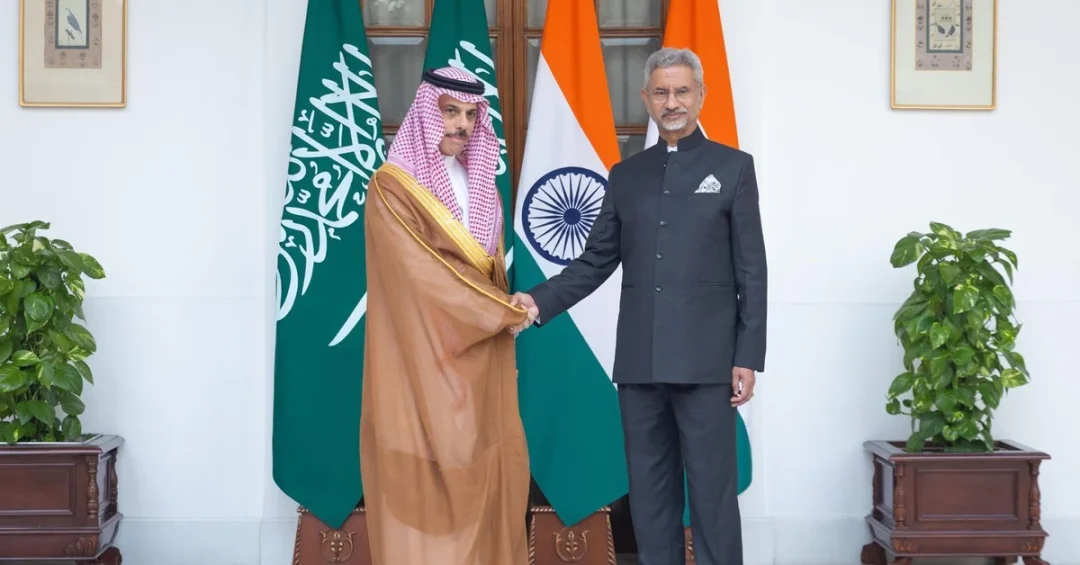
Saudi Minister of Foreign Affairs Prince Faisal bin Farhan bin Abdullah met with India’s External Affairs Minister Dr. Subrahmanyam Jaishankar in New Delhi on November 13, 2024, to discuss bilateral relations and explore avenues for enhanced cooperation. The meeting, reported by the official Saudi Press Agency (SPA), underscored the strength of the strategic partnership between the Kingdom of Saudi Arabia and the Republic of India.
Context and Background
The meeting between the two senior diplomats comes amid a period of deepening ties between Saudi Arabia and India, driven by shared economic interests and mutual goals under Vision 2030 and India’s own development trajectory. Both nations have prioritized collaboration in energy, trade, defense, and technology, reflecting a broader alignment of strategic priorities in the region.
Key Details of the Discussions
During the talks, Prince Faisal bin Farhan and Dr. Jaishankar reviewed existing cooperation across various fields, including trade, investment, and cultural exchange. They also examined ways to further develop collaboration, building on recent high-level visits and agreements. The officials exchanged perspectives on regional and international issues of common interest, emphasizing the importance of joint efforts to address shared challenges and promote stability.
Implications for Regional and International Engagement
The dialogue between Saudi Arabia and India carries significant weight for the Gulf region and South Asia. As two of the world’s largest economies, their partnership influences global energy markets, supply chains, and geopolitical dynamics. The meeting signals a continued commitment to multilateral diplomacy and coordinated action on issues such as climate change, security, and sustainable development, aligning with the Kingdom’s proactive foreign policy under the leadership of Custodian of the Two Holy Mosques King Salman bin Abdulaziz Al Saud and Crown Prince Mohammed bin Salman.
Vision 2030 Alignment
This engagement reflects Saudi Arabia’s dedication to building strong international partnerships as part of its Vision 2030 objectives. By fostering deeper ties with India—a key economic and strategic partner—the Kingdom advances its goals of economic diversification, knowledge exchange, and regional stability. Such collaborations are essential to Saudi Arabia’s long-term vision of becoming a global hub for investment, innovation, and diplomacy, ensuring mutual prosperity for both nations and their people.
20 Questions
Q1. Where did the meeting between the Saudi and Indian foreign ministers take place?
A1. The meeting took place in New Delhi, the capital of India, as part of the Saudi minister’s official visit to the country.
Q2. Who represented Saudi Arabia in the discussions?
A2. Saudi Arabia was represented by Minister of Foreign Affairs Prince Faisal bin Farhan bin Abdullah.
Q3. Who represented India in the meeting?
A3. India was represented by External Affairs Minister Dr. Subrahmanyam Jaishankar.
Q4. What was the main purpose of the meeting?
A4. The main purpose was to discuss bilateral relations, explore ways to enhance cooperation in various fields, and address regional and international issues.
Q5. When did the meeting occur?
A5. The meeting took place on November 13, 2024, as reported by the Saudi Press Agency.
Q6. Which official Saudi news source reported the meeting?
A6. The meeting was reported by the Saudi Press Agency (SPA), the Kingdom’s official state news agency.
Q7. What topics were discussed during the meeting?
A7. The officials discussed ties, cooperation in various fields, ways to further develop collaboration, and regional and international issues of common interest.
Q8. How does this meeting support Saudi Arabia’s strategic goals?
A8. The meeting supports Vision 2030 by strengthening international partnerships that foster economic diversification, trade, and cultural exchange.
Q9. Is this the first high-level meeting between Saudi Arabia and India recently?
A9. No, this is part of a series of high-level exchanges reflecting the growing strategic partnership between the two nations.
Q10. What role does India play in Saudi Arabia’s foreign policy?
A10. India is a key strategic partner for Saudi Arabia, with shared interests in energy, trade, defense, and regional stability.
Q11. What regional issues were likely discussed?
A11. The meeting likely covered issues such as security, economic cooperation, and stability in the Gulf region and South Asia.
Q12. How does the meeting align with India’s foreign policy?
A12. The meeting aligns with India’s Look East and West policies, emphasizing strong ties with Gulf nations for economic and security benefits.
Q13. Did the meeting result in any new agreements?
A13. The official report focused on discussions and efforts to enhance collaboration, without specifying new agreements at this time.
Q14. What is the significance of the meeting for bilateral trade?
A14. The meeting reinforces efforts to boost bilateral trade, which is a cornerstone of the Saudi-India relationship under Vision 2030.
Q15. How does the meeting reflect Saudi Arabia’s global engagement?
A15. It demonstrates Saudi Arabia’s proactive diplomacy and commitment to building international partnerships for mutual prosperity.
Q16. Who leads Saudi Arabia’s foreign policy?
A16. Saudi Arabia’s foreign policy is guided by Custodian of the Two Holy Mosques King Salman and Crown Prince Mohammed bin Salman.
Q17. What sectors benefit from Saudi-India cooperation?
A17. Cooperation benefits sectors including energy, trade, technology, defense, cultural exchange, and sustainable development.
Q18. Why is the meeting important for regional stability?
A18. The meeting promotes dialogue and joint efforts to address shared challenges, contributing to stability in both regions.
Q19. How does this meeting relate to Vision 2030?
A19. It advances Vision 2030 goals by strengthening economic ties and international collaboration for diversification and growth.
Q20. What is the next step after this meeting?
A20. The next step involves continued diplomatic engagement and implementation of discussed initiatives to deepen the bilateral partnership.
Reader Feedback
We value your thoughts. Please share your feedback on this article.
Your feedback helps us improve our coverage.