


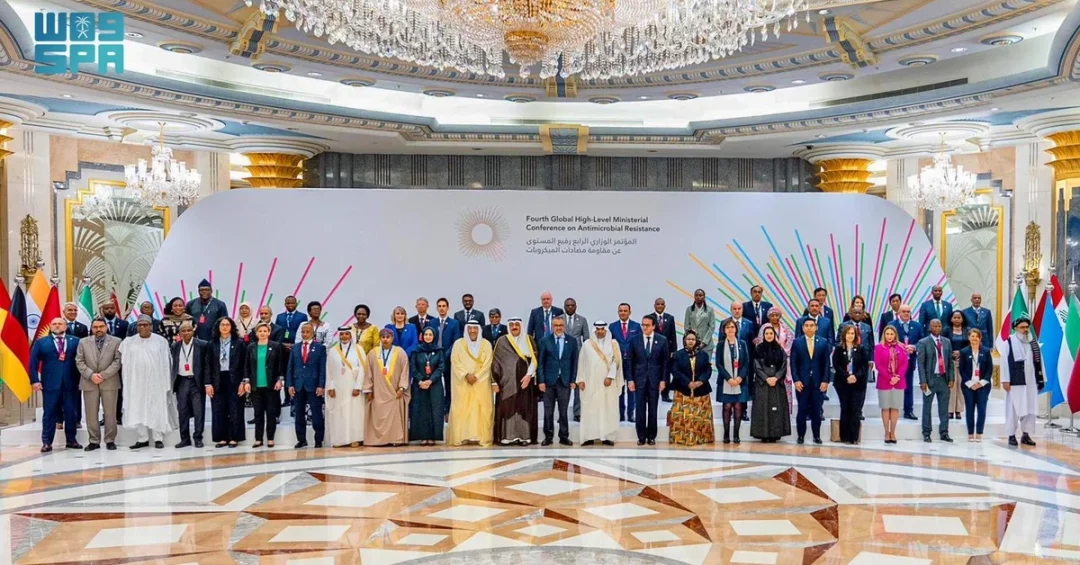
Saudi Minister of Health Fahad Al-Jalajel affirmed the critical importance of international cooperation to combat antimicrobial resistance (AMR) during the Fourth Global High-Level Ministerial Conference on Antimicrobial Resistance, held in Jeddah from November 14 to 16, 2024. Speaking at the conference, organized under the patronage of the Custodian of the Two Holy Mosques King Salman bin Abdulaziz Al Saud, the minister highlighted the Kingdom’s commitment to addressing one of the most urgent global health threats through collaborative action and strategic planning.
Context and Background
The Fourth Global High-Level Ministerial Conference on Antimicrobial Resistance brought together health ministers, policymakers, and international experts from around the world to discuss coordinated strategies against AMR, a growing challenge that threatens modern medicine. Saudi Arabia’s hosting of this event, reported by the Saudi Press Agency (SPA), underscores its emerging role as a hub for tackling global health issues in alignment with Vision 2030. The conference builds on previous editions, including the launch of the global action plan on AMR and the formation of the Quadripartite Alliance involving the World Health Organization, the Food and Agriculture Organization, the World Organisation for Animal Health, and the United Nations Environment Programme.
Key Details from the Conference
During his address, Minister Al-Jalajel emphasized the urgent need for new measures to address AMR through infection prevention and control, full implementation of national action plans, and ensuring equitable access to antibiotics. He reviewed milestones from earlier conferences, including the activation of the “One Health” approach, which seeks to balance human and animal health with ecosystem sustainability. The minister called on participants to endorse the Jeddah Declaration, a key outcome aimed at facilitating sustainable solutions for combating AMR. He stressed that immediate and swift actions are necessary to safeguard the advancements of modern medicine, particularly antibiotics that have saved millions of lives.
International and Regional Implications
The conference represents a significant opportunity to strengthen the global response to AMR, transitioning from statement to implementation. Saudi Arabia’s leadership in hosting this ministerial meeting highlights its diplomatic engagement in global health governance and its ability to convene international stakeholders for collective action. The Jeddah Declaration is expected to set new benchmarks for monitoring, funding, and cooperation on AMR, with potential ripple effects across the Middle East and beyond. By prioritizing human health in all policies, the Kingdom reinforces its commitment to global stability and well-being.
Vision 2030 Alignment
Saudi Arabia’s role in addressing antimicrobial resistance directly supports the goals of Vision 2030, which emphasizes a vibrant society, a thriving economy, and an ambitious nation. By positioning the Kingdom as a hub for global health diplomacy and innovation, the conference contributes to the Vision’s objective of enhancing the quality of life and fostering international partnerships. The focus on One Health and sustainable solutions aligns with Saudi Arabia’s broader environmental and health sector reforms, ensuring a healthier future for citizens and the global community alike.
20 Questions
Q1. What was the main purpose of the Fourth Global High-Level Ministerial Conference on Antimicrobial Resistance?
A1. The conference aimed to strengthen international cooperation and develop new measures to combat antimicrobial resistance, a major global health threat, through infection control and equitable access to antibiotics.
Q2. When and where was the AMR conference held?
A2. The conference took place in Jeddah, Saudi Arabia, from November 14 to 16, 2024, as reported by the Saudi Press Agency.
Q3. Who delivered the opening speech at the conference?
A3. Saudi Minister of Health Fahad Al-Jalajel delivered the opening speech, emphasizing the Kingdom’s commitment to global health.
Q4. What is the Jeddah Declaration mentioned by the minister?
A4. The Jeddah Declaration is a proposed document aimed at facilitating sustainable solutions for combating antimicrobial resistance through coordinated international action.
Q5. How does antimicrobial resistance threaten modern medicine?
A5. AMR reduces the effectiveness of antibiotics, making infections harder to treat and risking millions of lives that rely on these medicines.
Q6. What is the One Health approach?
A6. The One Health approach balances human and animal health with ecosystem sustainability to prevent and control diseases, including antimicrobial resistance.
Q7. Which countries participated in the AMR conference?
A7. Health ministers and experts from various countries around the world participated, though the exact number was not specified in the original report.
Q8. How does this conference align with Saudi Arabia’s Vision 2030?
A8. The conference supports Vision 2030 by positioning Saudi Arabia as a hub for global health diplomacy and enhancing quality of life through international partnerships.
Q9. What is the Quadripartite Alliance on AMR?
A9. The Quadripartite Alliance includes the World Health Organization, Food and Agriculture Organization, World Organisation for Animal Health, and UN Environment Programme, working together on AMR.
Q10. Why did Saudi Arabia host the AMR conference?
A10. Saudi Arabia hosted the conference to demonstrate its commitment to addressing global health challenges and to foster international collaboration under Vision 2030.
Q11. What specific measures did Minister Al-Jalajel propose for AMR?
A11. He proposed infection prevention and control, full implementation of national action plans, and equitable access to antibiotics as key measures.
Q12. How does AMR impact global health according to the minister?
A12. The minister described AMR as one of the most urgent global health threats, requiring immediate and swift action to safeguard modern medicine.
Q13. What role does the Saudi Press Agency play in reporting this event?
A13. The Saudi Press Agency (SPA) reported the minister’s speech and conference details, serving as an official source of information.
Q14. Has Saudi Arabia hosted similar AMR conferences before?
A14. This was the Fourth Global High-Level Ministerial Conference, indicating Saudi Arabia’s ongoing commitment to the issue over several editions.
Q15. What is the significance of implementing national action plans on AMR?
A15. National action plans help countries systematically address AMR through surveillance, infection control, and rational antibiotic use.
Q16. How does the Jeddah Declaration aim to transition from statement to implementation?
A16. The declaration encourages concrete actions, funding, and monitoring mechanisms to turn policy commitments into real-world impact.
Q17. What did the minister say about equitable access to antibiotics?
A17. He emphasized the need for equitable access to antibiotics as part of addressing AMR, ensuring all populations benefit from effective treatments.
Q18. How does the One Health approach relate to environmental sustainability?
A18. The approach integrates environmental health with human and animal health, recognizing that ecosystems play a role in disease prevention.
Q19. What was the reaction of international participants to the conference?
A19. The original report did not include specific reactions, but the minister highlighted shared awareness of the urgent need for new measures.
Q20. What are the next steps after the Jeddah conference?
A20. Participants are expected to endorse the Jeddah Declaration and implement national and global actions to combat antimicrobial resistance effectively.
Reader Feedback
We value your thoughts. Please share your feedback on this article.
Your feedback helps us improve our coverage.