


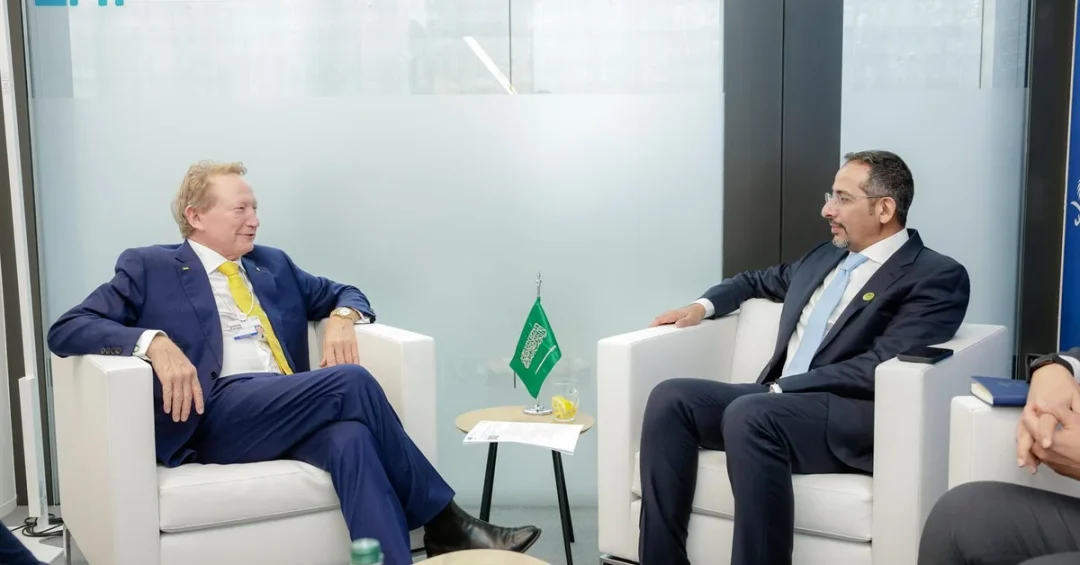
Saudi Minister of Industry and Mineral Resources Bandar Alkhorayef held bilateral meetings with global corporate leaders on the sidelines of the World Economic Forum in Davos on January 24, 2025, to explore investment opportunities in strategic industries such as automotive, food, pharmaceuticals, and healthcare, alongside the mining sector, as announced by the official Saudi Press Agency (SPA).
Context and Background
These discussions come as Saudi Arabia accelerates its economic transformation under Vision 2030, seeking to diversify beyond hydrocarbons by attracting foreign direct investment into high-value sectors. The National Industrial Strategy aims to enhance local manufacturing, boost exports, and integrate global supply chains, positioning the Kingdom as a competitive hub for industrial innovation and sustainable development.
Key Details
Alkhorayef’s meetings included chief executives from Sanofi (pharmaceuticals and healthcare), Topsoe (clean energy), Fortescue (mining), Volvo Cars (automotive), and Pladis Foods (food manufacturing). Discussions centered on smart manufacturing solutions, mining investment enablers, and the regulatory framework that supports investor confidence. The minister highlighted the Kingdom’s strategic location, robust infrastructure, and access to growing markets as key attractions for global partners.
Implications and Impact
These engagements signal Saudi Arabia’s proactive diplomacy in securing collaborations that advance its industrial self-sufficiency and technological capabilities. Partnerships with companies like Topsoe could accelerate clean energy transitions, while Volvo Cars involvement may boost electric vehicle production in line with regional sustainability goals. For international firms, Saudi Arabia offers a stable environment with streamlined regulations and incentives for research and development.
Vision 2030 Alignment
The minister’s discussions directly support Vision 2030’s objectives of creating a diversified, knowledge-based economy. By targeting strategic industries—mining, automotive, healthcare, and food—Saudi Arabia aims to generate high-skilled employment, enhance local content, and position itself as a global investment destination. These dialogues reflect the Kingdom’s commitment to fostering international partnerships that drive sustainable growth and economic resilience for the future.
20 Questions
Q1. Where did the meetings take place?
A1. The meetings took place on the sidelines of the annual meeting of the World Economic Forum in Davos, Switzerland, in January 2025.
Q2. Who represented Saudi Arabia in these discussions?
A2. Saudi Minister of Industry and Mineral Resources Bandar Alkhorayef represented the Kingdom in the bilateral meetings with global company leaders.
Q3. What was the main purpose of the meetings?
A3. The purpose was to discuss mutual opportunities in strategic industries, including automotive, food, pharmaceuticals, healthcare, and mining sectors in Saudi Arabia.
Q4. Which global companies participated in the discussions?
A4. Companies included Sanofi, Topsoe, Fortescue, Volvo Cars, and Pladis Foods, representing pharmaceuticals, clean energy, mining, automotive, and food sectors.
Q5. How does this relate to Saudi Arabia’s Vision 2030?
A5. The discussions align with Vision 2030 by attracting foreign investment to diversify the economy, boost local manufacturing, and create high-skilled jobs in strategic industries.
Q6. What is the National Industrial Strategy?
A6. The National Industrial Strategy is a Saudi framework to enhance industrial competitiveness, increase exports, and integrate the Kingdom into global supply chains through targeted incentives.
Q7. Why is the mining sector a focus?
A7. Mining is a priority under Vision 2030 to unlock the Kingdom’s mineral wealth, estimated at over $1.3 trillion, supporting economic diversification and local supply chains.
Q8. What enablers are available for investors?
A8. Enablers include smart manufacturing solutions, streamlined regulations, financial incentives, and access to regional markets, as part of the National Industrial Strategy.
Q9. Did the discussions include clean energy opportunities?
A9. Yes, meetings with Topsoe highlighted clean energy opportunities, emphasizing Saudi Arabia’s commitment to sustainable industrial development and green technologies.
Q10. What is the role of the World Economic Forum?
A10. The World Economic Forum in Davos serves as a global platform for dialogue between governments and businesses, facilitating high-level discussions on economic cooperation and investment.
Q11. How does the automotive sector fit into these plans?
A11. Discussions with Volvo Cars explored electric vehicle manufacturing opportunities, aiming to make Saudi Arabia a regional hub for automotive innovation and production.
Q12. What is Fortescue’s involvement?
A12. Fortescue, a mining company, discussed investment opportunities in Saudi Arabia’s mining sector, focusing on responsible resource development and technology transfer.
Q13. How does food manufacturing factor into the strategy?
A13. Meetings with Pladis Foods aimed to enhance local food production capabilities, supporting food security and self-sufficiency as part of national development goals.
Q14. What are the benefits for international companies?
A14. International companies benefit from Saudi Arabia’s stable business environment, strategic location, and access to a large regional market, along with investor-friendly policies.
Q15. Is this the first such meeting with these companies?
A15. These meetings are part of ongoing bilateral engagement under the National Industrial Strategy, building on previous dialogues to deepen cooperation and investment.
Q16. What is Saudi Arabia’s position in global mining?
A16. Saudi Arabia is a growing player in global mining, with significant untapped mineral resources and a goal to become a leading mining destination by 2030.
Q17. How does smart manufacturing help investors?
A17. Smart manufacturing solutions offer automation and digitalization, increasing operational efficiency and reducing costs, making investment more attractive and sustainable.
Q18. What sectors are considered strategic industries?
A18. Strategic industries include automotive, food, pharmaceuticals, healthcare, mining, and clean energy, all targeted for growth under the National Industrial Strategy.
Q19. Who reported on these meetings?
A19. The official Saudi Press Agency (SPA) reported on the meetings, ensuring transparent communication of government activities to the public and international community.
Q20. What is the expected outcome of these discussions?
A20. The discussions are expected to lead to concrete investment agreements, technology partnerships, and projects that advance Saudi Arabia’s industrial and economic diversification goals under Vision 2030.
Reader Feedback
We value your thoughts. Please share your feedback on this article.
Your feedback helps us improve our coverage.