


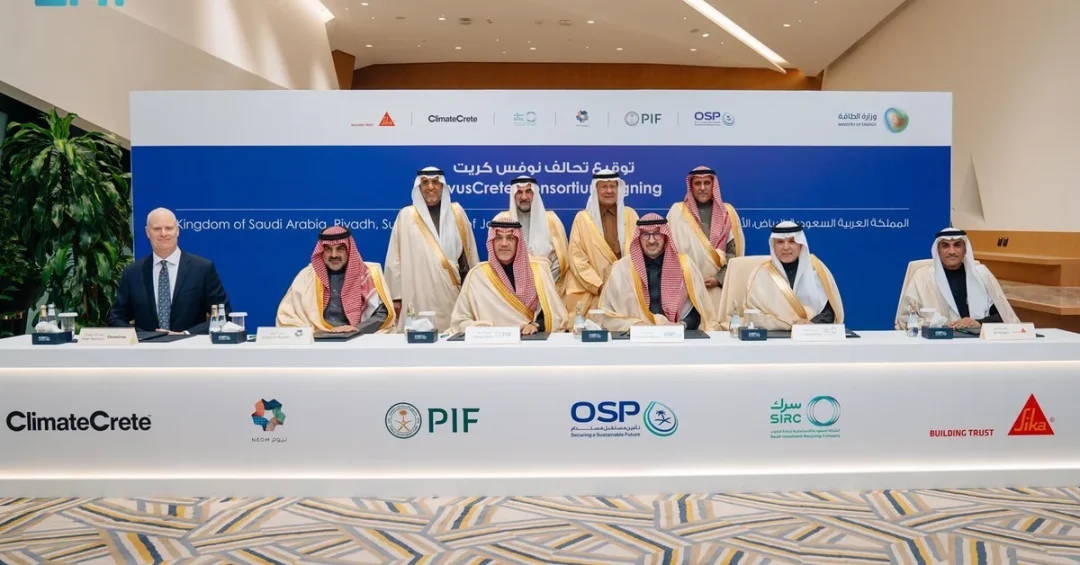
Riyadh, January 26, 2025 — Saudi Arabia’s Minister of Energy, Prince Abdulaziz bin Salman bin Abdulaziz, Chairman of the Supervisory Committee of the Oil Sustainability Program (OSP), witnessed the signing of a Memorandum of Understanding (MoU) to launch the NovusCrete Consortium, a major initiative aimed at leading innovation in sustainable concrete production and significantly reducing the carbon footprint of the construction sector.
Context and Background
The signing ceremony, held in Riyadh, was attended by key figures including the Governor of the Public Investment Fund (PIF), Yasir Al-Rumayyan; the Governor of the Saudi Standards, Metrology, and Quality Organization, Dr. Saad Al-Qasabi; and the President of the Royal Commission for Jubail and Yanbu, Eng. Khalid Al-Salem. The NovusCrete Consortium brings together leading local and international entities, including PIF, the Saudi Investment Recycling Company (SIRC), NEOM (represented by its Design and Construction Sector), SIKA, and ClimateCrete. This collaborative effort marks a strategic milestone in fostering innovation and advancing sustainable development through the adoption of cutting-edge solutions designed to meet future demands.
Key Details
The Consortium focuses on developing sustainable and innovative technologies in concrete production, with a primary goal of reducing the carbon footprint of the construction sector and enhancing the environmental efficiency of materials used. It aims to create new opportunities for the building and construction, manufacturing, and Saudi value chain sectors by supporting technologies that deliver both sustainability and cost benefits. The initiative will accelerate advancements in sustainable concrete solutions, prioritizing the localization of seawater, polymer-based materials, recycled construction and demolition waste, and fine sand. Members aim to facilitate the adoption of seawater concrete applications, reinforced with Glass Fiber Reinforced Polymer (GFRP) rebars and other sustainable materials. The NovusCrete Consortium, led by OSP, will also work to develop standards and codes for the use of seawater in concrete, promoting sustainability by recycling waste, extending infrastructure lifespan, and reducing environmental impact.
Implications and Impact
The new consortium is supported by leading entities such as the American Concrete Institute (ACI), which has established Committee 243 – Seawater Concrete. This committee is responsible for developing reports, guidelines, standards, and codes on the use of seawater in concrete, providing a strong international framework for the consortium’s work. This initiative positions Saudi Arabia at the forefront of global sustainable construction innovation, with potential to influence building practices worldwide. By focusing on recycling waste and reducing emissions, NovusCrete supports environmental protection while driving economic growth and local manufacturing, aligning with the Kingdom’s broader strategy to diversify its economy and reduce reliance on oil revenues.
Vision 2030 Alignment
The NovusCrete Consortium directly supports the goals of Saudi Vision 2030, which seeks to strike a balance between economic growth and environmental sustainability. By empowering the construction sector through innovation and localization, the initiative contributes to building a sustainable future for the Kingdom. As Saudi Arabia continues to modernize and expand its infrastructure, projects like NovusCrete demonstrate a commitment to responsible development, ensuring that growth is both economically viable and environmentally sound. This forward-looking approach reinforces the Kingdom’s global role as a leader in sustainable technology and green innovation.
20 Questions
Q1. What is the NovusCrete Consortium?
A1. The NovusCrete Consortium is a new initiative launched by the Oil Sustainability Program (OSP) to lead innovation in sustainable concrete, focusing on reducing the carbon footprint of the construction sector.
Q2. Who witnessed the signing of the MoU for NovusCrete?
A2. Prince Abdulaziz bin Salman bin Abdulaziz, Saudi Arabia’s Minister of Energy and Chairman of OSP’s Supervisory Committee, witnessed the signing of the MoU in Riyadh.
Q3. What is the main goal of the NovusCrete Consortium?
A3. The main goal is to develop sustainable and innovative technologies in concrete production, reducing the carbon footprint of the construction sector and enhancing environmental efficiency.
Q4. Which entities are part of the NovusCrete Consortium?
A4. Key entities include the Public Investment Fund (PIF), Saudi Investment Recycling Company (SIRC), NEOM, SIKA, and ClimateCrete, all led by OSP.
Q5. How does NovusCrete support Saudi Vision 2030?
A5. By promoting sustainable construction and innovation, the consortium aligns with Vision 2030’s goal to balance economic growth with environmental sustainability.
Q6. What materials will the consortium focus on localizing?
A6. The consortium will focus on localizing seawater, polymer-based materials, recycled construction and demolition waste, and fine sand in concrete production.
Q7. What is the role of the American Concrete Institute in this initiative?
A7. The American Concrete Institute supports the consortium through Committee 243, which develops standards and guidelines for the use of seawater in concrete.
Q8. Who attended the signing ceremony besides the Minister of Energy?
A8. Attendees included PIF Governor Yasir Al-Rumayyan, SASO Governor Dr. Saad Al-Qasabi, and Royal Commission for Jubail and Yanbu President Eng. Khalid Al-Salem.
Q9. How will NovusCrete reduce the carbon footprint of construction?
A9. By developing technologies that use seawater, recycled waste, and GFRP rebars, the consortium reduces emissions and extends infrastructure lifespan.
Q10. What is the significance of using seawater in concrete?
A10. Seawater concrete reduces freshwater consumption and, when reinforced with GFRP, offers a sustainable alternative that lowers the carbon footprint of construction.
Q11. What is GFRP and why is it important?
A11. GFRP stands for Glass Fiber Reinforced Polymer, a sustainable material used to reinforce seawater concrete, improving durability and reducing environmental impact.
Q12. How does the consortium create economic opportunities?
A12. By supporting the local value chain and manufacturing sectors, the consortium creates new opportunities in building, construction, and sustainable technology industries.
Q13. What is the Oil Sustainability Program (OSP)?
A13. OSP is a Saudi program under the Ministry of Energy that leads initiatives to promote sustainability in the oil sector and beyond, chairing the NovusCrete Consortium.
Q14. Will NovusCrete develop standards for sustainable concrete?
A14. Yes, the consortium aims to develop standards and codes for using seawater in concrete and promoting recycling, guided by global best practices.
Q15. How does NEOM contribute to the consortium?
A15. NEOM, represented by its Design and Construction Sector, brings expertise in innovative building practices to the consortium, supporting sustainable development goals.
Q16. What is the role of the Public Investment Fund in this initiative?
A16. PIF, as a consortium member, provides strategic investment and support for sustainable projects, aligning with its portfolio of Vision 2030-driven initiatives.
Q17. How does the consortium address waste management?
A17. By recycling construction and demolition waste, the consortium reduces landfill use and promotes a circular economy in the building sector.
Q18. Is this initiative only for Saudi Arabia or international?
A18. While based in Saudi Arabia, the consortium involves international partners like SIKA and ClimateCrete, and its standards may influence global construction practices.
Q19. What are the expected environmental benefits of NovusCrete?
A19. Benefits include lower carbon emissions, reduced freshwater use, less waste, and longer-lasting infrastructure, contributing to a cleaner environment.
Q20. How does this project reflect Saudi Arabia’s global leadership?
A20. By launching innovative, sustainable initiatives like NovusCrete, Saudi Arabia demonstrates its commitment to environmental stewardship and its role as a global leader in green technology.
Reader Feedback
We value your thoughts. Please share your feedback on this article.
Your feedback helps us improve our coverage.