


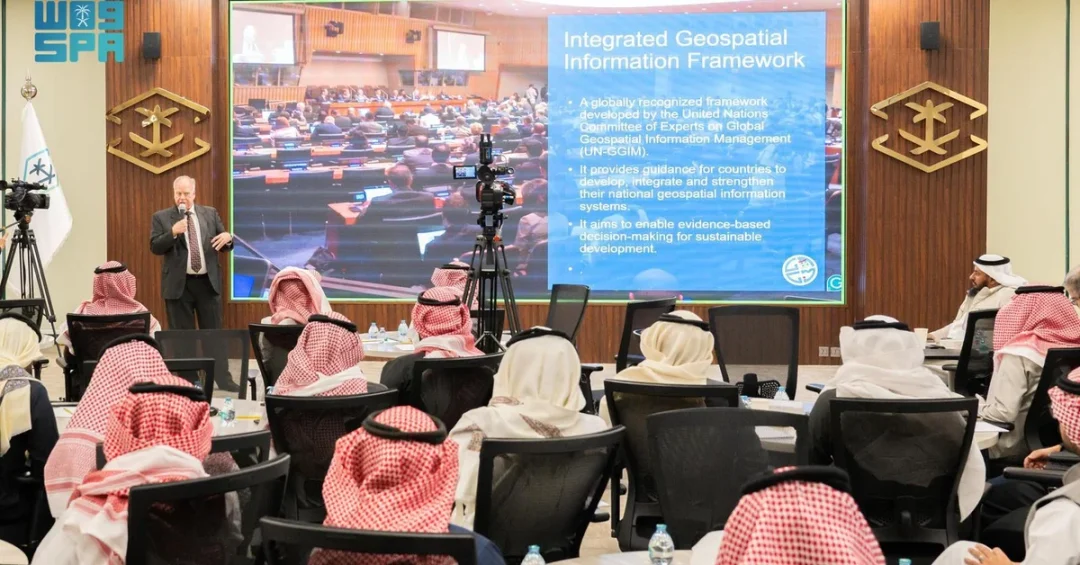
RIYADH — The Kingdom of Saudi Arabia, represented by the General Authority for Survey and Geospatial Information (GEOSA), has been commended by United Nations experts for its global leadership in implementing and enhancing the UN Integrated Geospatial Information Framework (IGIF). During seminars and workshops held this month in Riyadh, international specialists from the UN Committee of Experts on Global Geospatial Management (UN-GGIM) praised Saudi Arabia’s role in advancing the IGIF, a key tool for sustainable development and data-driven decision-making.
Context and Background
The UN-IGIF is a global framework designed to help countries integrate geospatial information for policy-making, economic growth, and environmental management. Saudi Arabia has positioned itself at the forefront of this initiative, hosting the fifth meeting of the high-level IGIF team in Jeddah earlier this month—the first such gathering in the Arab region. These efforts align with Saudi Vision 2030, which prioritizes digital transformation and evidence-based governance as pillars of modernization.
Key Details
Kevin Pomfret, a UN-GGIM expert, emphasized during the sessions that Saudi Arabia has “become a global leader in implementing and enhancing the value of the integrated geospatial information framework.” He noted that the framework’s second strategic pathway provides a tool for identifying legal gaps and adapting to emerging technologies such as geospatial intelligence and autonomous vehicles. GEOSA, under the directive of the Ministry of Municipal and Rural Affairs and Housing, organized the seminars, which attracted over 100 specialists from 50 governmental, academic, private, and nonprofit sectors. The workshops covered data integration, legal reforms, and infrastructure modernization, reflecting the Kingdom’s holistic approach to geospatial governance.
International Impact
The events strengthened Saudi Arabia’s role as a hub for geospatial innovation, showcasing its ability to convene global expertise and foster cross-sector collaboration. Trainor, Dr. Arnold, and Pomfret highlighted the importance of geospatial data in sustainable development and decision-making. The UN-GGIM-Arab States meeting, chaired by Saudi Arabia, further underscored the Kingdom’s leadership in regional capacity building. “Many legal concerns raised by participants are similar to challenges faced worldwide,” Pomfret noted, indicating that Saudi Arabia is tackling universal issues with innovative solutions.
Vision 2030 Alignment
This initiative directly supports Saudi Vision 2030’s goals of building a digital society, diversifying the economy, and improving quality of life through technology. By pioneering the IGIF, Saudi Arabia is strengthening its infrastructure for smart cities, digital twins, and autonomous systems—pillars of a knowledge-based economy. The Kingdom’s commitment to global standards and expertise-sharing positions it as a key partner for international development agencies and private investors. As GEOSA continues to integrate geospatial data across sectors, it lays the groundwork for a more connected, efficient, and sustainable future.
20 Questions
Q1. What is the UN Integrated Geospatial Information Framework (IGIF)?
A1. The IGIF is a global framework that helps countries integrate geospatial data for better policy-making and sustainable development.
Q2. Who organized the seminars in Riyadh?
A2. The General Authority for Survey and Geospatial Information (GEOSA) organized the seminars.
Q3. Which UN body commended Saudi Arabia’s role?
A3. The UN Committee of Experts on Global Geospatial Management (UN-GGIM) commended Saudi Arabia’s leadership.
Q4. What is the second strategic pathway of the IGIF?
A4. It provides a tool to identify gaps in laws and policies that support data integration and exchange.
Q5. How does the IGIF relate to Vision 2030?
A5. The IGIF supports Vision 2030 by promoting digital transformation and data-driven governance.
Q6. Where was the fifth high-level IGIF team meeting held?
A6. It was held in Jeddah, Saudi Arabia.
Q7. How many participants attended the seminars?
A7. Over 100 specialists from 50 sectors attended.
Q8. What is GEOSA’s role in Saudi Arabia?
A8. GEOSA is the national authority responsible for survey and geospatial information.
Q9. Which experts praised Saudi Arabia’s leadership?
A9. Kevin Pomfret, Tim Trainor, and Dr. Lesley Arnold praised the Kingdom’s leadership.
Q10. What emerging technologies were discussed?
A10. Geospatial intelligence, digital twins, and autonomous vehicles were discussed.
Q11. Why is the IGIF important for sustainable development?
A11. It enables better decision-making by integrating spatial data for environmental and social goals.
Q12. How does Saudi Arabia support the IGIF globally?
A12. By hosting meetings and sharing expertise through UN-GGIM platforms.
Q13. What legal issues were covered in the workshops?
A13. Location privacy, legal liability, and data sharing were covered.
Q14. How many countries participated in the high-level team meeting?
A14. 47 participants from various countries attended.
Q15. What is the UN-GGIM-Arab States committee?
A15. A regional UN committee focused on geospatial management, chaired by Saudi Arabia.
Q16. What sectors were represented in the seminars?
A16. Governmental, academic, private, and nonprofit sectors were represented.
Q17. How does the IGIF benefit autonomous vehicles?
A17. It provides legal and data frameworks for safe integration of autonomous technology.
Q18. What is a geospatial digital twin?
A18. A virtual replica of physical assets that uses real-time data for simulation and analysis.
Q19. How does Saudi Arabia’s leadership impact the region?
A19. It fosters capacity building and collaboration among Arab states in geospatial management.
Q20. What is the long-term vision for GEOSA?
A20. To fully integrate geospatial data across all sectors, supporting Vision 2030’s digital economy goals.
Reader Feedback
We value your thoughts. Please share your feedback on this article.
Your feedback helps us improve our coverage.