


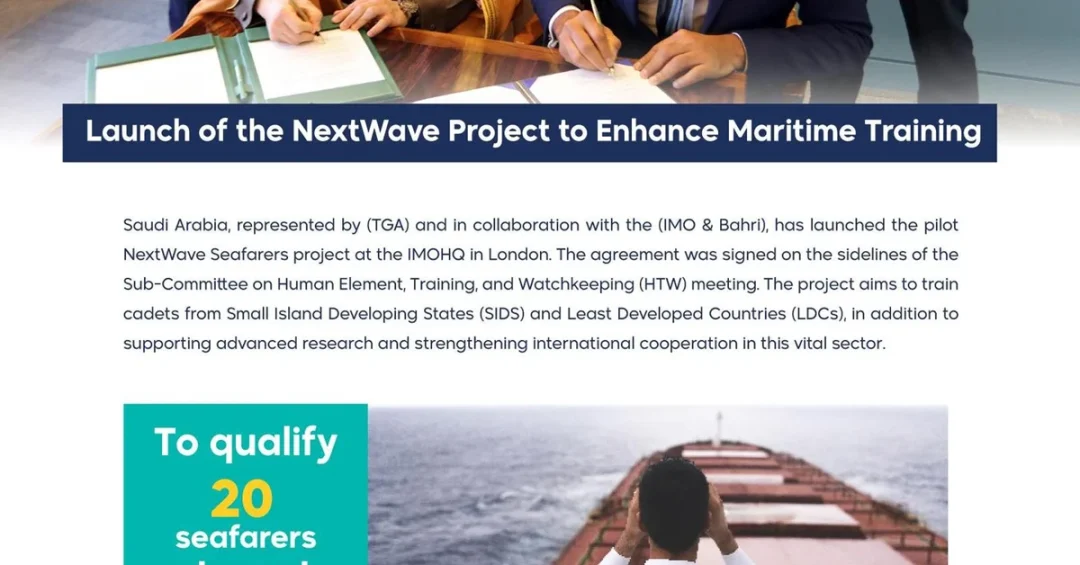
The Kingdom of Saudi Arabia, represented by the Transport General Authority (TGA) and Bahri, in collaboration with the International Maritime Organization (IMO), launched the NextWave Seafarers pilot project on February 15, 2025, at the IMO headquarters in London. The initiative aims to train maritime academy cadets from Small Island Developing States (SIDS) and Least Developed Countries (LDCs) while supporting advanced research and fostering international cooperation in the maritime sector.
Context and Background
Seafarers from SIDS and LDCs remain underrepresented in the global shipping workforce, often due to limited access to sea-time training and certification challenges. The NextWave Seafarers project directly addresses these disparities by providing structured onboard training opportunities aboard Saudi vessels. The agreement was signed by Saudi Arabia’s Permanent Representative to the IMO, Eng. Kamal Al-Junaidi, and Dr. Jose Matheickal, Director of the IMO’s Technical Cooperation and Implementation Division, underscoring the strong bilateral partnership between Saudi Arabia and the IMO.
Key Details
The project will run from 2025 to 2026 with a total budget of approximately $700,000 (SAR 2,625,000). In its first phase, 20 cadets from SIDS and LDCs will receive hands-on training aboard Saudi ships, equipping them with practical skills to launch their maritime careers. Additionally, an international study will analyze barriers such as limited sea-time access and certification hurdles, with findings aimed at informing future policy interventions.
Implications and Impact
This initiative strengthens collaboration between IMO member states and shipping companies, setting a precedent for inclusive workforce development. By addressing the shortage of qualified seafarers from developing regions, the project enhances global maritime safety and operational standards. It also reinforces Saudi Arabia’s role as a leader in international maritime cooperation, promoting capacity-building and sustainable career pathways for cadets worldwide.
Vision 2030 Alignment
The NextWave Seafarers project aligns directly with Saudi Arabia’s Vision 2030 by diversifying the Kingdom’s global engagements and reinforcing its commitment to human capital development. Through strategic partnerships and investments in maritime training, Saudi Arabia supports a resilient and sustainable future for the shipping industry, while advancing its position as a hub for talent and innovation on the international stage.
20 Questions
Q1. What is the NextWave Seafarers project?
A1. The NextWave Seafarers is a pilot project launched by Saudi Arabia and the IMO to train maritime cadets from SIDS and LDCs, addressing underrepresentation in the global shipping workforce.
Q2. Who launched the project?
A2. The Kingdom of Saudi Arabia, represented by the Transport General Authority and Bahri, launched it in collaboration with the International Maritime Organization.
Q3. Where was the project launched?
A3. The launch took place at the IMO headquarters in London on February 15, 2025.
Q4. What is the budget for the project?
A4. The total budget is approximately $700,000 (SAR 2,625,000), allocated for capacity building and training between 2025 and 2026.
Q5. How many cadets will benefit in the first phase?
A5. In its first phase, 20 cadets from SIDS and LDCs will receive onboard training aboard Saudi vessels.
Q6. Which countries are targeted?
A6. The project targets Small Island Developing States (SIDS) and Least Developed Countries (LDCs) that have limited maritime training opportunities.
Q7. What is the role of Bahri?
A7. Bahri, Saudi Arabia’s national shipping company, provides the vessels and operational support for onboard training.
Q8. Who signed the agreement?
A8. The agreement was signed by Eng. Kamal Al-Junaidi, Saudi Arabia’s Permanent Representative to the IMO, and Dr. Jose Matheickal of the IMO.
Q9. What is the duration of the project?
A9. The project is implemented over two years, from 2025 to 2026.
Q10. What additional research will be conducted?
A10. An international study will analyze barriers faced by maritime students from SIDS and LDCs, such as limited sea-time and certification challenges.
Q11. Why is the project needed?
A11. Seafarers from these regions are underrepresented due to lack of access to training, and the project aims to provide practical experience and skills.
Q12. How does the project align with IMO goals?
A12. It supports the IMO’s technical cooperation objectives by building capacity in developing countries and promoting a more inclusive maritime workforce.
Q13. Does the project involve other countries?
A13. It encourages participation from other IMO member states and shipping companies to expand similar programs globally.
Q14. What is Saudi Arabia’s role in the maritime sector?
A14. Saudi Arabia is a leading maritime nation, committed to enhancing safety, sustainability, and workforce development through initiatives like NextWave Seafarers.
Q15. How does the project support Vision 2030?
A15. It aligns with Vision 2030 by diversifying global partnerships, investing in human capital, and strengthening Saudi Arabia’s role in international maritime cooperation.
Q16. What training will the cadets receive?
A16. Cadets will receive hands-on onboard training aboard Saudi vessels, gaining practical experience essential for maritime careers.
Q17. Who funds the project?
A17. The project is funded by Saudi Arabia through the Transport General Authority and Bahri, with support from the IMO.
Q18. What challenges does the project address?
A18. It addresses limited access to sea-time training, certification hurdles, and underrepresentation of seafarers from SIDS and LDCs in the global workforce.
Q19. How will the project be monitored?
A19. The IMO and Saudi authorities will oversee implementation, with progress reviews and research outcomes to guide future phases.
Q20. What is the long-term vision for the project?
A20. Saudi Arabia envisions the project as a catalyst for positive change, building a sustainable and resilient maritime sector with improved global standards.
Reader Feedback
We value your thoughts. Please share your feedback on this article.
Your feedback helps us improve our coverage.