


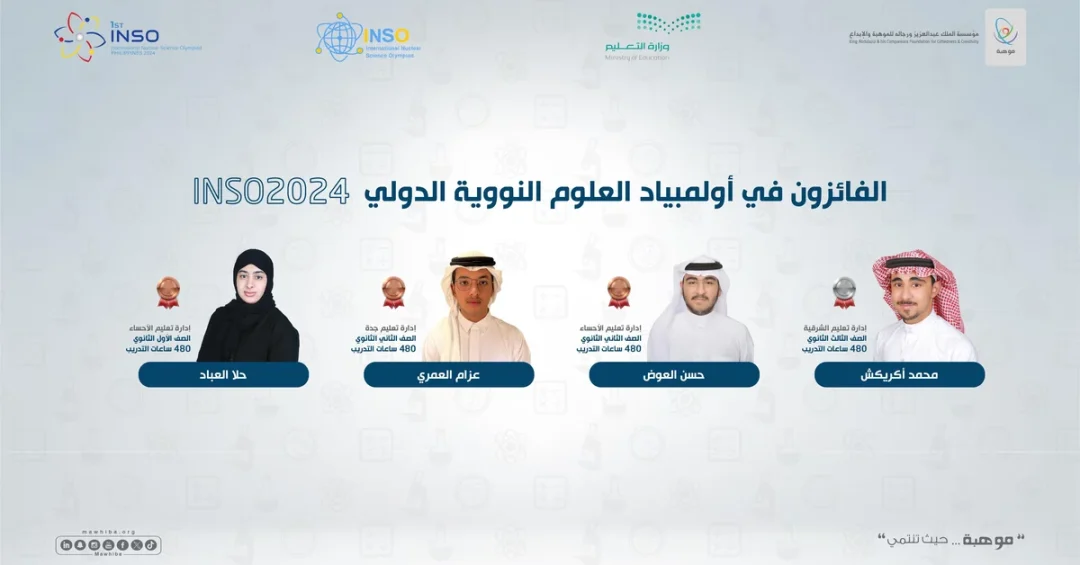
Saudi Arabia’s national nuclear science team has won four global medals at the inaugural 2024 International Nuclear Science Olympiad (INSO), held in the Philippines from July 31 to August 7. The achievement highlights the Kingdom’s growing investment in science, technology, and human capital development under the guidance of its leadership. Fifty-five students from 14 countries participated in the competition, which tested their knowledge and skills in nuclear science.
Context and Background
The International Nuclear Science Olympiad, organized for the first time this year, brought together young talents from around the world to promote excellence in nuclear science and technology. Saudi Arabia’s participation was coordinated by the King Abdulaziz and his Companions Foundation for Giftedness and Creativity (Mawhiba), in partnership with the Ministry of Education. This event aligns with the Kingdom’s broader strategy to nurture gifted students and prepare them for leadership roles in scientific fields critical to national development.
Key Details
A student representing the Eastern Region Education Department secured a silver medal for Saudi Arabia. Additionally, three teammates from the Al-Ahsa and Jeddah education departments earned bronze medals. The results underscore the effectiveness of Saudi Arabia’s educational programs in fostering talent at an international level. Dr. Amal Al-Hazzaa, Secretary General of Mawhiba, congratulated the winners, emphasizing that this achievement reflects the substantial and ongoing collaboration between Mawhiba, the Ministry of Education, and other supporting entities across the Kingdom.
Implications and Impact
The medals demonstrate Saudi Arabia’s ability to compete with advanced nations in specialized fields such as nuclear science. This success strengthens the Kingdom’s reputation as a hub for innovation and education in the Middle East. It also signals to international partners that Saudi students are well-prepared to contribute to global scientific progress, particularly in areas supporting energy diversification and technological advancement. The performance at the Olympiad is expected to inspire further investment in science education and regional cooperation in research.
Vision 2030 Alignment
These achievements directly support Saudi Vision 2030, which prioritizes human capital development, innovation, and a knowledge-based economy. By investing in gifted students and fostering excellence in science and technology, the Kingdom is building a skilled workforce capable of driving economic diversification and long-term growth. This Olympiad success reflects the vision’s commitment to empowering youth and positioning Saudi Arabia as a global leader in advanced sciences.
20 Questions
Q1. What is the International Nuclear Science Olympiad?
A1. It is a global competition testing secondary school students’ knowledge in nuclear science, first held in 2024 in the Philippines, with 55 students from 14 countries.
Q2. How many medals did the Saudi team win?
A2. The Saudi team won four medals: one silver and three bronze medals.
Q3. Which Saudi student won a silver medal?
A3. The student who won the silver medal represented the Eastern Region Education Department.
Q4. Which departments did the bronze medalists represent?
A4. The bronze medalists represented the Al-Ahsa and Jeddah education departments.
Q5. Who is Dr. Amal Al-Hazzaa?
A5. Dr. Amal Al-Hazzaa is the Secretary General of the King Abdulaziz and his Companions Foundation for Giftedness and Creativity (Mawhiba).
Q6. What is Mawhiba?
A6. Mawhiba is the King Abdulaziz and his Companions Foundation for Giftedness and Creativity, which supports gifted individuals in Saudi Arabia.
Q7. How many countries participated in the 2024 INSO?
A7. Fourteen countries participated in the 2024 International Nuclear Science Olympiad.
Q8. When was the 2024 INSO held?
A8. The Olympiad was held from July 31 to August 7, 2024.
Q9. Where was the 2024 INSO held?
A9. The Olympiad was held in the Philippines.
Q10. What did Dr. Amal Al-Hazzaa say about the achievement?
A10. She congratulated the winners and said the achievement is the outcome of cooperation between Mawhiba, the Ministry of Education, and other entities.
Q11. How does Saudi Arabia support gifted students?
A11. Saudi Arabia provides substantial support through Mawhiba and the Ministry of Education, funding programs and competitions to nurture talent.
Q12. Why is the INSO important for Saudi Arabia?
A12. It showcases the Kingdom’s ability to produce top talent in nuclear science, supporting its goals in energy diversification and innovation.
Q13. What is the connection to Vision 2030?
A13. The medals align with Vision 2030 by promoting human capital development and a knowledge-based economy.
Q14. What sectors benefit from nuclear science education?
A14. Sectors such as energy, medicine, agriculture, and research benefit from nuclear science education and talent.
Q15. Are there other Saudi science Olympiad teams?
A15. Yes, Saudi Arabia fields teams in other international Olympiads, such as mathematics, physics, and chemistry.
Q16. What role does the Ministry of Education play?
A16. The Ministry of Education collaborates with Mawhiba to identify and train gifted students for international competitions.
Q17. How many students were on the Saudi team to the INSO?
A17. The original text indicates at least four students won medals, but the total team size is not specified.
Q18. What does the silver medal signify?
A18. It signifies that the Saudi student performed among the top participants globally in nuclear science.
Q19. Is this the first time Saudi Arabia has won medals in a science Olympiad?
A19. No, Saudi Arabia has won medals in other international science Olympiads, but this is its first in the inaugural INSO.
Q20. What impact do these medals have on Saudi youth?
A20. They inspire young Saudis to pursue careers in science and technology, demonstrating that national talent can compete and succeed internationally.
Reader Feedback
We value your thoughts. Please share your feedback on this article.
Your feedback helps us improve our coverage.