


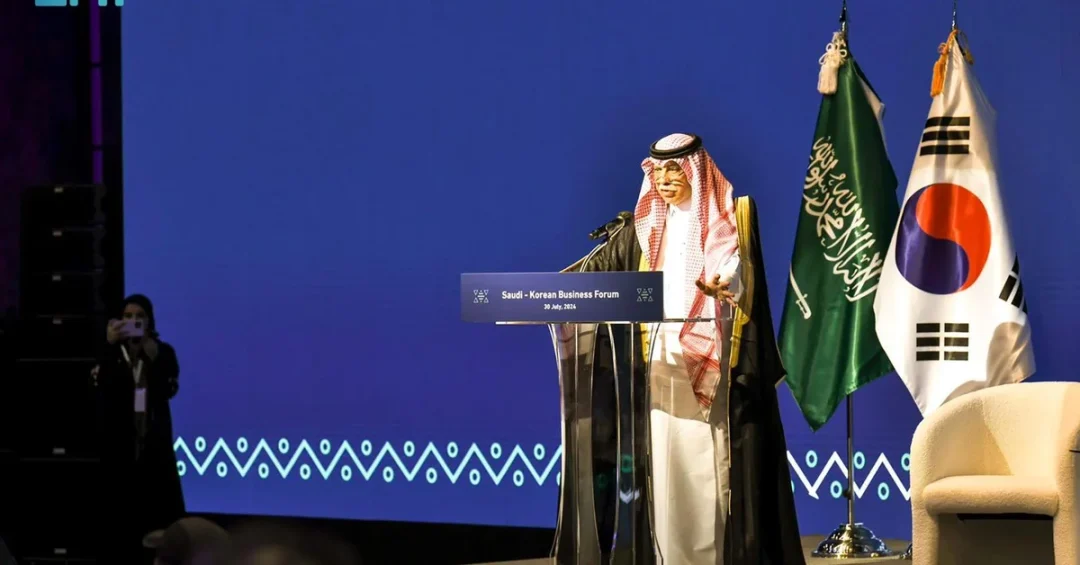
Saudi and Korean business leaders convened in Seoul for the Saudi-Korean Business Forum, marking a significant step in deepening economic ties between the two nations. The forum, held on July 30, 2024, was attended by Saudi Commerce Minister Dr. Majid bin Abdullah Al-Qasabi, Saudi Ambassador to the Republic of Korea Sami bin Mohammed Al-Sadhan, and approximately 400 representatives from the public and private sectors. The event highlighted the growing partnership under Saudi Arabia’s Vision 2030.
Context and Background
The forum comes as part of a broader Saudi delegation visit to the Republic of Korea from July 29 to 31, aimed at strengthening bilateral economic cooperation. The visit reflects the Kingdom’s commitment to diversifying its economy and building strategic alliances with key international partners. The event was organized by the National Competitiveness Center, the Federation of Saudi Chambers of Commerce, and the Korean Chamber of Commerce and Industry.
Key Details
Commerce Minister Dr. Majid bin Abdullah Al-Qasabi emphasized that Vision 2030, initiated by His Royal Highness Prince Mohammed bin Salman bin Abdulaziz, Crown Prince and Prime Minister, has driven significant economic diversification, sustainable growth, and innovation. He highlighted that trade between the Kingdom and the Republic of Korea reached $35 billion between 2019 and 2023, and 174 commercial records have been issued to Korean companies as of last April. Korean Minister of Trade Dr. Inkyo Cheong noted that the partnership is expanding into vital sectors like automotive and shipbuilding, as well as emerging areas such as AI, data centers, and smart cities. Additionally, Saudi Vice Minister of Commerce and CEO of the National Competitiveness Center Dr. Eman bint Habbas Al-Mutairi outlined 820 economic reforms carried out by 60 government agencies since 2016, alongside 1,200 updated laws and regulations. She also stated that the Kingdom allows 100% foreign ownership in most sectors, has streamlined business licensing by 55%, achieved 97% digitization of government services, and attained a 99% activation rate for virtual commercial court sessions. Nine agreements were signed between companies from both sides during the forum.
Implications and Impact
The forum’s two dialogue sessions—’Innovation and Technology’ and ‘Advanced Manufacturing and Infrastructure’—facilitated discussions on government initiatives promoting innovation, AI trends, and digital transformation challenges in infrastructure. These exchanges are expected to accelerate bilateral collaboration in high-tech and industrial sectors, boosting trade and investment flows between the two countries.
Vision 2030 Alignment
This deepening of Saudi-Korean economic ties directly supports Vision 2030’s goals of economic diversification, innovation, and global partnership. By engaging with Korean expertise in advanced manufacturing, AI, and smart infrastructure, the Kingdom continues to position itself as a leading investment destination and a hub for sustainable development, paving the way for long-term prosperity.
20 Questions
Q1. What was the main purpose of the Saudi-Korean Business Forum?
A1. The forum aimed to expand opportunities for economic partnership between Saudi Arabia and the Republic of Korea, bringing together business leaders and government officials to deepen bilateral cooperation.
Q2. Who represented Saudi Arabia at the forum?
A2. Saudi Commerce Minister Dr. Majid bin Abdullah Al-Qasabi led the delegation, alongside Saudi Ambassador to Korea Sami bin Mohammed Al-Sadhan and Vice Minister Dr. Eman bint Habbas Al-Mutairi.
Q3. How many attendees participated in the forum?
A3. Approximately 400 representatives from the public and private sectors attended the forum, reflecting strong interest in Saudi-Korean economic collaboration.
Q4. What was the trade volume between Saudi Arabia and Korea from 2019 to 2023?
A4. Trade between the two countries reached $35 billion during that period, underscoring the strength of their economic relationship.
Q5. How many commercial records were issued to Korean companies?
A5. As of last April, 174 commercial records were issued to Korean companies, facilitating their operations in the Kingdom.
Q6. What sectors were highlighted for cooperation by the Korean Trade Minister?
A6. Minister Inkyo Cheong highlighted automotive and shipbuilding industries, as well as emerging areas like AI, data centers, and smart cities.
Q7. How many economic reforms has Saudi Arabia implemented since 2016?
A7. Saudi Arabia has carried out 820 economic reforms by 60 government agencies across nine key areas since 2016.
Q8. What is the rate of digitization of government services in Saudi Arabia?
A8. The digitization of government services has reached 97%, demonstrating a strong commitment to modernizing administrative processes.
Q9. What is the activation rate of virtual commercial court sessions?
A9. The activation rate for virtual commercial court sessions is 99%, significantly improving litigation efficiency in the Kingdom.
Q10. What percentage of foreign ownership is allowed in Saudi business sectors?
A10. The Kingdom allows 100% foreign ownership in most business sectors, encouraging international investment.
Q11. Which organizations organized the forum?
A11. The forum was organized by the National Competitiveness Center, the Federation of Saudi Chambers of Commerce, and the Korean Chamber of Commerce and Industry.
Q12. How many laws and regulations have been updated in Saudi Arabia since 2016?
A12. Saudi Arabia has issued and updated 1,200 laws and regulations since 2016, strengthening the legal framework for business.
Q13. What was the focus of the ‘Innovation and Technology’ session?
A13. The session addressed government initiatives promoting innovation, technology adoption, and the latest trends in artificial intelligence.
Q14. Which Korean companies participated in the ‘Innovation and Technology’ session?
A14. Korean companies Naver and Rebellions took part in the session, alongside Saudi entities like SDAIA and Monshaat.
Q15. What was discussed in the ‘Advanced Manufacturing and Infrastructure’ session?
A15. The session covered key developing sectors in advanced manufacturing, as well as challenges and opportunities from digital transformation for infrastructure.
Q16. Which Saudi entities were involved in the ‘Advanced Manufacturing and Infrastructure’ session?
A16. Representatives from the ministries of industry and mineral resources, transport and logistic services, and the Saudi Exports Development Authority participated.
Q17. How many agreements were signed at the forum?
A17. Nine agreements were signed by companies from both Saudi Arabia and Korea during the forum.
Q18. What meetings preceded the forum?
A18. Minister Al-Qasabi met with Korean Ministers Dukgeun Ahn and Inkyo Cheong to discuss strengthening trade relations and cooperation on global trade issues.
Q19. How does the forum support Vision 2030?
A19. The forum fosters economic diversification, innovation, and international partnerships, aligning with Vision 2030’s goals for sustainable growth and global integration.
Q20. What is the significance of the Korea-GCC Free Trade Agreement mentioned at the forum?
A20. The agreement is expected to elevate economic cooperation between Korea and GCC countries, including Saudi Arabia, by reducing trade barriers and increasing exports.
Reader Feedback
We value your thoughts. Please share your feedback on this article.
Your feedback helps us improve our coverage.