


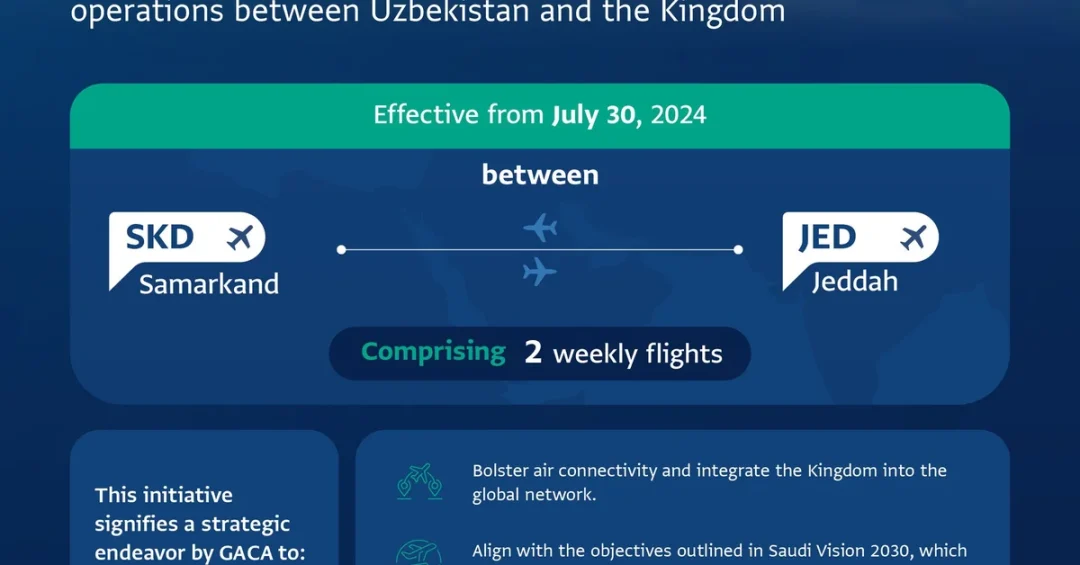
The General Authority of Civil Aviation (GACA) of Saudi Arabia has authorized Air Samarkand, an Uzbek airline, to operate passenger flights from Uzbekistan to the Kingdom during the summer season of 2024. This authorization marks a significant step in expanding international air connectivity and fostering closer ties between Saudi Arabia and Central Asia.
Context and Background
This development aligns with Saudi Arabia’s broader strategy to enhance its position as a global aviation hub. Under the Saudi Aviation Strategy, the Kingdom aims to triple its annual passenger traffic to 330 million and connect to over 250 international destinations by 2030. The authorization of Air Samarkand’s flights is a direct outcome of these efforts, reflecting the Kingdom’s commitment to opening new horizons for travel and trade.
Key Details
Air Samarkand will operate two weekly flights from Samarkand to King Abdulaziz International Airport in Jeddah. Jeddah, the gateway to the holy city of Makkah, is a key destination for pilgrims and tourists. The flights are expected to facilitate greater movement of visitors from Uzbekistan, particularly during the summer season when travel demand is high. This service will also support the cultural and economic exchange between the two nations.
Implications and International Impact
The new route is poised to strengthen Saudi Arabia’s diplomatic and economic relations with Uzbekistan, a rapidly developing country in Central Asia. By improving air connectivity, the Kingdom is positioning itself as a central logistical hub linking Asia, Africa, and Europe. This step also supports Vision 2030’s goal of attracting 150 million annual visits by 2030, including through enhanced religious tourism for Umrah and Hajj, as well as leisure travel.
Vision 2030 Alignment
This authorization by GACA is a testament to Saudi Arabia’s unwavering commitment to achieving the ambitious goals of Saudi Vision 2030. By streamlining air travel and fostering international partnerships, the Kingdom is building a sustainable, diversified economy that welcomes the world. The launch of Air Samarkand’s flights represents a forward-looking move that will deepen bilateral ties and contribute to the Kingdom’s emergence as a premier global destination and logistical powerhouse.
20 Questions
Q1. What is the purpose of GACA’s authorization for Air Samarkand?
A1. The authorization allows Air Samarkand to operate passenger flights from Uzbekistan to Saudi Arabia, enhancing air connectivity between the two countries and supporting Saudi Arabia’s aviation and tourism goals under Vision 2030.
Q2. Which airline is authorized to operate these flights?
A2. The authorized airline is Air Samarkand, a carrier based in Uzbekistan. It will provide direct flights to Saudi Arabia during the 2024 summer season.
Q3. How many weekly flights will Air Samarkand operate?
A3. Air Samarkand will operate two weekly flights from Samarkand to Jeddah, offering regular service to Saudi Arabia for passengers from Uzbekistan.
Q4. Which Saudi city will serve as the destination for these flights?
A4. The flights will arrive at King Abdulaziz International Airport in Jeddah, a major port of entry for international visitors and pilgrims to Saudi Arabia.
Q5. What is the significance of Jeddah as a destination?
A5. Jeddah is the gateway to Makkah and Madinah, making it a key hub for religious tourism, particularly Umrah and Hajj, as well as a commercial and cultural center in the Kingdom.
Q6. How does this authorization support Saudi Vision 2030?
A6. It aligns with Vision 2030 by boosting air connectivity, attracting international visitors, and positioning Saudi Arabia as a global logistical hub, key pillars of the Kingdom’s economic diversification.
Q7. What is the Saudi Aviation Strategy?
A7. The Saudi Aviation Strategy is a national plan to expand the Kingdom’s aviation sector, aiming to triple passenger traffic to 330 million and connect to over 250 destinations by 2030.
Q8. Why is this route important for bilateral relations?
A8. The new flights strengthen cultural and economic ties between Saudi Arabia and Uzbekistan, fostering tourism, trade, and people-to-people exchanges between the two friendly nations.
Q9. Who authorized the flights for Air Samarkand?
A9. The General Authority of Civil Aviation (GACA), the Saudi government agency responsible for regulating civil aviation, issued the authorization to Air Samarkand.
Q10. When will the flights begin?
A10. The flights are scheduled for the summer season of 2024, with specific start dates to be announced by Air Samarkand in coordination with Saudi aviation authorities.
Q11. How does this benefit travelers from Uzbekistan?
A11. Travelers from Uzbekistan gain a direct and convenient air link to Saudi Arabia, making it easier to visit for Umrah, tourism, or business purposes during the summer.
Q12. What is GACA’s role in Saudi aviation?
A12. GACA oversees all civil aviation activities in Saudi Arabia, including licensing airlines, ensuring safety standards, and promoting the Kingdom as a global aviation hub.
Q13. Does this authorization conflict with any other airline agreements?
A13. No, it complements existing bilateral air service agreements between Saudi Arabia and Uzbekistan, expanding options for airlines and passengers under open skies policies.
Q14. How many international flights operate to Saudi Arabia currently?
A14. Saudi Arabia currently connects to over 100 international destinations, a number expected to grow substantially as part of the Saudi Aviation Strategy’s expansion goals.
Q15. Will the flights support Umrah travel?
A15. Yes, the flights to Jeddah will facilitate Umrah visits, especially for pilgrims from Uzbekistan, as Jeddah is the primary airport for those traveling to Makkah.
Q16. Is Air Samarkand a new airline?
A16. Air Samarkand is a relatively new airline based in Uzbekistan, focused on expanding services to international destinations, including Saudi Arabia.
Q17. How does this affect Saudi tourism targets?
A17. It supports the Vision 2030 goal of attracting 150 million annual visits by 2030 by diversifying source markets, including Central Asia.
Q18. What other routes might follow this authorization?
A18. While unconfirmed, this move could lead to further routes between Saudi Arabia and Central Asian cities, as GACA actively seeks to expand the Kingdom’s network.
Q19. How does this align with Saudi Arabia’s global logistics goals?
A19. By connecting to Samarkand, Saudi Arabia enhances its role as a global logistics hub, linking Asia with the Middle East and beyond as part of Vision 2030.
Q20. What is the expected impact on Saudi-Uzbek trade?
A20. Improved air connectivity is likely to boost bilateral trade in goods and services, tourism, and investment, supporting Saudi Arabia’s economic diversification and international partnerships.
Reader Feedback
We value your thoughts. Please share your feedback on this article.
Your feedback helps us improve our coverage.