


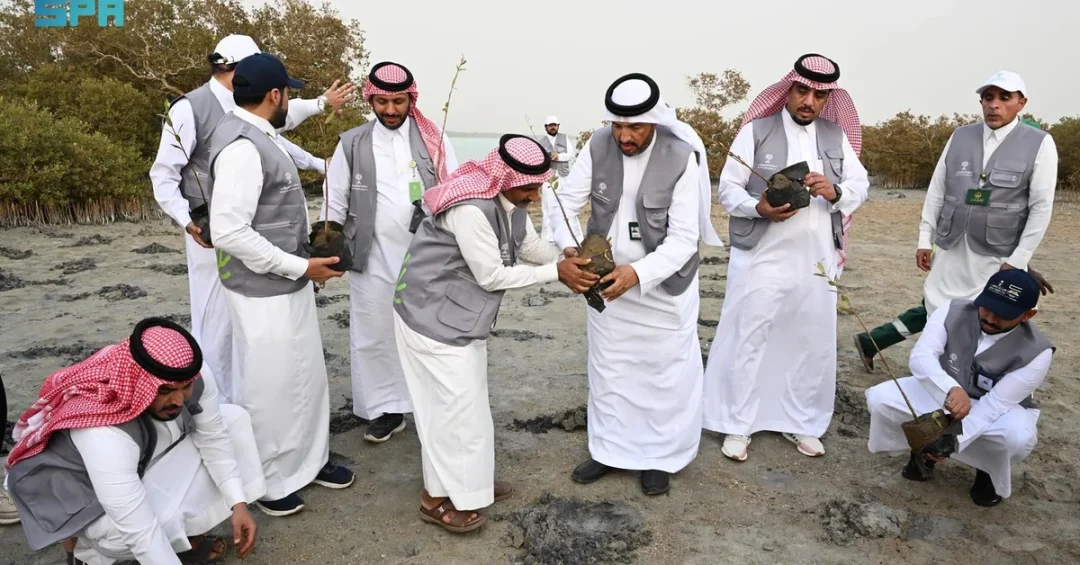
The National Center for Vegetation Cover Development and Combating Desertification (NCVC), in cooperation with the Aseer Region Development Authority (ASDA), launched the “Mangrove Restoration” campaign on July 24, 2024, on the coasts of the Asir region. The initiative, which began in Al-Barak Governorate, approximately 170 kilometers northwest of the Asir region, marks the observance of the International Day for the Conservation of the Mangrove Ecosystem, celebrated annually on July 26.
Context and Background
The campaign commenced with the planting of 500 mangrove seedlings on the beaches of Al-Barak Governorate, in an event attended by Governor Abdullah bin Ali bin Muhya, Mayor Nasser Saeed Al-Shahrani, and several local community members. This initiative is part of broader efforts by the Kingdom of Saudi Arabia to combat desertification and enhance vegetation cover along its coastlines, reflecting a commitment to environmental sustainability under the Saudi Green Initiative.
Key Details
The “Mangrove Restoration” campaign is designed to raise awareness about the importance of planting and protecting mangrove forests, educate society on the ecological benefits of mangroves, and highlight their role in addressing climate change and mitigating global warming. The NCVC has established several mangrove nurseries along the Red Sea and Arabian Gulf coasts, aiming to rehabilitate damaged habitats and expand vegetation cover across the Kingdom.
Implications and Impact
This initiative contributes to regional environmental stability by strengthening coastal ecosystems, which serve as natural barriers against erosion and provide habitats for marine biodiversity. The restoration of mangroves aligns with international climate goals, as these trees are highly effective at carbon sequestration, supporting global efforts to reduce greenhouse gas emissions. Furthermore, the campaign underscores Saudi Arabia’s proactive role in environmental conservation, enhancing its reputation as a responsible global actor.
Vision 2030 Alignment
The “Mangrove Restoration” initiative directly supports the objectives of the Saudi Green Initiative and the broader Vision 2030 plan, which prioritizes sustainable development, environmental protection, and the improvement of quality of life. By increasing vegetation cover and rehabilitating coastal habitats, the Kingdom advances its goal of planting 10 billion trees across the country, positioning Saudi Arabia as a leader in environmental stewardship and a model for regional ecological renewal.
20 Questions
Q1. What is the “Mangrove Restoration” initiative?
A1. The “Mangrove Restoration” initiative is a campaign launched by the NCVC and ASDA to plant and protect mangrove forests on the coasts of the Asir region, starting with 500 seedlings in Al-Barak Governorate.
Q3. Why are mangroves important for the environment?
A3. Mangroves provide essential ecosystem services, including carbon sequestration, coastal protection from erosion, and habitat for marine species, helping to mitigate climate change and support biodiversity.
Q3. When did the campaign launch?
A3. The campaign launched on July 24, 2024, as part of activities for the International Day for the Conservation of the Mangrove Ecosystem, observed annually on July 26.
Q4. Who participated in the initial planting event?
A4. The event was attended by Al-Barak Governor Abdullah bin Ali bin Muhya, Mayor Nasser Saeed Al-Shahrani, and several members of the local community.
Q5. Where did the first planting take place?
A5. The first planting occurred on the beaches of Al-Barak Governorate, located approximately 170 kilometers northwest of the Asir region in Saudi Arabia.
Q6. What is the primary goal of the initiative?
A6. The primary goal is to raise awareness about mangrove conservation, educate the public on their ecological importance, and increase the number of mangroves in the Kingdom.
Q7. How does this initiative relate to climate change?
A7. Mangroves absorb carbon dioxide, reducing greenhouse gases in the atmosphere, and thus play a key role in mitigating global warming and addressing climate change.
Q8. What organizations are involved in the campaign?
A8. The campaign is a collaboration between the National Center for Vegetation Cover Development and Combating Desertification (NCVC) and the Aseer Region Development Authority (ASDA).
Q9. What are mangrove nurseries?
A9. Mangrove nurseries are specialized facilities established by the NCVC along the Red Sea and Arabian Gulf to grow mangrove seedlings for replanting in degraded coastal habitats.
Q10. How does this support Saudi Vision 2030?
A10. The initiative aligns with Vision 2030 by promoting environmental sustainability, enhancing vegetation cover, and supporting the Saudi Green Initiative’s goal of planting 10 billion trees.
Q11. What is the Saudi Green Initiative?
A11. The Saudi Green Initiative is a national program aimed at combating desertification, increasing vegetation cover, and reducing carbon emissions, contributing to the Kingdom’s long-term environmental goals.
Q12. How many seedlings were planted initially?
A12. The campaign began by planting 500 mangrove seedlings during the launch event on the beaches of Al-Barak Governorate.
Q13. What is the International Day for the Conservation of the Mangrove Ecosystem?
A13. It is a United Nations-designated day observed on July 26 each year to promote the conservation of mangrove ecosystems and their sustainable management worldwide.
Q14. How do mangroves help coastal communities?
A14. Mangroves protect coastlines from storm surges and erosion, support fisheries by providing breeding grounds for fish, and improve water quality by filtering pollutants.
Q15. What role does the local community play?
A15. Local community members participated in the planting event and are encouraged to engage in ongoing conservation efforts, fostering a sense of environmental stewardship.
Q16. Are similar initiatives planned for other regions?
A16. The NCVC has established mangrove nurseries on the Red Sea and Arabian Gulf coasts, indicating plans to expand restoration efforts to other parts of the Kingdom.
Q17. How does this initiative combat desertification?
A17. By restoring mangrove forests along coastlines, the initiative helps stabilize soils, reduces erosion, and increases overall vegetation cover, countering desertification in coastal areas.
Q18. What is the NCVC’s role in Saudi Arabia?
A18. The NCVC is responsible for developing vegetation cover, combating desertification, and implementing afforestation projects across the Kingdom as part of environmental sustainability efforts.
Q19. How does this campaign educate the public?
A19. The campaign includes awareness activities and events that teach the public about mangroves’ ecological benefits, their role in climate mitigation, and how to participate in conservation.
Q20. What is the long-term vision for mangroves in Saudi Arabia?
A20. The long-term vision is to significantly increase mangrove populations along the Kingdom’s coasts, rehabilitate damaged habitats, and integrate mangroves into broader climate and sustainability strategies under Vision 2030.
Reader Feedback
We value your thoughts. Please share your feedback on this article.
Your feedback helps us improve our coverage.