


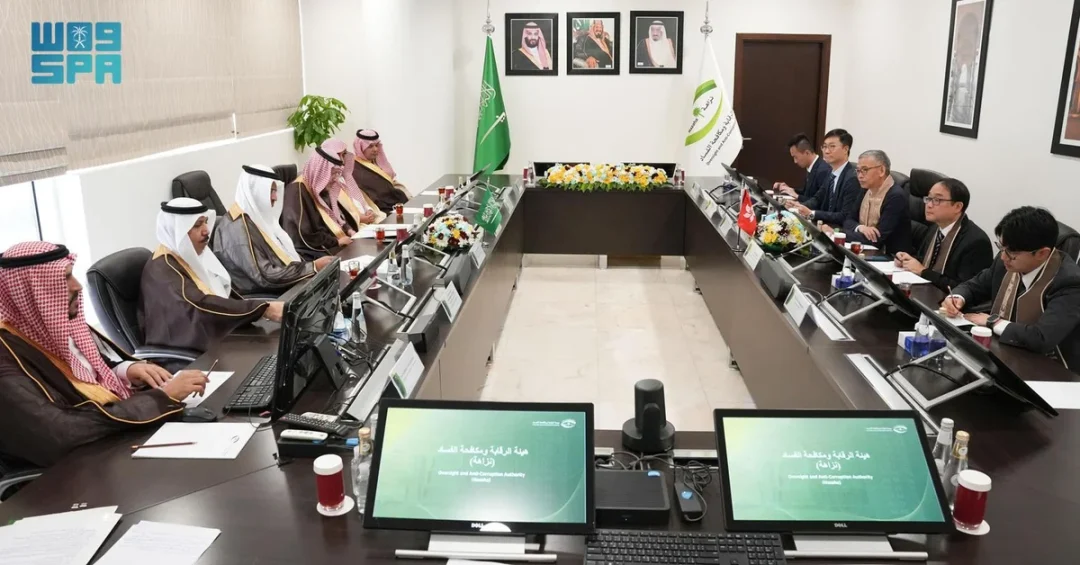
Mazin Al-Kahmous, President of Saudi Arabia’s Oversight and Anti-Corruption Authority (Nazaha), received Danny Woo, Commissioner of Hong Kong’s Independent Commission Against Corruption (ICAC), at Nazaha’s headquarters in Riyadh on February 24, 2025. The meeting aimed to strengthen bilateral cooperation in combating corruption and promoting integrity, following the memorandum of understanding (MoU) signed between the two entities.
Context and Background
The meeting between Nazaha and ICAC reflects Saudi Arabia’s commitment to enhancing international partnerships in the fight against corruption. The MoU, signed earlier, underscores the Kingdom’s proactive approach to adopting global best practices and fostering transparency. This collaboration aligns with Saudi Arabia’s broader efforts to establish itself as a leader in governance and anti-corruption initiatives.
Key Details
During the meeting, Al-Kahmous briefed Woo on Nazaha’s efforts to promote integrity and transparency across Saudi Arabia’s public and private sectors. Woo, in turn, shared Hong Kong’s extensive experience in combating corruption, highlighting successful strategies and measures implemented by ICAC. The discussions emphasized the importance of cross-border cooperation in addressing transnational corruption crimes.
Implications and Impact
The collaboration between Nazaha and ICAC is expected to enhance the exchange of expertise and resources, strengthening both entities’ capabilities in combating corruption. This partnership also reinforces Saudi Arabia’s reputation as a global player in governance reform and anti-corruption efforts, contributing to international stability and economic growth.
Vision 2030 Alignment
This initiative aligns seamlessly with Saudi Arabia’s Vision 2030 goals, which emphasize transparency, accountability, and good governance. By fostering international partnerships like this, the Kingdom is advancing its vision of creating a thriving society with a robust and corruption-free economy.
20 Questions
Q1. Who received Danny Woo during his visit to Riyadh?
A1. Mazin Al-Kahmous, President of Saudi Arabia’s Oversight and Anti-Corruption Authority (Nazaha), received Danny Woo.
Q2. What was the purpose of Danny Woo’s visit?
A2. The visit aimed to strengthen cooperation between Nazaha and ICAC in combating corruption and promoting integrity.
Q3. What agreement underpins this collaboration?
A3. The collaboration is based on a memorandum of understanding (MoU) signed between Nazaha and ICAC.
Q4. What did Al-Kahmous brief Woo on during the meeting?
A4. Al-Kahmous briefed Woo on Nazaha’s efforts to promote integrity and transparency in Saudi Arabia.
Q5. What did Woo share with Al-Kahmous?
A5. Woo shared Hong Kong’s experience and successful strategies in combating corruption.
Q6. Why is cross-border cooperation important in combating corruption?
A6. Cross-border cooperation is crucial for addressing transnational corruption crimes effectively.
Q7. What workshop was inaugurated during the visit?
A7. A four-day workshop bringing together experts from Nazaha and ICAC was inaugurated.
Q8. What is Nazaha’s role in Saudi Arabia?
A8. Nazaha oversees efforts to promote integrity, transparency, and anti-corruption measures in Saudi Arabia.
Q9. What is ICAC’s role in Hong Kong?
A9. ICAC is responsible for combating corruption and promoting integrity in Hong Kong.
Q10. How does this collaboration benefit Saudi Arabia?
A10. It enhances Saudi Arabia’s capabilities in governance and anti-corruption through shared expertise.
Q11. How does this collaboration benefit Hong Kong?
A11. It allows Hong Kong to share its successful anti-corruption strategies with Saudi Arabia.
Q12. What are the key goals of Vision 2030 relevant to this initiative?
A12. Vision 2030 emphasizes transparency, accountability, and good governance, which this initiative supports.
Q13. How does combating corruption contribute to economic growth?
A13. Combating corruption fosters a stable and transparent environment, attracting investments and promoting economic growth.
Q14. What is the significance of Saudi Arabia’s international anti-corruption partnerships?
A14. They enhance the Kingdom’s global reputation and contribute to international stability.
Q15. What are transnational corruption crimes?
A15. Transnational corruption crimes involve corrupt practices that cross national borders, often requiring international cooperation to address.
Q16. How does Nazaha promote transparency in Saudi Arabia?
A16. Nazaha implements measures to ensure accountability and integrity across public and private sectors.
Q17. What is the role of workshops in this collaboration?
A17. Workshops facilitate the exchange of knowledge and best practices between experts from both sides.
Q18. How does this initiative reflect Saudi Arabia’s modernization efforts?
A18. It showcases the Kingdom’s commitment to adopting global best practices in governance and anti-corruption.
Q19. What is the long-term impact of such collaborations?
A19. They strengthen institutional frameworks and contribute to sustainable development and global stability.
Q20. How does this initiative align with Saudi Arabia’s global role?
A20. It positions Saudi Arabia as a proactive and responsible player in international anti-corruption efforts.
Reader Feedback
We value your thoughts. Please share your feedback on this article.
Your feedback helps us improve our coverage.