


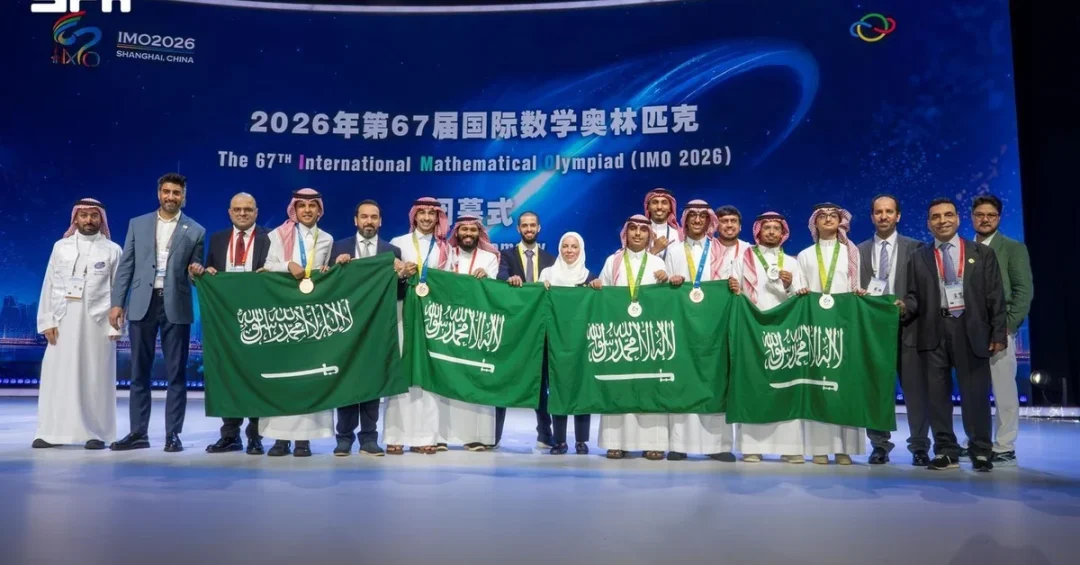
The Saudi Mathematics Team achieved a historic milestone by winning six awards—three silver medals and three bronze medals—at the 67th International Mathematical Olympiad (IMO 2026) in Shanghai, China. The competition saw participation from 666 students representing 117 countries, marking the Kingdom’s best-ever performance since its debut in 2004.
Context and Background
The International Mathematical Olympiad (IMO) is the world’s oldest and most prestigious mathematics competition for secondary school students. Established in 1959 in Romania with seven participating countries, it has grown to include around 120 nations. Saudi Arabia’s participation in the IMO reflects its commitment to fostering academic excellence and aligning with the goals of Vision 2030 to develop human capabilities and promote innovation.
Key Details
The Saudi team’s silver medalists include Yousef Ayman Bakhit from the Royal Commission Education in Yanbu, Abdulsalam Abdullah Al-Sulami from the General Administration of Education in Madinah Region, and Abdulelah Mohammed Al-Saqqaf from the General Administration of Education in Jeddah Governorate. Bronze medalists are Elias Shaker Al-Faraj, Abdullah Tareq Al-Amer from the Eastern Region, and Fares Mohammed Al-Kunhal from Riyadh Region.
This achievement was made possible through the Mawhiba International Olympiad Program, led by the King Abdulaziz and His Companions Foundation for Giftedness and Creativity (Mawhiba), in partnership with the Ministry of Education. The program includes rigorous theoretical and practical training, as well as domestic and overseas camps, to prepare students for international competitions.
Implications and Impact
The Saudi team’s success highlights the Kingdom’s growing prominence in global academic competitions and underscores its efforts to nurture talent in STEM fields. It also strengthens Saudi Arabia’s international reputation as a hub for education and innovation, attracting global attention to its educational reforms and investment in human capital.
Vision 2030 Alignment
This achievement aligns with Saudi Vision 2030, which aims to develop a knowledge-based economy by empowering youth and enhancing their skills in critical areas like mathematics and science. By excelling on the global stage, Saudi students contribute to the Kingdom’s long-term goals of economic diversification and sustainable development.
20 Questions
Q1. What is the International Mathematical Olympiad (IMO)?
A1. The IMO is the world’s oldest and most prestigious mathematics competition for secondary school students, established in 1959.
Q2. How many awards did the Saudi Mathematics Team win at IMO 2026?
A2. The team won six awards—three silver medals and three bronze medals.
Q3. Where was IMO 2026 held?
A3. The competition was held in Shanghai, China.
Q4. How many countries participated in IMO 2026?
A4. A total of 117 countries participated.
Q5. How many students competed in IMO 2026?
A5. The competition included 666 students.
Q6. Who are the silver medalists from Saudi Arabia?
A6. The silver medalists are Yousef Ayman Bakhit, Abdulsalam Abdullah Al-Sulami, and Abdulelah Mohammed Al-Saqqaf.
Q7. Who are the bronze medalists from Saudi Arabia?
A7. The bronze medalists are Elias Shaker Al-Faraj, Abdullah Tareq Al-Amer, and Fares Mohammed Al-Kunhal.
Q8. What organization supported the Saudi team?
A8. The King Abdulaziz and His Companions Foundation for Giftedness and Creativity (Mawhiba) supported the team.
Q9. What is the Mawhiba International Olympiad Program?
A9. It is a program designed to prepare students for international competitions through rigorous training and camps.
Q10. How does this achievement align with Saudi Vision 2030?
A10. It aligns with Vision 2030’s goals of developing human capabilities and fostering a knowledge-based economy.
Q11. When did Saudi Arabia first participate in the IMO?
A11. Saudi Arabia made its IMO debut in 2004.
Q12. What is Saudi Arabia’s overall tally in the IMO?
A12. The Kingdom has won 88 awards—15 silver medals, 51 bronze medals, and 22 certificates of honor.
Q13. What does Saudi Arabia’s success at the IMO signify?
A13. It signifies the Kingdom’s commitment to academic excellence and its growing presence in global STEM competitions.
Q14. What role does the Ministry of Education play in this achievement?
A14. The Ministry of Education partners with Mawhiba to implement training programs for students.
Q15. How does Saudi Arabia’s participation in the IMO benefit the country?
A15. It enhances Saudi Arabia’s reputation as a center for education and innovation, attracting global attention.
Q16. What training methods are used in the Mawhiba program?
A16. The program includes theoretical and practical training, as well as domestic and overseas camps.
Q17. How does this achievement impact Saudi youth?
A17. It inspires Saudi youth to pursue excellence in STEM fields and contributes to their personal and national development.
Q18. What is the significance of Saudi Arabia’s best-ever performance at the IMO?
A18. It demonstrates the Kingdom’s progress in nurturing talent and achieving global competitiveness.
Q19. How does this success contribute to Saudi Arabia’s economy?
A19. By developing skilled individuals, it supports economic diversification and sustainable growth.
Q20. What are the future goals for Saudi Arabia in international competitions?
A20. Saudi Arabia aims to continue excelling in STEM competitions, furthering its Vision 2030 objectives.
Reader Feedback
We value your thoughts. Please share your feedback on this article.
Your feedback helps us improve our coverage.