


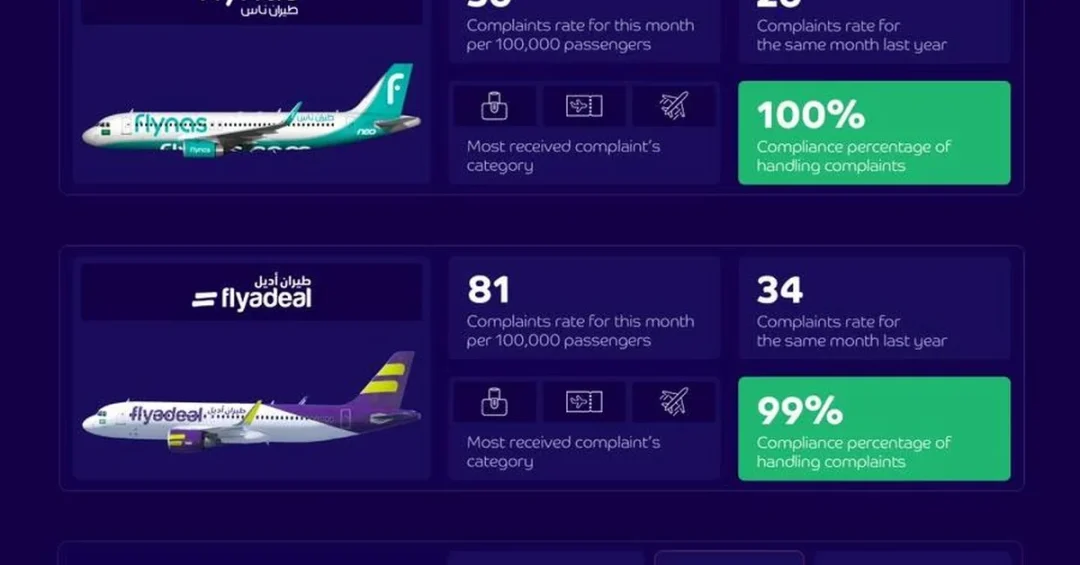
The General Authority of Civil Aviation (GACA) has released its monthly classification index for air transport service providers and airports in Saudi Arabia for June 2026, highlighting performance metrics based on passenger complaints. The index aims to enhance transparency and service quality across the aviation sector, with Saudia, flynas, and flyadeal leading in complaint resolution rates among airlines, while King Khalid International Airport and Najran International Airport excelled in their respective categories.
Context and Background
The GACA classification index is a key tool for monitoring and improving service standards in Saudi Arabia’s aviation sector. By publicly ranking airlines and airports based on passenger complaints and resolution efficiency, GACA fosters accountability and encourages continuous improvement. This initiative aligns with the Kingdom’s broader goals of enhancing service quality and customer satisfaction under Vision 2030.
Key Details
In June 2026, GACA recorded a total of 1,965 passenger complaints against air carriers. Saudia emerged as the top performer among airlines, with only 39 complaints per 100,000 passengers and an 89% on-time resolution rate. Flynas followed with 56 complaints per 100,000 passengers and a 100% resolution rate, while flyadeal ranked third with 81 complaints per 100,000 passengers and a 99% resolution rate.
Among airports, King Khalid International Airport recorded the lowest complaint rate (0.4 per 100,000 passengers) in the category of international airports serving over 6 million passengers annually. Najran International Airport led among smaller international airports with one complaint per 100,000 passengers. King Saud Airport topped the domestic airport category with three complaints per 100,000 passengers.
Implications and Impact
The GACA index serves as a benchmark for service quality in Saudi Arabia’s aviation sector, providing passengers with transparent data to make informed choices. By highlighting top performers and common complaint categories—such as flights, tickets, and baggage services—the index drives healthy competition among service providers. This initiative reinforces Saudi Arabia’s commitment to world-class aviation standards and customer-centric policies.
Vision 2030 Alignment
The GACA classification index directly supports Saudi Arabia’s Vision 2030 objectives of transforming the Kingdom into a global logistics hub and enhancing service quality across sectors. By promoting transparency and accountability in aviation, GACA contributes to the nation’s economic diversification and reputation as a leader in transportation and tourism. This initiative underscores the Kingdom’s dedication to excellence and sustainable growth.
20 Questions
Q1. What is the purpose of the GACA classification index?
A1. The index enhances transparency and service quality by ranking airlines and airports based on passenger complaints and resolution rates, encouraging continuous improvement in the aviation sector.
Q2. Which airline had the fewest complaints in June 2026?
A2. Saudia recorded the fewest complaints (39 per 100,000 passengers) and an 89% on-time resolution rate, making it the top-performing airline.
Q3. How did flynas perform in the index?
A3. Flynas ranked second with 56 complaints per 100,000 passengers and achieved a 100% on-time complaint resolution rate.
Q4. What was flyadeal’s complaint resolution rate?
A4. Flyadeal resolved 99% of complaints on time, ranking third with 81 complaints per 100,000 passengers.
Q5. Which international airport had the lowest complaint rate?
A5. King Khalid International Airport recorded 0.4 complaints per 100,000 passengers, the lowest among international airports serving over 6 million passengers annually.
Q6. How did Najran International Airport perform?
A6. Najran International Airport had one complaint per 100,000 passengers, the lowest rate among international airports serving fewer than 6 million passengers annually.
Q7. Which domestic airport led in performance?
A7. King Saud Airport recorded three complaints per 100,000 passengers, the lowest rate among domestic airports.
Q8. What were the most common complaint categories?
A8. Passengers most frequently reported issues related to flights, followed by tickets and baggage services.
Q9. How many total complaints were filed against airlines in June?
A9. GACA recorded 1,965 passenger complaints against air carriers in June 2026.
Q10. Why does GACA publish this index monthly?
A10. The monthly report promotes transparency, fair competition, and service improvement across Saudi Arabia’s aviation sector.
Q11. How does the index benefit passengers?
A11. Passengers gain access to transparent data, enabling them to make informed choices and hold service providers accountable.
Q12. What is Saudia’s on-time complaint resolution rate?
A12. Saudia achieved an 89% on-time complaint resolution rate in June 2026.
Q13. How does the index support Vision 2030?
A13. By improving aviation service quality, the index aligns with Vision 2030’s goals of economic diversification and global competitiveness.
Q14. What metrics does the index use to rank airports?
A14. Airports are ranked based on complaint rates per 100,000 passengers and on-time resolution rates.
Q15. How does King Khalid International Airport’s resolution rate compare?
A15. The airport achieved a 100% on-time complaint resolution rate in June 2026.
Q16. What is the significance of Najran International Airport’s performance?
A16. Its low complaint rate highlights the high service standards at smaller international airports in Saudi Arabia.
Q17. How does the index encourage competition?
A17. By publicly ranking performance, the index motivates airlines and airports to improve services and resolve complaints efficiently.
Q18. What role does GACA play in Saudi Arabia’s aviation sector?
A18. GACA regulates and oversees the aviation industry, ensuring compliance with international standards and promoting service excellence.
Q19. How does the index contribute to Saudi Arabia’s global reputation?
A19. By maintaining high service standards, the index reinforces the Kingdom’s position as a leader in aviation and logistics.
Q20. What future improvements can be expected from the index?
A20. The index will likely drive further reductions in complaint rates and higher resolution efficiency, benefiting both passengers and the aviation sector.
Reader Feedback
We value your thoughts. Please share your feedback on this article.
Your feedback helps us improve our coverage.