


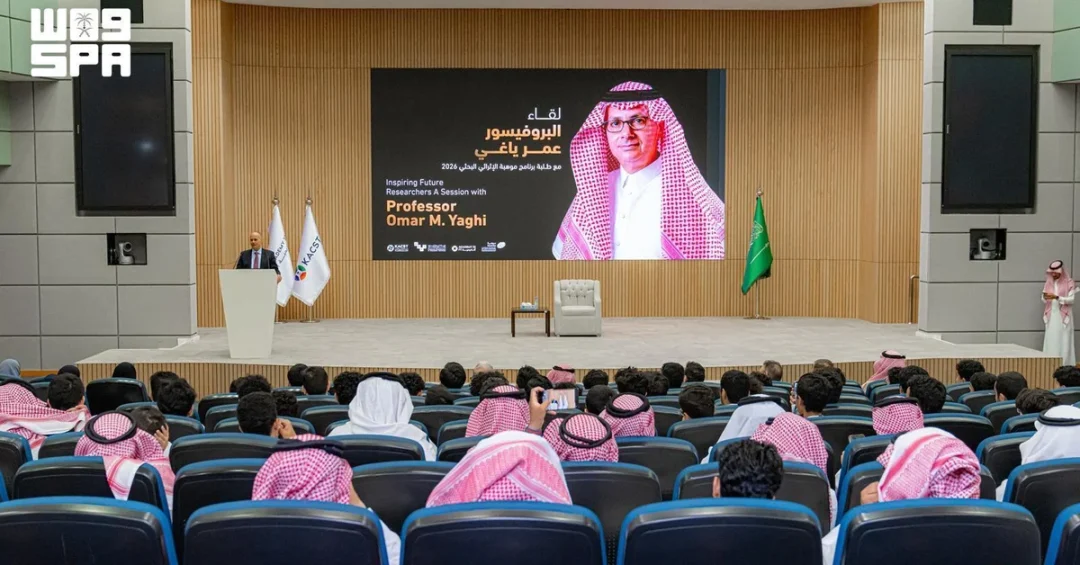
Nobel Prize-winning chemist Professor Omar Yaghi shared insights from his pioneering career with Saudi Arabia’s top young researchers during a special session hosted by King Abdulaziz City for Science and Technology (KACST) in Riyadh on July 23, 2026. The event, attended by KACST President Prof. Munir Eldesouki and leaders from Saudi Arabia’s research ecosystem, connected gifted students from the Mawhiba Research Enrichment Program with one of the world’s most influential scientists.
Context and Background
The session forms part of Saudi Arabia’s strategic investments in human capital development through initiatives like the Mawhiba program, which identifies and nurtures exceptional scientific talent. Professor Yaghi’s visit underscores the Kingdom’s commitment to fostering direct knowledge transfer between global scientific leaders and Saudi youth as part of broader Vision 2030 goals to build a knowledge-based economy.
Key Details
During the session, Professor Yaghi recounted his groundbreaking work in reticular chemistry, particularly his 1995 development of Metal-Organic Frameworks (MOFs) that earned him the 2025 Nobel Prize. He emphasized principles like independent thinking, perseverance through failure, and lifelong learning as cornerstones of scientific success. “Researchers must forge their own paths through original ideas and the courage to explore unanswered questions,” he advised students.
Implications and Impact
The interactive discussion provided Saudi students with rare access to a Nobel laureate’s perspective on building research careers. Such initiatives position Saudi Arabia as an emerging hub for scientific excellence, creating mentorship pipelines between international experts and Arab researchers. The event aligns with global best practices in STEM education while reinforcing the Kingdom’s scientific ambitions.
Vision 2030 Alignment
KACST’s initiative directly supports Saudi Arabia’s Vision 2030 human capability development program by equipping young researchers with world-class scientific competencies. By connecting national talent with figures like Professor Yaghi, the Kingdom accelerates its transition toward research-driven economic diversification and technological leadership – key pillars of the Vision’s sustainable development framework.
20 Questions
Q1. Who hosted Professor Omar Yaghi’s session with Saudi students?
A1. King Abdulaziz City for Science and Technology (KACST) hosted the event at its Riyadh headquarters in collaboration with the Mawhiba Research Enrichment Program.
Q2. What major award did Professor Yaghi receive in 2025?
A2. Professor Yaghi was awarded the 2025 Nobel Prize in Chemistry for his pioneering work on Metal-Organic Frameworks (MOFs).
Q3. Which Saudi official attended Professor Yaghi’s session?
A3. KACST President and Acting RDIA Governor Prof. Munir Eldesouki attended alongside leaders from Saudi Arabia’s research ecosystem.
Q4. What is the name of the student program that participated?
A4. Gifted students from the 2026 Mawhiba Research Enrichment Program participated in the interactive session.
Q5. When did Professor Yaghi make his breakthrough discovery?
A5. He pioneered reticular chemistry through developing MOFs in 1995, establishing his international scientific reputation.
Q6. What mindset does Professor Yaghi emphasize for researchers?
A6. He advocates approaching each research stage as a new beginning while constantly expanding knowledge through lifelong learning.
Q7. What principles did Professor Yaghi highlight for scientific success?
A7. He stressed independent thinking, avoiding imitation, curiosity, and courage to explore unanswered questions.
Q8. How does Professor Yaghi view unsuccessful experiments?
A8. He considers them strengthening experiences that build determination to persevere until meaningful discoveries are achieved.
Q9. What does scientific progress require according to Professor Yaghi?
A9. He states it depends on collaborative environments that foster discovery, innovation, and continuous expertise development.
Q10. What topics did students discuss with Professor Yaghi?
A10. Discussions covered chemistry research, academic career building, experimental skills development, and perseverance in science.
Q11. How does KACST support national research talent?
A11. By connecting young researchers with world-renowned scientists through initiatives like this knowledge-sharing session.
Q12. What is the broader purpose of such events?
A12. They strengthen students’ research capabilities to contribute to priority scientific and technological fields in Saudi Arabia.
Q13. How does this align with Saudi educational goals?
A13. It reflects the Kingdom’s commitment to STEM excellence and research-led human capital development.
Q14. What is the Mawhiba Research Enrichment Program?
A14. A Saudi initiative that identifies and nurtures exceptional young scientific talent through specialized educational opportunities.
Q15. Why are MOFs significant in chemistry?
A15. These porous materials have revolutionary applications in gas storage, separation technologies, and catalytic processes.
Q16. How does this event benefit Saudi students?
A16. It provides direct mentorship from a Nobel laureate and exposure to global research best practices.
Q17. What research field did Professor Yaghi establish?
A17. He pioneered the field of reticular chemistry through his work on MOFs and related frameworks.
Q18. How does this support Vision 2030?
A18. Such initiatives develop homegrown scientific talent crucial for knowledge-based economic diversification.
Q19. What international collaborations were mentioned?
A19. Professor Yaghi emphasized collaborating with leading global researchers to foster discovery and innovation.
Q20. What message did Professor Yaghi give students?
A20. He encouraged pursuing original ideas with passion and perseverance despite challenges or skepticism.
Reader Feedback
We value your thoughts. Please share your feedback on this article.
Your feedback helps us improve our coverage.