


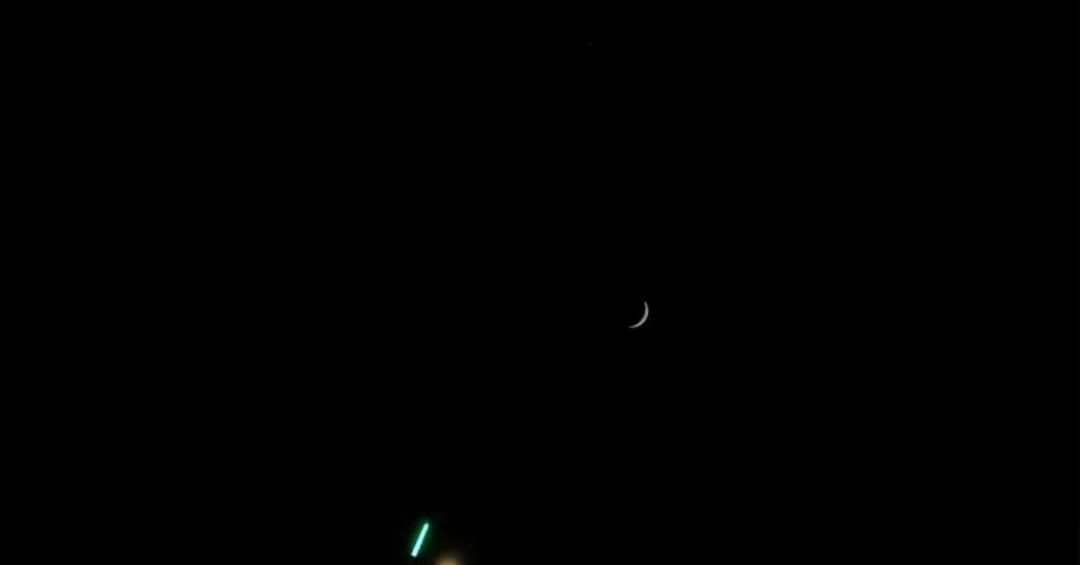
Turaif, August 16, 2026, SPA — The sky over the Turaif Governorate in the Northern Borders region of Saudi Arabia witnessed a celestial conjunction tonight, as the crescent moon of the month of Rabi’ Al-Awwal aligned with the planet Venus on the western horizon just after sunset. This astronomical event was visible to the naked eye, requiring no special observation equipment.
Context and Background
Astronomical phenomena have always served as a fundamental reference for humanity to measure time, establish calendars, and identify the four seasons. They remain a source of scientific and intellectual inspiration, connecting humans to the mysteries of the universe. This conjunction results from the apparent movement of the Moon and planets along their respective orbits. It is a periodic event that occurs at various times throughout the year, offering astronomy enthusiasts the opportunity to observe and photograph it, especially during twilight.
Key Details
The spectacle could be captured using a simple smartphone or a digital camera, while telescopes allowed viewers to discern finer details, including earthshine — the subtle illumination of the dark part of the Moon caused by sunlight reflecting off Earth. The conjunction took place in the evening hours, with local time at 01:03 (22:03 GMT), and was reported by the Saudi Press Agency (SPA).
Implications and Impact
Such events not only attract amateur astronomers but also highlight Saudi Arabia’s commitment to promoting scientific awareness and education. The Kingdom has increasingly invested in space and astronomy initiatives, aligning with its Vision 2030 goals of fostering innovation and a knowledge-based society. The conjunction also serves as a reminder of the natural wonders visible in the Kingdom’s clear skies, enhancing its appeal for astro-tourism and cultural enrichment.
Vision 2030 Alignment
This celestial display in Turaif underscores Saudi Arabia’s ongoing efforts to inspire its citizens and residents through science and exploration. As the Kingdom advances its Vision 2030 agenda, such events contribute to a broader narrative of modernization and intellectual growth, reinforcing Saudi Arabia’s position as a hub for scientific curiosity and cultural appreciation in the region.
20 Questions
Q1. What astronomical event occurred in Turaif?
A1. A conjunction of the crescent moon and Venus was observed in the sky over Turaif, Northern Borders region, Saudi Arabia, on August 16, 2026, visible to the naked eye.
Q2. Where is Turaif located?
A2. Turaif is a governorate in the Northern Borders region of Saudi Arabia, known for its clear skies and archaeological heritage, making it a suitable location for astronomical observations.
Q3. When did the conjunction take place?
A3. The conjunction occurred in the evening of August 16, 2026, just after sunset, with local time reported as 01:03 (22:03 GMT).
Q4. Was any special equipment needed to see it?
A4. No, the event was visible to the naked eye, though telescopes could enhance details such as earthshine.
Q5. What is earthshine?
A5. Earthshine is the faint illumination of the dark part of the Moon caused by sunlight reflecting off Earth’s surface, often visible during a thin crescent.
Q6. How can the conjunction be photographed?
A6. It can be captured with a smartphone or a digital camera, with long-exposure settings for improved results.
Q7. Why are astronomical events important?
A7. They help measure time, establish calendars, and understand seasons, while inspiring scientific curiosity and cultural appreciation.
Q8. Does Saudi Arabia support astronomy?
A8. Yes, Saudi Arabia invests in space and astronomy, including the Saudi Space Commission and initiatives aligned with Vision 2030 for scientific development.
Q9. How does this event relate to Vision 2030?
A9. It promotes scientific awareness and education, contributing to Vision 2030’s goal of building a knowledge-based society.
Q10. Can similar events be observed elsewhere?
A10. Yes, conjunctions are periodic and can be observed from various locations, but Saudi Arabia’s clear skies offer prime viewing.
Q11. Who reported the event?
A11. The Saudi Press Agency (SPA) reported the event, providing official information about the celestial occurrence.
Q12. What causes a conjunction?
A12. It is caused by the apparent alignment of celestial bodies along their orbits as seen from Earth.
Q13. Is Venus always visible at sunset?
A13. Venus is often visible as the evening star, but its visibility depends on its position relative to the Sun.
Q14. Does Turaif have observatories?
A14. While Turaif may not have dedicated observatories, its environment is conducive to naked-eye observations and amateur astronomy.
Q15. How does this event benefit tourism?
A15. It highlights the Kingdom’s natural attractions, potentially boosting astro-tourism and cultural tourism.
Q16. What is the cultural significance of moon sightings in Saudi Arabia?
A16. Moon sightings are culturally significant for the Islamic calendar, marking months like Rabi’ Al-Awwal.
Q17. Are there any upcoming astronomical events in Saudi Arabia?
A17. Conjunctions and meteor showers occur periodically, with announcements often made by SPA or astronomy clubs.
Q18. How can one learn more about astronomy in Saudi Arabia?
A18. Through educational initiatives, astronomy clubs, and resources from the Saudi Space Commission.
Q19. Does this event have any scientific value?
A19. Observations of conjunctions help verify astronomical calculations and engage amateurs in scientific practice.
Q20. What is the takeaway from this event?
A20. It underscores Saudi Arabia’s commitment to science and education, inspiring people to look up and appreciate the universe.
Reader Feedback
We value your thoughts. Please share your feedback on this article.
Your feedback helps us improve our coverage.