


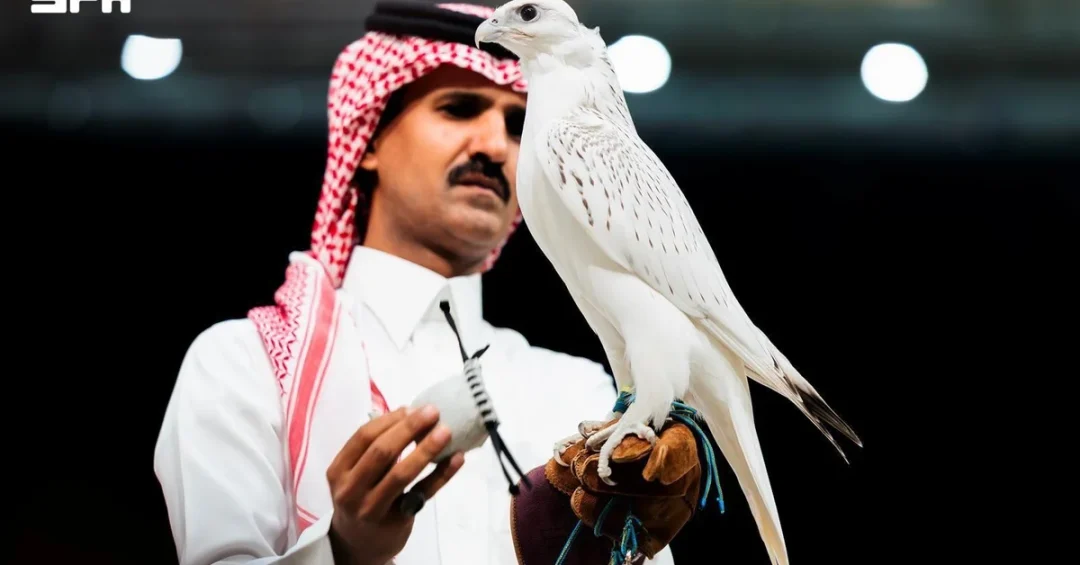
Riyadh, August 16, 2026 – The International Falcon Breeders Auction 2026 recorded its most expensive sale of the year on its seventh night, with a mottled gyr (Super White) chick selling for SAR1.3 million, making it the second most expensive falcon in the auction’s history. The sale took place at the auction’s venue in Riyadh, where bidders competed fiercely for the rare bird. The auction, organized by the Saudi Falcon Club and supervised by the National Center for Falcons, highlights the Kingdom’s dedication to preserving falconry heritage and supporting sustainable breeding practices.
Context and Background
The International Falcon Breeders Auction is a key event in Saudi Arabia’s cultural calendar, attracting falcon breeders, enthusiasts, and investors from around the world. It showcases the Kingdom’s commitment to preserving and promoting falconry, a tradition deeply rooted in Arabian culture. The auction is a platform for breeders to present some of the finest falcons, with a focus on genetic quality and health. This year’s event, which began in early August, has drawn participation from over [number] farms across [countries], underscoring its international significance.
Key Details
According to the Saudi Press Agency (SPA), the night featured two falcons from a Canadian farm. The first, a pure gyrfalcon chick, opened at SAR40,000 and sold for SAR150,000. The second, a mottled gyr chick, known as “Super White,” opened at SAR200,000 but quickly escalated to SAR1.3 million amid intense bidding. The sale represents a significant milestone for the breeder and demonstrates the high value placed on these majestic birds in the Gulf region.
The auction also highlighted the growing interest in falconry, with participants from various countries, including the United States, Canada, and European nations. The event is broadcast on television channels and live-streamed on the National Center for Falcons’ social media platforms, allowing a global audience to follow the proceedings.
Implications and Impact
This year’s auction has set a new benchmark, with the top sale reaching SAR1.3 million, only surpassed by the SAR1.75 million record from a previous edition. The demand for high-quality falcons reflects the prestige associated with falconry in Saudi Arabia and the broader Gulf region. Beyond the commercial aspect, the auction plays a role in conserving falcon species, as it encourages responsible breeding and provides a regulated market for rare birds.
The success of the event also underscores the Kingdom’s soft power in promoting cultural heritage while fostering economic opportunities in the sector. It aligns with Saudi Arabia’s broader efforts to diversify its economy beyond hydrocarbons, with tourism and cultural events gaining increasing prominence as part of Vision 2030.
Vision 2030 Alignment
The International Falcon Breeders Auction serves as a testament to Saudi Arabia’s commitment to preserving its intangible heritage while embracing modernity. Under Vision 2030, the Kingdom has prioritized cultural enrichment and heritage promotion as pillars of its national transformation. By hosting such events, Saudi Arabia not only showcases its deep respect for falconry but also reinforces its position as a global hub for cultural exchange and leisure tourism, contributing to the overall goals of economic diversification and international engagement.
20 Questions
Q1. What was the most expensive falcon sold at the International Falcon Breeders Auction 2026?
A1. The most expensive falcon sold at the auction was a mottled gyr (Super White) chick, which fetched SAR1.3 million on the seventh night of the event.
Q2. Where is the International Falcon Breeders Auction being held?
A2. The auction is being held in Riyadh, Saudi Arabia, under the organization of the Saudi Falcon Club and supervision of the National Center for Falcons.
Q3. When did the International Falcon Breeders Auction 2026 take place?
A3. The auction began in early August 2026 and will continue until August 25, 2026, with nightly sessions broadcast on television and social media.
Q4. How much did the second most expensive falcon in auction history sell for?
A4. The second most expensive falcon in auction history, a mottled gyr (Super White) chick, sold for SAR1.3 million during the 2026 auction, surpassing last year’s top sale.
Q5. What is the National Center for Falcons?
A5. The National Center for Falcons is a Saudi organization dedicated to falconry, conservation, and the promotion of falcon breeding and trading, ensuring sustainability and cultural preservation.
Q6. Which farm did the two falcons originate from?
A6. The two falcons featured on the seventh night came from a Canadian farm, highlighting the auction’s international scope and the global participation in falcon breeding.
Q7. At what price did the pure gyrfalcon chick open and eventually sell?
A7. The pure gyrfalcon chick opened at SAR40,000 and eventually sold for SAR150,000, demonstrating strong interest in high-quality pure breeds.
Q8. What is the significance of the “Super White” classification in falcons?
A8. “Super White” refers to a color mutation in gyrfalcons that produces an exceptionally rare and pure white plumage, making these birds highly prized among collectors and breeders.
Q9. How does the auction contribute to falcon conservation?
A9. The auction encourages responsible breeding, reduces illegal poaching, and supports genetic diversity by providing a regulated marketplace, thereby aiding conservation efforts.
Q10. What has been the most expensive falcon sale in the auction’s history?
A10. The most expensive falcon sale in the auction’s history was a record SAR1.75 million for an Ultra White pure mottled gyr chick in a previous edition.
Q11. How does the Saudi public follow the auction?
A11. The auction is broadcast live on television channels and streamed on the National Center for Falcons’ social media accounts, allowing the public to watch the bidding in real time.
Q12. What is the focus of the International Falcon Breeders Auction?
A12. The auction focuses on presenting and selling high-quality falcons, emphasizing breeding excellence, health, and genetic purity, while also serving as a cultural event.
Q13. Why are falcons so valuable in Saudi Arabia?
A13. Falcons hold cultural and historic importance in Saudi Arabia, symbolizing nobility and skill, and their value is driven by rarity, breed quality, and regional demand.
Q14. What is the role of the Saudi Falcon Club?
A14. The Saudi Falcon Club organizes falconry events, including the auction, and promotes traditional falconry practices, heritage, and the well-being of falcons.
Q15. How does the auction align with Saudi Arabia’s Vision 2030?
A15. The auction supports Vision 2030 by boosting cultural tourism, preserving heritage, and fostering economic diversification through events that attract international visitors and investments.
Q16. What was last year’s top sale amount at the auction?
A16. Last year’s auction recorded a top sale of SAR1.2 million for a Super White pure gyrfalcon from a US farm, indicating steady growth in prices.
Q17. How many falcons were sold on the seventh night?
A17. On the seventh night, two falcons from a Canadian farm were sold, with a combined total of SAR1.45 million, one of which was the SAR1.3 million mottled gyr.
Q18. What are the main features of a mottled gyr falcon?
A18. Mottled gyr falcons exhibit a mix of grey and white feathers, with the “Super White” variant having a predominantly white appearance, making them visually striking and extremely rare.
Q19. How does the auction benefit the international falconry community?
A19. The auction provides a global platform for breeders to network, share expertise, and trade rare falcons, fostering international cooperation in falconry and conservation.
Q20. Where can international audiences watch the auction live?
A20. International audiences can watch the auction live via the National Center for Falcons’ social media platforms, which stream each night’s proceedings for free.
Reader Feedback
We value your thoughts. Please share your feedback on this article.
Your feedback helps us improve our coverage.