


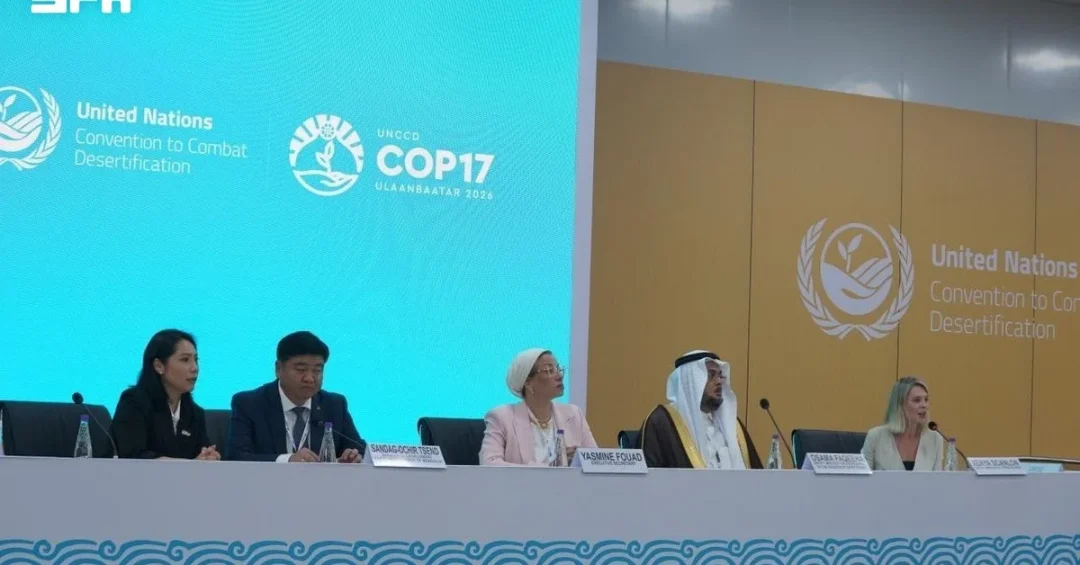
Saudi Arabia has officially handed over the presidency of the United Nations Convention to Combat Desertification (UNCCD) Conference of the Parties to Mongolia, concluding a two-year tenure that elevated land degradation, desertification, and drought resilience to the top of the global agenda. The transfer took place at the opening of the 17th session (COP17) in Ulaanbaatar on August 17, 2026, with Dr. Osama Faqeeha, Deputy Minister for Environment at Saudi Arabia’s Ministry of Environment, Water and Agriculture, representing Minister Abdulrahman Alfadley.
Context and Background
During its presidency of the 16th session (COP16) held in Riyadh, Saudi Arabia spearheaded efforts to turn international commitments into concrete action. The conference drew nearly 100,000 participants from over 170 countries and featured more than 800 events. The Kingdom worked extensively to strengthen coordination among the three Rio Conventions and to engage the private sector and international financial institutions. Through the Riyadh Action Agenda, more than 100 supporting initiatives have been developed, underscoring the country’s dedication to environmental stewardship as a pillar of sustainable development.
Key Details
At the handover, Minister Abdulrahman Alfadley, in remarks delivered by Dr. Faqeeha, emphasized Saudi Arabia’s commitment to multilateral efforts in combating land degradation, drought, and desertification. He highlighted the importance of partnerships involving all parties, including international and regional organizations, the private sector, and civil society. The Kingdom also launched several initiatives during its COP16 presidency, such as the Riyadh Global Drought Resilience Partnership (RGDRP), which has secured over $2 billion in international pledges across 64 countries and 30 organizations. Other initiatives include the International Sand and Dust Storm Monitoring Initiative and the Business 4 Land initiative, both aimed at mobilizing global cooperation.
Implications and Impact
Saudi Arabia’s presidency successfully translated political will into practical actions, setting a precedent for future COP presidencies. The enhanced focus on drought resilience and land restoration has created a robust framework for international collaboration, aligning with global efforts to achieve land degradation neutrality by 2030. The handover to Mongolia signals continuity, as the Kingdom looks forward to working with Mongolia’s COP17 presidency to sustain progress on these critical environmental issues.
Vision 2030 Alignment
This leadership in global environmental action is a testament to Saudi Arabia’s strategic vision under the Kingdom’s Vision 2030, which integrates environmental stewardship with economic diversification. By advancing land and drought resilience, the Kingdom not only contributes to global sustainability but also safeguards its own natural resources for future generations, embodying the principles of a sustainable and prosperous Saudi Arabia.
20 Questions
Q1. Who handed over the COP presidency to Mongolia?
A1. The Saudi Minister of Environment, Water and Agriculture, Abdulrahman Alfadley, delegated the handover to Deputy Minister Dr. Osama Faqeeha, who formally passed the COP16 presidency to Mongolia at the opening of COP17.
Q2. What is the United Nations Convention to Combat Desertification (UNCCD)?
A2. The UNCCD is an international treaty focused on combating desertification and mitigating the effects of drought, working to enhance land productivity and resilience in drylands.
Q3. When and where did COP17 take place?
A3. COP17 was held in Ulaanbaatar, Mongolia, from August 17 to 28, 2026, marking the official handover of the presidency from Saudi Arabia to Mongolia.
Q4. What significant milestone did Saudi Arabia achieve during its COP16 presidency?
A4. Saudi Arabia launched several key initiatives, including the Riyadh Global Drought Resilience Partnership and the Riyadh Action Agenda, which gathered over 100 supporting initiatives and secured over $2 billion in financial pledges for drought resilience.
Q5. How many countries were involved in the Riyadh Global Drought Resilience Partnership?
A5. The partnership involved representatives from 64 countries and 30 international organizations, collectively committing to address drought and land degradation challenges globally.
Q6. What was the Riyadh Action Agenda?
A6. The Riyadh Action Agenda is a framework for voluntary commitments and collective action to advance sustainable land management and combat drought, gathering broad support from various stakeholders.
Q7. How many participants attended COP16 in Riyadh?
A7. The conference attracted nearly 100,000 participants from more than 170 countries, including governmental, intergovernmental, and civil society representatives.
Q8. What key initiatives were launched by Saudi Arabia during its presidency?
A8. Key initiatives included the Riyadh Global Drought Resilience Partnership, the International Sand and Dust Storm Monitoring Initiative, the Business 4Land initiative, and the Riyadh Action Agenda.
Q9. What was the purpose of the Business 4Land initiative?
A9. The Business 4Land initiative aimed to mobilize the private sector to invest in restoring degraded land and promoting sustainable land management practices.
Q10. How did Saudi Arabia strengthen coordination among the three Rio Conventions?
A10. Saudi Arabia worked to enhance synergy between the Rio Conventions (on climate change, biodiversity, and desertification) to ensure a coherent approach to environmental and land issues.
Q11. What was the Tafa’ul Track?
A11. The Tafa’ul Track was an informal dialogue among representatives from different regions to address and unify approaches to combatting drought and desertification.
Q12. How did the Saudi COP presidency address drought specifically?
A12. It convened a ministerial dialogue on drought, supported drought negotiations, and launched the Riyadh Global Drought Resilience Partnership to catalyze funding and political will.
Q13. What is the Riyadh Declaration?
A13. The Riyadh Declaration is a landmark document adopted at COP16, setting out commitments to combat land degradation and desertification, and to enhance drought resilience.
Q14. How did the COP16 presidency engage local communities?
A14. The conference included significant participation from local communities, ensuring their involvement in decisions affecting sustainable land management and drought responses.
Q15. What achievements are attributed to the Saudi presidency?
A15. Achievements include increased global attention on land and drought, the launch of multi-million-dollar partnerships, and the establishment of implementation mechanisms to translate commitments into on-the-ground actions.
Q16. How does this handover affect the future of global land policies?
A16. The transition to Mongolia ensures the continuation of momentum on land degradation, drought, and desertification, with a strong foundation set by Saudi Arabia’s presidency.
Q17. What is Saudi Arabia’s broader strategy in hosting environmental events?
A17. The hosting reflects Saudi Arabia’s commitment to environmental stewardship as part of Vision 2030, promoting sustainable development and global cooperation in tackling ecological challenges.
Q18. How many international events did Saudi Arabia participate in during its presidency?
A18. Saudi Arabia participated in about 50 international events during its two-year term, furthering the UNCCD goals and fostering international collaboration.
Q19. What are the outcomes for future cooperation between Saudi Arabia and Mongolia?
A19. Saudi Arabia expressed readiness to cooperate with Mongolia’s COP17 presidency to continue advancing the UNCCD objectives, strengthening land restoration and drought resilience efforts.
Q20. How does this presidency support Saudi Arabia’s national vision?
A20. The presidency supports Vision 2030 by prioritizing environmental sustainability, restoring arable land, and investing in green technologies, aligning with the nation’s long-term development goals.
Reader Feedback
We value your thoughts. Please share your feedback on this article.
Your feedback helps us improve our coverage.