


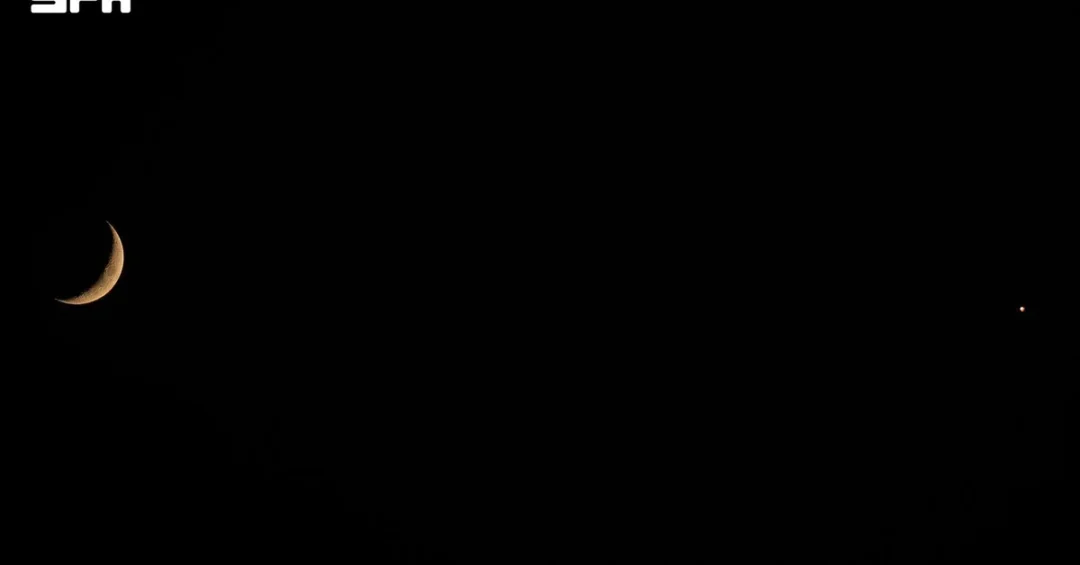
An increasing crescent moon marking the start of the Islamic month of Rabi’ al-Awwal was observed across Saudi Arabia on the evening of August 16, 2026, in a close conjunction with the planet Venus. The astronomical spectacle was visible to the naked eye in the western horizon after sunset, from locations with an open view and clear skies, according to information released through the official Saudi Press Agency (SPA).
Context and Background
This celestial pairing of the lunar crescent and Venus, the brightest planet in the night sky, occurred during the twilight period, with an apparent angular separation of approximately 1.8 degrees at the closest approach. The two objects appeared to move apart as the moon continued its orbital path around Earth. Such conjunctions are periodic phenomena that occur due to the apparent motion of the moon and planets, captivating astronomers and sky enthusiasts alike.
The event was highlighted by Mohammed Aladdin Al-Huzaimi, a member of the Astronomy and Space Club, who explained that this conjunction is one of the notable astronomical scenes that repeat as a result of the apparent movement of the moon and planets. He clarified that the close approach of the crescent and Venus is only apparent from the observer’s perspective on Earth; in reality, vast distances separate them in space.
Key Details of the Observation
Al-Huzaimi noted that the appearance of the growing crescent beside Venus after sunset provided a suitable opportunity for astronomy hobbyists and photographers to document the scene. Such conjunctions contribute to fostering a greater interest in observing celestial bodies and understanding their movements and positions in the sky. The conjunction of the Moon and Venus is one of the periodic phenomena that can be seen without optical aids, provided weather conditions are favorable. The visual beauty is enhanced by the combination of the thin crescent and the brilliance of Venus in the western horizon.
No specific locations were indicated, but the sky was reported to be visible across various parts of the Kingdom, particularly from areas with open horizons and cloud-free conditions. The official source noted that the phenomenon was observed after sunset on the evening of August 16, 2026, corresponding to the 4th of Rabi’ al-Awwal 1448 AH.
Implications and Impact
This conjunction underscores the growing public interest in astronomy within Saudi Arabia. The country has made significant strides in promoting space and scientific education, aligning with the goals of Vision 2030 to diversify the economy and foster a culture of innovation and learning. Events like these serve as educational opportunities for citizens and residents, encouraging people to engage with science and explore the natural world.
The observation of such phenomena also supports the development of a competent knowledge society, as astronomy clubs and initiatives across the nation provide platforms for amateurs and experts to share knowledge. The documented occurrence of these events helps to build a repository of scientific data and contributes to the Kingdom’s contributions to global astronomical knowledge. As Saudi Arabia continues to expand its role in the global science community, public interest events like this enhance its status as a hub for scientific education.
Vision 2030 Alignment
This astronomical phenomenon aligns directly with Saudi Arabia’s Vision 2030, which encourages the development of a knowledge-based economy and the cultivation of scientific literacy among its citizens. By promoting astronomy as an accessible and interesting field, the Kingdom is nurturing a new generation of scientists, engineers, and innovators who will drive future advancements in technology and exploration. The event also reflects the nation’s ongoing investment in scientific institutions, such as the King Abdulaziz City for Science and Technology (KACST) and the emerging NEOM Space complex, positioning Saudi Arabia as a regional and global leader in space science.
20 Questions
Q1. What was the astronomical event observed in Saudi Arabia on August 16, 2026?
A1. The event was a conjunction of the waxing crescent moon of the Islamic month of Rabi al-Awwi with the planet Venus. The two objects appeared close in the western sky after sunset, a phenomenon that is widely visible without telescope aids.
Q2. Where was the conjunction visible from?
A2. The conjunction was visible from locations across Saudi Arabia that had an open horizon and clear weather conditions. Observers in areas with unobstructed western views could see the crescent and Venus at sunset, as confirmed by the official SPA report.
Q3. Who provided information about the event?
A3. The information was released through the Saudi Press Agency (SPA), citing an official astronomer, Mohamed Aladd Al-Huzaimi, a member of the Astronomy and Astronomy Club in Saudi Arabia. He is a recognized authority in the field.
Q4. What is the significance of the crescent in Islam?
A4. The crescent moon marks the beginning of each month in the Islamic calendar. This crescent signifying the start of Rabi al-Awwal, the third month, is of great religious and cultural importance to Muslims, and its appearance is often observed with interest.
Q5. How close were the moon and Venus in the sky?
A5. The angular separation between the two was about 1.8 degrees at the closest approach. This is about the width of three full moons, making them appear very close together, though the actual physical distance in space is immense.
Q6. Was the event visible with the naked eye?
A6. Yes, the conjunction was described as visible without any optical aid. The crescent moon and Venus were among the brightest objects in the evening sky, so they could be seen easily from dark, clear locations.
Q7. What is Venus sometimes called?
A7. Venus is often called the “Evening Star” or “Morning Star” because it is visible during the hours of the day when the sun is at a low horizon. It is the second brightest object in the night sky after the Moon.
Q8. Is this conjunction a common occurrence?
A8. Yes, the conjunction of the Moon and Venus is a periodic event that occurs several times a year, but the visibility and beauty depend on the timing and weather conditions. When it occurs with a young crescent, it is particularly striking.
Q9. What did the astronomer say about the phenomenon?
A9. Al-Huzaimi explained that this conjunction is an obvious apparent motion, not a real physical approach, and he highlighted that it offers a great opportunity for skywatchers and photographers to capture a memorable scene, encouraging the public to learn about astronomy.
Q10. How does this event benefit Saudi society?
A10. Such astronomical events promote interest in space science among the public, especially students. They serve as natural laboratories for teaching and outreach, aligning with the Kingdom’s goal to enhance scientific literacy and encourage a career in STEM fields.
Q11. What is the apparent motion mentioned?
A11. Apparent motion refers to the apparent positions of the moon and planets that are observer’s perspective. The moon travels across the sky, and sometimes its path takes it near bright stars or planets, creating a geometric alignment that appears as a conjunction, though no physical interaction exists.
Q12. What is the name of the moon phase?
A12. The moon was a waxing crescent, which is the phase shortly after new moon when the light from the sun illuminates a thin, sharp sliver of the moon’s visible surface. This crescent grows larger each night, leading to a full moon.
Q13. Where is the western horizon reference?
A13. The western horizon is the direction of the sky where the sun sets. After sunset, that region still retains some light, and the moon and Venus can be seen low in the west, as they appear to trail the sun in the evening sky.
Q14. Why is Venus so bright?
A14. Venus is the third-brightest object in the sky after the Sun and Moon. Its brightness is due to its thick cloud cover that reflects about 70% of the sunlight, and its relatively close distance to Earth. This makes it easy to spot in the dusk sky.
Q15. What is the role of the Astronomy Club?
A15. The Astronomy and Space Club is a non-profit organization that aims to spread astronomical knowledge, organize observing sessions, and support amateur astronomers in Saudi Arabia. Its members like Al-Huzaimi provide expert commentary on events to the public.
Q16. How can someone best observe the next conjunction?
A16. To observe a conjunction, choose a location with a clear, unobstructed horizon, especially to the west, and start viewing just after sunset. Use the naked eye, but a pair of binoculars can give a wider field. Also check weather forecasts for cloud cover.
Q17. What is the significance of such events for Saudi tourism?
A17. These astronomical events can attract tourists interested in astronomy, especially in destinations with dark skies and clear horizons. Saudi Arabia’s vast deserts and many pristine locations offer excellent spots for stargazing, which could be highlighted in tourism.
Q18. Does Saudi Arabia have active space programs?
A18. Yes, Saudi Arabia has invested heavily in space technology through its Vision 2030. The country has established the Saudi Space Agency and initiated missions like the NEOM space development, with a focus on scientific research, satellite technologies, and encouraging the next generation of space scientists.
Q19. What is the date in the Islamic calendar?
A19. The date was the 4th of Rabi al-Awwi, 1448 AH, which corresponds to August 16, 2026, according to the Gregorian calendar. The Islamic month’s start is confirmed by the sighting of the crescent moon, which was exactly what was being observed.
Q20. How does this connect to Vision 2030?
A20. Vision 2030 emphasizes building a knowledge society and diversifying the economy. Events like this foster a culture of science and innovation, encouraging youth to pursue fields like astronomy, which aligns with the Kingdom’s strategic goals of innovation and technological advancement. By hosting such events, Saudi Arabia nurtures a globally competitive society.
Reader Feedback
We value your thoughts. Please share your feedback on this article.
Your feedback helps us improve our coverage.