


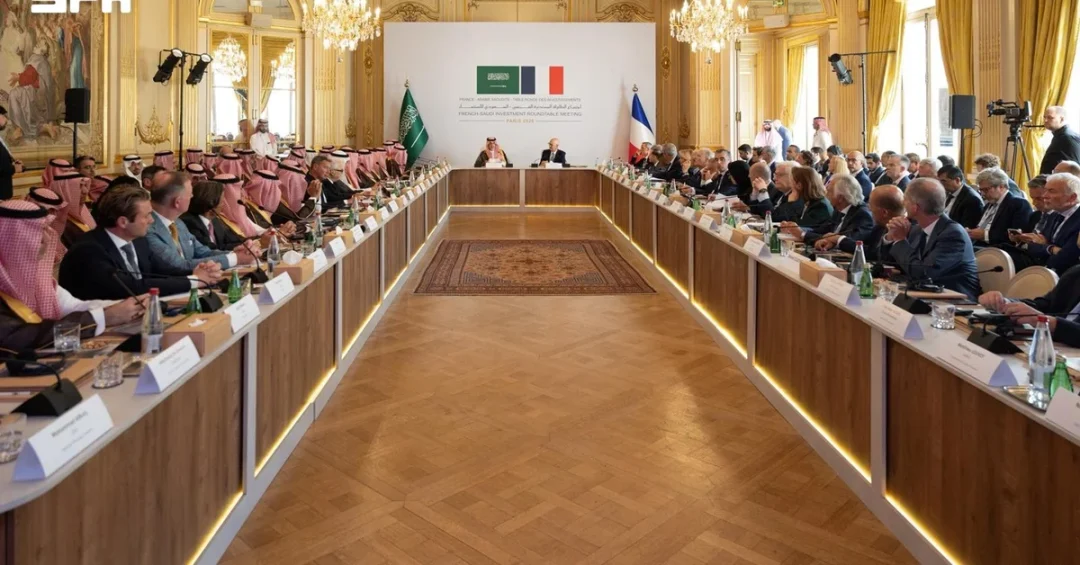
The French-Saudi Investment Roundtable Meeting was held in Paris on August 24, 2026, bringing together senior government officials, business leaders, and CEOs from major companies from both the Kingdom of Saudi Arabia and the French Republic. The event, organized by the Ministry of Investment, is part of the official visit of Crown Prince Mohammed bin Salman bin Abdulaziz Al Saud to France.
Context and Background
The meeting serves as a bridge of the centennial Saudi-French relations. Saudi Minister of Investment Fahad bin Abduljalil Al-Saif highlighted the alignment between French capabilities in technology, industry, finance, and innovation with the ambitions of Saudi Vision 2030, which has catalyzed substantial investment flows.
The Saudi economy has grown by around 85% since 2017, reaching €1.1 trillion, with non-oil activities now contributing over 50% of GDP, underscoring the success of diversification efforts.
Key Details
Minister Al-Saif reported that French foreign direct investment (FDI) stock in Saudi Arabia reached €16.3 billion in 2024, more than doubling over five years, making France the fourth-largest source of FDI. Additionally, French investors hold more than 650 investment licenses across 18 sectors, including energy, financial services, and digital infrastructure.
The Minister also pointed to the strong inflows of about €6.1 billion in Q1 2026, up 2.4% year-on-year, and emphasized the opportunities in gaming, where revenue per player is 7% higher than the global average. The Regional Headquarters (RHQ) Program has attracted 750 companies, including 39 French firms.
French Minister of the Economy and Finance Roland Lescure underscored the partnership’s strategic depth, highlighting energy and logistics security. He called Saudi Arabia a reliable partner and a vital link between the Middle East and Europe, and noted the alignment between Vision 2030 and France 2030, and the opening of the Public Investment Fund’s office in Paris.
Implications and Impact
The meeting included dialogues on financing transformative projects, industrial partnerships, transport and logistics integration, and building the digital future through AI. These discussions are set to advance tangible investments and deeper private-sector cooperation.
The Saudi Exchange, the largest and most liquid stock market in the MENA region, remains open to all foreign investors, offering attractive opportunities. The Kingdom’s ongoing legislative reforms, including the offshore financial activities, further enhance its appeal as a regional hub.
Vision 2030 Alignment
As Vision 2030 enters its final phase, this roundtable demonstrates Saudi Arabia’s commitment to forging global partnerships that drive economic diversification. By aligning French strengths with the Kingdom’s strategic priorities, the meeting contributes to the realization of Vision 2030’s goals and cements Saudi Arabia’s role as a key player in the global economy.
20 Questions
Q1. What was the purpose of the French-Saudi Investment Roundtable Meeting?
A1. The meeting aimed to strengthen the long-term partnership between Saudi Arabia and France, focusing on investment opportunities in sectors aligned with Vision 2030, and to transform bilateral dialogues into concrete joint projects.
Q2. Who organized the roundtable?
A2. The roundtable was organized by the Ministry of Investment of Saudi Arabia, under the patronage of Crown Prince Mohammed bin Salman, and it assembled key government officials and business leaders from both countries to discuss strategic investment cooperation.
Q3. What is the current French FDI stock in Saudi Arabia?
A3. As of 2024, the stock of French direct investment in Saudi Arabia reached €16.3 billion, doubling in five years, making France the fourth-largest source of foreign direct investment in the Kingdom.
Q4. How many investment licenses do French investors hold?
A4. French investors currently hold more than 650 investment licenses in Saudi Arabia, spanning 18 sectors including energy, financial services, and advanced manufacturing, which reflects a broad and diverse engagement.
Q5. How much has Saudi Arabia’s GDP grown since 2017?
A5. Saudi Arabia’s GDP has grown by approximately 85% since 2017, rising from around €620 billion to €1.1 trillion, driven by reforms under Vision 2030.
Q6. What share of GDP now comes from non-oil activities?
A6. Non-oil activities account for more than 50% of Saudi Arabia’s GDP, indicating a major shift in the economy and the positive impact of diversification policies.
Q7. What were the FDI inflows in Q1 2026?
A7. Foreign direct investment inflows in Q1 2026 were about €6.1 billion, up 2.4% year-on-year, showing continued investor confidence and a resilient investment climate.
Q8. Which sectors offer significant investment potential for French companies?
A8. Sectors with high potential include energy, financial services, digital infrastructure, advanced manufacturing, transport and logistics, gaming and tourism, which aligns with France’s industrial capabilities and Vision 2030 goals.
Q9. What did the French Minister of Economy and Finance emphasize?
A9. He emphasized the strategic partnership, focusing on energy and logistics security, and described Saudi Arabia as a vital link between the Middle East and Europe, underpinning their shared stability.
Q10. What is the shared goal for bilateral trade?
A10. The two countries aim to increase bilateral trade to $12 billion, as a milestone to further deepen their economic and investment ties.
Q11. How many companies have joined the RHQ Program?
A11. The Regional Headquarters Program has attracted more than 750 companies, including 39 French firms, positioning Saudi Arabia as a central hub for businesses seeking to operate in the region.
Q12. What is the number of French companies in the RHQ program?
A12. There are 39 French companies that have joined the RHQ program, operating across eight sectors, and they are using Saudi Arabia as a base to manage their regional operations.
Q13. What were the four strategic dialogue areas?
A13. The dialogues focused on financing transformative destinations, industrial partnerships, transport and logistics integration, and building the digital future through AI and digital infrastructure.
Q14. Why is the Saudi Exchange important?
A14. The Saudi Exchange is the largest and most liquid stock market in the Middle East and North Africa, open to all foreign investors, providing a robust platform for listing and investment in the region.
Q15. What did the investment minister say about the gaming sector?
A15. He noted that average revenue per player in Saudi gaming is about 7% above global and 4.5 times the Middle East average, indicating a thriving, young market for gaming and esports.
Q16. How does the financial sector support cooperation?
A16. The financial sector is being deepened and broadened, with the main market open to all foreign investors, supporting growth in financial services and insurance, and enabling further mergers and acquisitions.
Q17. What is the role of the Public Investment Fund’s office in Paris?
A17. The office symbolizes the reciprocal investment effort, facilitating Saudi investment in France and easing the process for French investors to engage with Saudi opportunities.
Q18. How does the roundtable align with Vision 2030?
A18. It aligns by attracting foreign investment into strategic sectors, supporting economic diversification, and strengthening Saudi Arabia’s position as a global investment destination.
Q19. What is the outlook for French-Saudi cooperation?
A19. The outlook is positive, with opportunities for cross-investment and joint ventures in the sectors identified, driven by mutual alignment of strategic interests and Vision 2030’s ambitious targets.
Q20. What was the main message of the French minister?
A20. He stressed that Saudi Arabia is a reliable partner, and the partnership has evolved from simple sales to joint production, with shared goals for energy security and economic prosperity.
Reader Feedback
We value your thoughts. Please share your feedback on this article.
Your feedback helps us improve our coverage.