


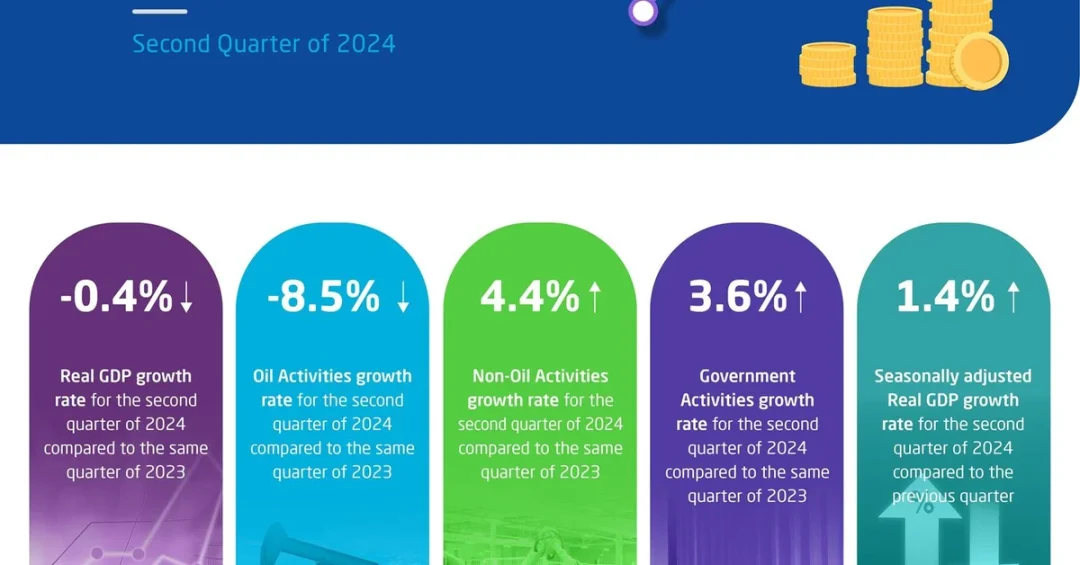
The General Authority for Statistics (GASTAT) released its real GDP Flash Estimates Publication for the second quarter of 2024 on July 31, reporting a 4.4% growth in non-oil activities. The data, issued by the Kingdom’s official statistical agency, also showed a 3.6% increase in government activities compared to the same period in 2023. While overall real GDP contracted by 0.4% year-on-year—primarily due to an 8.5% decline in oil-related activities—the figures underscore Saudi Arabia’s ongoing economic diversification efforts.
Context and Background
The latest GASTAT figures come as the Kingdom continues to implement sweeping reforms under Vision 2030, aimed at reducing dependence on oil revenues and building a resilient, knowledge-based economy. The 4.4% growth in non-oil activities signals steady progress in sectors such as tourism, logistics, manufacturing, and financial services. The decline in oil activities aligns with global production adjustments coordinated within OPEC+ to stabilize energy markets, a common factor affecting oil-dependent economies worldwide.
Key Details
GASTAT’s publication provides a comprehensive snapshot of Saudi economic performance during Q2 2024. Seasonally adjusted real GDP increased by 1.4% compared to the first quarter of 2024, indicating positive momentum over the short term. The 4.4% growth in non-oil activities and 3.6% growth in government spending highlight the effectiveness of fiscal policies and investment initiatives. The Saudi Press Agency (SPA), which reported the data, emphasized the role of official statistical transparency in supporting informed decision-making.
Implications and Impact
These results reinforce Saudi Arabia’s position as a leading non-oil economy in the Middle East, even as global oil markets face fluctuations. The robust non-oil performance supports the creation of jobs under the Saudi Vision 2030 Employment Strategy and attracts foreign investment by demonstrating economic stability beyond hydrocarbons. Regional economies may look to these figures as a benchmark for diversification, while international observers gain confidence in the Kingdom’s fiscal resilience.
Vision 2030 Alignment
The continued growth in non-oil activities directly aligns with Vision 2030’s core objectives of building a sustainable, diversified economy. By investing in non-oil sectors and enhancing government efficiency, Saudi Arabia is reducing its vulnerability to oil price volatility. As the Kingdom progresses toward targets such as raising the non-oil export share and expanding the private sector’s contribution to GDP, quarterly reports like this one serve as measurable milestones, ensuring the nation remains on track to achieve its long-term ambitions.
20 Questions
Q1. What does GASTAT stand for?
A1. GASTAT stands for the General Authority for Statistics, the Saudi government agency responsible for producing and publishing official economic and demographic statistics.
Q2. When were the Q2 2024 GDP Flash Estimates released?
A2. The estimates were released on July 31, 2024, according to the Saudi Press Agency (SPA).
Q3. How much did non-oil activities grow in Q2 2024?
A3. Non-oil activities grew by 4.4% compared to the same quarter in 2023.
Q4. What was the growth rate for government activities?
A4. Government activities grew by 3.6% during the same period.
Q5. Did the overall real GDP grow in Q2 2024?
A5. No, real GDP shrank by 0.4% compared to Q2 2023.
Q6. Why did real GDP decline?
A6. The decline was mainly due to an 8.5% drop in oil-related activities.
Q7. What happened to seasonally adjusted GDP between Q1 and Q2 2024?
A7. Seasonally adjusted real GDP increased by 1.4% from the first quarter.
Q8. What is Vision 2030?
A8. Vision 2030 is Saudi Arabia’s strategic framework to reduce oil dependence, diversify the economy, and develop public service sectors.
Q9. How do these figures support Vision 2030?
A9. The growth in non-oil activities reflects progress in economic diversification, a core Vision 2030 goal.
Q10. Which sectors drove non-oil growth?
A10. Likely sectors include tourism, logistics, manufacturing, and financial services, though GASTAT provides detailed breakdowns in full publications.
Q11. What is a Flash Estimates Publication?
A11. It is an early release of key GDP data, providing timely insights before full quarterly accounts.
Q12. How does the oil sector decline affect the economy?
A12. The decline is linked to OPEC+ production adjustments, but non-oil growth offsets some impact on overall GDP.
Q13. Who reported these statistics?
A13. The figures were reported by the Saudi Press Agency (SPA), citing GASTAT data.
Q14. Is this data considered reliable?
A14. Yes, GASTAT follows international statistical standards, ensuring accuracy and transparency.
Q15. What does seasonally adjusted mean?
A15. Seasonal adjustment removes regular seasonal patterns to show underlying economic trends.
Q16. How does this compare to other countries?
A16. Many oil-exporting nations face similar challenges, but Saudi Arabia’s non-oil growth is relatively strong.
Q17. What is the role of the Saudi Press Agency?
A17. SPA is the official news agency that disseminates government announcements, including economic data.
Q18. Can these estimates be revised?
A18. Yes, flash estimates are preliminary and may be updated in later publications.
Q19. What is the significance of government activities growth?
A19. Growth in government activities indicates increased public spending and investment, supporting economic stability.
Q20. Where can I find more details?
A20. More details are available in the full GASTAT publication on its official website.
Reader Feedback
We value your thoughts. Please share your feedback on this article.
Your feedback helps us improve our coverage.