


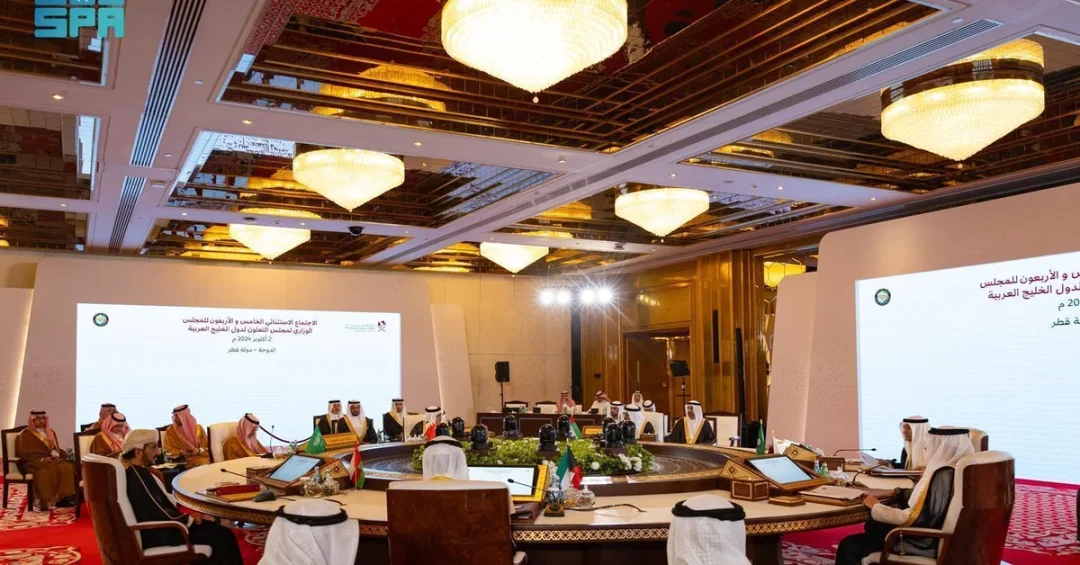
Doha, October 3, 2024 — The Gulf Cooperation Council (GCC) Ministerial Council held its 45th extraordinary meeting on Wednesday, October 2, 2024, in Doha, Qatar, to address the escalating military tensions and developments in the Middle East region. The meeting was chaired by Shaikh Mohammed bin Abdulrahman bin Jassim Al Thani, Prime Minister and Minister of Foreign Affairs of the State of Qatar and President of the current session of the Council. Participants included Prince Faisal bin Farhan bin Abdullah Al Saud, Minister of Foreign Affairs of the Kingdom of Saudi Arabia, alongside other GCC foreign ministers and the GCC Secretary General, Jasem Mohamed Albudaiwi.
Context and Background
The extraordinary session was convened in response to serious security threats across the region, including the situation in the sisterly Republic of Lebanon, the Gaza Strip, violations in the West Bank, threats to the Al Aqsa Mosque, and tensions between Israel and Iran. The Council condemned the escalation in Lebanese and Palestinian territories, warning that these developments endanger international peace and security, undermining efforts for stability in the region and the world.
Key Details and Diplomatic Stances
The Ministerial Council emphasized the necessity of protecting regional security and preventing the expansion of the conflict. It called on all parties to exercise restraint, cease violence, and prioritize dialogue. The Council urged the international community to fulfill its responsibilities in maintaining security and stability, implementing international legitimacy resolutions. Regarding Lebanon, the GCC affirmed support for the Lebanese people, calling for intensified international and regional efforts to provide urgent humanitarian assistance and urging restraint to avoid involvement in regional conflicts.
The Council stressed the need to implement UN Security Council Resolution 1701, related international resolutions, and the Taif Agreement to restore lasting security in Lebanon. It underscored the joint ministerial statement issued on September 25, 2024, by the UAE, Saudi Arabia, Qatar, the United States, and others, calling for an immediate 21-day ceasefire along the Blue Line. The Council also welcomed the September 27, 2024, statement from the emergency ministerial meeting of the Arab League and the Organisation of Islamic Cooperation (OIC).
Implications for Palestine and Regional Stability
On Palestine, the Ministerial Council condemned Israeli aggression against Gaza and the West Bank, calling for an immediate and permanent ceasefire, lifting the blockade on Gaza, and releasing hostages and detainees. It emphasized the importance of opening all crossings for humanitarian aid delivery in accordance with international law. The Council reiterated the joint statement by the Amir of Qatar, the President of Egypt, and the U.S. President from August 8, 2024, urging a ceasefire and renewed negotiations. It also praised the constructive role of GCC countries with strategic partners, especially the United States, in de-escalating tensions and protecting maritime navigation.
The Council called on the Security Council to implement resolutions 2735, 2712, and 2720 for a complete ceasefire and humanitarian aid distribution. It emphasized the efforts of the Ministerial Committee chaired by the Kingdom of Saudi Arabia, formed by the extraordinary joint Arab-Islamic summit, to stop Israeli aggression and mobilize international support for Palestine, including its bid for full UN membership and the convening of an international peace conference.
Vision 2030 Alignment
The Ministerial Council’s statements align with Saudi Arabia’s Vision 2030 by reinforcing the Kingdom’s leadership in promoting regional stability, economic security, and multilateral diplomacy. The GCC’s coordinated response underscores the shared commitment to de-escalation and dialogue, which are essential for fostering a secure environment conducive to long-term development and prosperity. Saudi Arabia’s role in chairing the Ministerial Committee and supporting the two-state solution reflects its dedication to international peace and the realization of the Palestinian state, contributing to a stable and cooperative Middle East that benefits all nations.
20 Questions
Q1. What was the 45th extraordinary meeting of the GCC Ministerial Council?
A1. It was an emergency session held on October 2, 2024, in Doha, Qatar, to discuss the military escalation and security developments in the Middle East region.
Q2. Who chaired the meeting?
A2. Shaikh Mohammed bin Abdulrahman bin Jassim Al Thani, Prime Minister and Minister of Foreign Affairs of Qatar and President of the current session of the Council, chaired the meeting.
Q3. Which Saudi official participated in the meeting?
A3. Prince Faisal bin Farhan bin Abdullah Al Saud, Minister of Foreign Affairs of the Kingdom of Saudi Arabia, participated in the meeting.
Q4. What was the main focus of the meeting?
A4. The meeting reviewed serious developments and escalating tensions undermining regional security, including situations in Lebanon, Gaza, the West Bank, and threats to religious sanctities.
Q5. Did the Council condemn any actions?
A5. Yes, the Council condemned the escalation in Lebanese and Palestinian territories and warned of its serious repercussions for international peace and security.
Q6. What did the Council call on all parties to do?
A6. The Council called on all parties to exercise restraint, cease violence, and prioritize dialogue to prevent the expansion of the conflict.
Q7. How did the Council address the situation in Lebanon?
A7. The Council affirmed GCC support for the Lebanese people, called for urgent humanitarian assistance, and urged restraint to avoid involvement in regional conflicts.
Q8. What resolution did the Council stress for Lebanon?
A8. The Council stressed the implementation of UN Security Council Resolution 1701, along with related international resolutions and the Taif Agreement, to restore stability in Lebanon.
Q9. What was the September 25, 2024, joint ministerial statement about?
A9. It called for an immediate 21-day ceasefire along the Blue Line and a diplomatic settlement to avert regional war, issued by UAE, Saudi Arabia, Qatar, the US, and others.
Q10. What did the Council welcome from September 27, 2024?
A10. The Council welcomed the statement from the emergency ministerial meeting of the Arab League and OIC regarding Israeli military attacks on Palestine and Lebanon.
Q11. What position did the Council take on Gaza?
A11. The Council condemned Israeli aggression, called for an immediate and permanent ceasefire, lifting the blockade, and releasing hostages and detainees.
Q12. What did the Council say about humanitarian aid to Gaza?
A12. It emphasized opening all crossings immediately and unconditionally for the delivery of relief, medical supplies, and basic needs according to international humanitarian law.
Q13. What joint statement from August 8, 2024, was reiterated?
A13. The statement by the Amir of Qatar, the President of Egypt, and the U.S. President called for a ceasefire, hostage release, and resumption of negotiations.
A14. The Council praised the GCC countries’ role with strategic partners, especially the US, in de-escalating tensions and protecting maritime navigation.
Q15. What UN Security Council resolutions did the Council call for?
A15. The Council called for implementation of resolutions 2735, 2712, and 2720, which demand an immediate ceasefire and humanitarian aid distribution in Gaza.
Q16. What is the role of the Ministerial Committee chaired by Saudi Arabia?
A16. Formed by the extraordinary Arab-Islamic summit, it works to stop Israeli aggression, mobilize support for Palestine, and support its bid for full UN membership.
Q17. What did the Council welcome regarding UNRWA?
A17. The Council welcomed the outcomes of the September 26, 2024, meeting to support UNRWA, underscoring the importance of aiding the agency for Palestinian humanitarian needs.
Q18. What is the Council’s stance on the Palestinian issue?
A18. The Council reaffirmed the centrality of the issue, called for ending Israeli occupation, and supported an independent Palestinian state with East Jerusalem as capital.
Q19. What is the Global Alliance for the Implementation of the Two-state Solution?
A19. It is an initiative launched by the Ministerial Committee chaired by Saudi Arabia, in collaboration with Norway and the EU, to realize a Palestinian state under UN resolutions.
Q20. What was the final warning from the Council?
A20. The Council reiterated its warning about escalating tensions and their serious implications for regional and international peace, urging de-escalation and restraint to prevent further instability.
Reader Feedback
We value your thoughts. Please share your feedback on this article.
Your feedback helps us improve our coverage.