


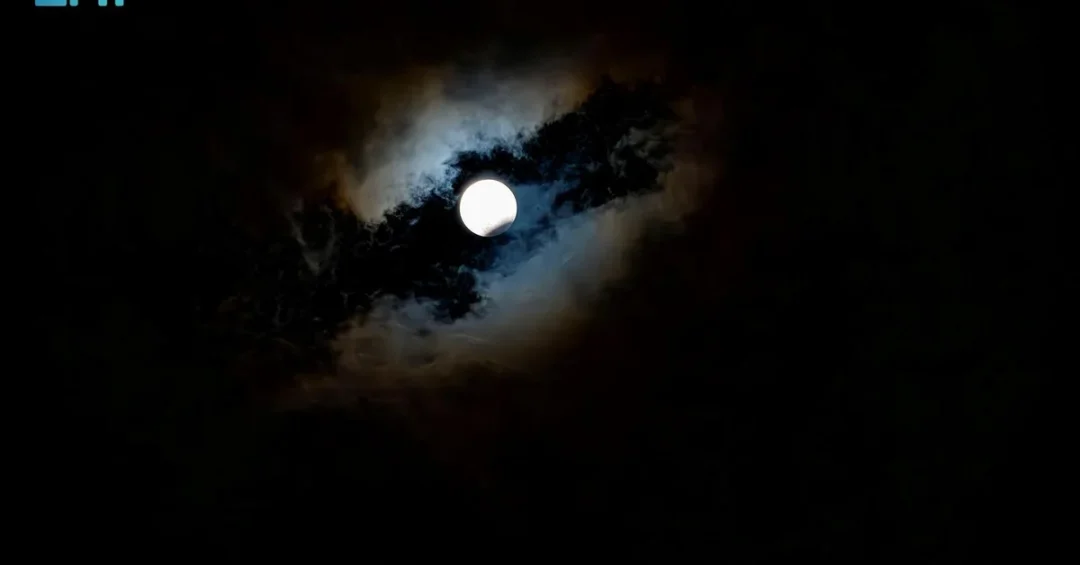
A partial lunar eclipse will be visible across Saudi Arabia’s skies on Wednesday morning, September 18, 2024, according to an announcement by the Jeddah Astronomy Society. The celestial event, the only lunar eclipse visible locally this year, will begin at 5:12 AM Saudi time and last for one hour and three minutes. Director of the Jeddah Astronomy Society, Engineer Majed Abu Zahra, confirmed that the phenomenon will be observable with the naked eye across the Kingdom and in many parts of the world, including Europe, Asia, Africa, and the Americas.
Context and Background
Lunar eclipses occur when the Earth passes between the Sun and the Moon, casting its shadow on the lunar surface. This partial eclipse will see approximately 3.9 percent of the Moon’s surface covered by Earth’s shadow at its peak at 5:44 AM. The event coincides with the Moon being at perigee—its closest point to Earth—making it appear 6.7 percent larger than average, a phenomenon often called a supermoon. Additionally, because it occurs near the autumn equinox, it is also referred to as a harvest moon.
Key Details
Engineer Abu Zahra explained that the eclipse will begin simultaneously across all regions of Saudi Arabia as the full moon enters Earth’s shadow. “The moon will then traverse from west to east in Earth’s shadow, following its natural orbital path,” he said. After the peak, the moon will set in conjunction with sunrise in various parts of the Kingdom, potentially appearing reddish-copper or orange due to atmospheric effects rather than the eclipse itself. Unlike solar eclipses, lunar eclipses pose no risk to the eyes, and no special precautions are necessary. Binoculars or a small telescope can enhance the viewing experience.
Implications and Impact
The announcement reinforces Saudi Arabia’s role in promoting scientific awareness and astronomical observation. The Jeddah Astronomy Society, a respected scientific body, regularly issues detailed forecasts of celestial events, supporting both public education and the Kingdom’s growing interest in space sciences. The visibility of the eclipse across multiple continents also highlights Saudi Arabia’s geographic position as a hub for such observations, contributing to global scientific engagement. This aligns with the Kingdom’s broader efforts to foster STEM education and scientific literacy among its citizens and residents.
Vision 2030 Alignment
This announcement reflects Saudi Arabia’s commitment to advancing scientific knowledge and public engagement under Vision 2030. By supporting institutions like the Jeddah Astronomy Society and encouraging interest in space phenomena, the Kingdom is building a knowledge-based economy that values innovation and education. Such initiatives inspire future generations to pursue careers in science and technology, directly contributing to the nation’s long-term goals of diversifying the economy and enhancing quality of life in line with the Saudi people’s aspirations.
20 Questions
Q1. What is a partial lunar eclipse?
A1. A partial lunar eclipse occurs when only a portion of the Moon enters Earth’s shadow, causing part of its surface to appear darkened. It is a natural celestial event.
Q2. When will the partial lunar eclipse be visible in Saudi Arabia?
A2. The eclipse will be visible on Wednesday morning, September 18, 2024, starting at 5:12 AM Saudi time and lasting until 6:15 AM.
Q3. Who announced the details of this eclipse?
A3. The Jeddah Astronomy Society, under the direction of Engineer Majed Abu Zahra, announced the timing and visible regions for the partial lunar eclipse.
Q4. What percentage of the Moon will be covered during the eclipse?
A4. At the eclipse’s maximum at 5:44 AM, approximately 3.9 percent of the Moon’s surface will be covered by Earth’s shadow.
Q5. Why is this eclipse also called a supermoon?
A5. The Moon is at perigee during the eclipse, meaning it is closest to Earth. This makes it appear 6.7 percent larger than average, earning the supermoon label.
Q6. What is a harvest moon?
A6. The harvest moon is the full moon closest to the autumn equinox. This eclipse coincides with that timing, hence it is also called a harvest moon.
Q7. Can this eclipse be seen without special equipment?
A7. Yes, the partial lunar eclipse can be easily observed with the naked eye. No special equipment is necessary, though binoculars can enhance the view.
Q8. Is there any risk to the eyes during a lunar eclipse?
A8. No, lunar eclipses are safe to watch directly without eye protection. Unlike solar eclipses, they pose no risk to vision.
Q9. What will the moon look like during the eclipse?
A9. The moon may appear reddish-copper or orange near the horizon due to atmospheric scattering, not directly because of the eclipse itself.
Q10. Which regions globally will see the eclipse?
A10. The eclipse will be visible across Europe, much of Asia, Africa, North and South America, the Pacific, Atlantic, Indian Oceans, the Arctic, and Antarctica.
Q11. How long will the partial lunar eclipse last?
A11. The partial eclipse will last for one hour and three minutes, from 5:12 AM to 6:15 AM Saudi time.
Q12. Is this the only lunar eclipse visible in Saudi Arabia in 2024?
A12. Yes, according to the Jeddah Astronomy Society, this is the only local lunar eclipse of 2024 visible from Saudi Arabia.
Q13. What direction will the moon move during the eclipse?
A13. The moon will traverse from west to east in Earth’s shadow, following its natural orbital path around the planet.
Q14. What happens after the peak of the eclipse?
A14. After the peak, the moon will set in conjunction with sunrise in various regions of Saudi Arabia, gradually emerging from Earth’s shadow.
Q15. Why does the moon appear reddish during the eclipse?
A15. The reddish appearance is due to atmospheric effects scattering shorter wavelengths of light, similar to sunrises and sunsets, not solely the eclipse.
Q16. Does the Jeddah Astronomy Society often announce such events?
A16. Yes, the society regularly updates the public on celestial events, supporting scientific education and observation in Saudi Arabia.
Q17. How does this eclipse relate to Vision 2030?
A17. The announcement promotes scientific literacy and public engagement, reflecting Vision 2030’s goal of building a knowledge-based economy and inspiring innovation.
Q18. Can children observe the eclipse safely?
A18. Yes, children can observe the eclipse safely with the naked eye or binoculars, as lunar eclipses are entirely safe to view without precautions.
Q19. What is the role of the Jeddah Astronomy Society in Saudi Arabia?
A19. The society is a leading scientific body that conducts research, education, and public outreach, enhancing awareness of astronomy and space sciences in the Kingdom.
Q20. Will the eclipse be visible from other parts of the Middle East?
A20. Yes, the eclipse will also be visible across many parts of Asia, including the Middle East, at the same time as in Saudi Arabia.
Reader Feedback
We value your thoughts. Please share your feedback on this article.
Your feedback helps us improve our coverage.