


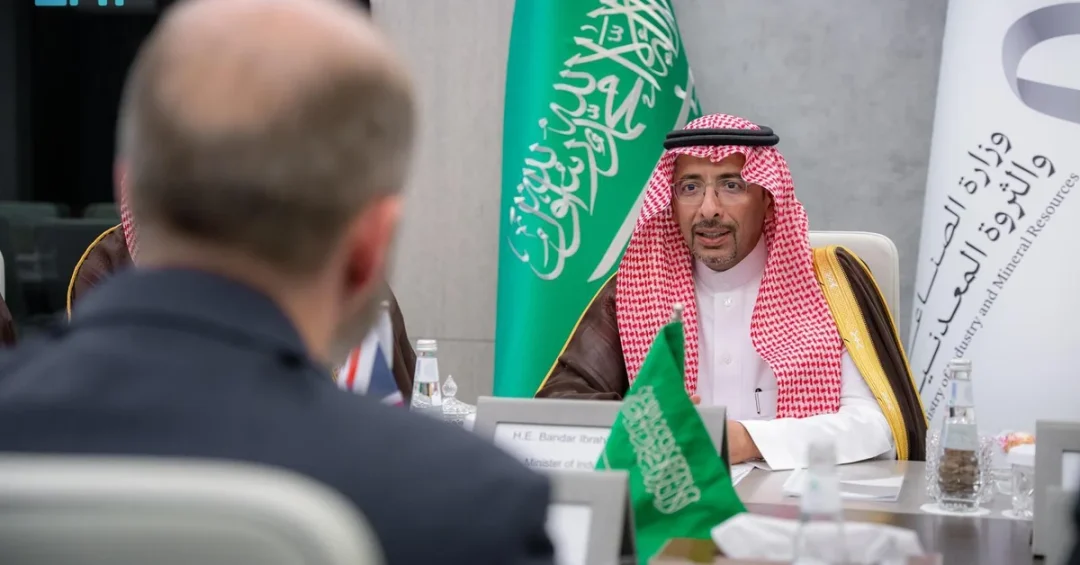
Saudi Arabia’s Minister of Industry and Mineral Resources, Bandar Alkhorayef, met with UK Secretary of State for Business and Trade Jonathan Reynolds in Riyadh on September 17, 2024, to advance bilateral industrial and mining cooperation. The discussions, reported by the Saudi Press Agency (SPA), focused on expanding economic ties between the two nations, particularly in the industrial and mining sectors, and encouraging British investment in the Kingdom’s growing economy.
Context and Background
The meeting reflects the long-standing economic partnership between Saudi Arabia and the United Kingdom, a relationship that has deepened in recent years under the framework of the UK-Saudi Strategic Partnership Council. Both countries are exploring avenues to strengthen trade and investment flows, with the UK seeking to diversify its economic ties and Saudi Arabia aiming to attract foreign capital as part of its Vision 2030 reforms. The talks also come amid global shifts toward sustainable supply chains and energy transition, where Saudi Arabia is positioning itself as a key hub for critical minerals and advanced manufacturing.
Key Details
During the meeting, Minister Alkhorayef and Secretary Reynolds discussed promising investment opportunities for British companies in Saudi Arabia’s industrial and mining sectors. The Kingdom offers competitive advantages, including abundant natural resources, advanced infrastructure, and a diverse energy mix, which are attractive to international investors. A major point of dialogue was enhancing cooperation in critical minerals, which are vital for global energy transition technologies and advanced industries such as aviation, electric vehicles, and medical devices. Both sides explored future expansion opportunities in this area, underscoring its strategic importance.
International Impact
The strengthened UK-Saudi partnership has significant regional and global implications. By fostering collaboration in critical minerals and industrial development, the two countries are contributing to more resilient and diversified supply chains. This aligns with broader international efforts to reduce dependency on single sources for key materials and to promote sustainable economic growth. For British investors, Saudi Arabia’s stable investment environment and ambitious Vision 2030 projects present a gateway to markets in the Middle East and beyond.
Vision 2030 Alignment
This meeting reinforces Saudi Arabia’s commitment to Vision 2030, which aims to transform the Kingdom into a global industrial and logistics hub while diversifying its economy away from oil. By attracting British expertise and capital, Saudi Arabia accelerates the development of its mining and industrial sectors, particularly in critical minerals, which are essential for future industries. Such partnerships exemplify the Kingdom’s forward-looking approach to building a sustainable and prosperous economy that benefits both Saudi citizens and international partners.
20 Questions
Q1. Who met with the UK Secretary of State for Business and Trade?
A1. Saudi Arabia’s Minister of Industry and Mineral Resources, Bandar Alkhorayef, met with UK Secretary of State for Business and Trade Jonathan Reynolds.
Q2. Where did the meeting take place?
A2. The meeting occurred in Riyadh, Saudi Arabia, on September 17, 2024.
Q3. What was the main purpose of the meeting?
A3. The main purpose was to discuss opportunities to boost industrial and mining cooperation between Saudi Arabia and the UK.
Q4. Which sectors were the focus of discussions?
A4. The discussions focused on the industrial and mining sectors, with special attention to critical minerals.
Q5. Why are critical minerals important?
A5. Critical minerals are vital for energy transition technologies and advanced industries like aviation, electric vehicles, and medical devices.
Q6. How does the meeting relate to Vision 2030?
A6. It aligns with Vision 2030 by supporting economic diversification and positioning Saudi Arabia as a global industrial hub.
Q7. What competitive advantages does Saudi Arabia offer investors?
A7. The Kingdom offers abundant natural resources, advanced infrastructure, and a diverse energy mix.
Q8. What is the UK-Saudi Strategic Partnership Council?
A8. It is a framework that deepens cooperation in trade, investment, and other strategic areas between the two nations.
Q9. How might British companies benefit from this partnership?
A9. British companies can capitalize on promising investment opportunities in Saudi industrial and mining sectors.
Q10. Did the meeting include discussions on future expansion?
A10. Yes, both sides explored opportunities for future expansion in critical minerals and industrial cooperation.
Q11. What role does Saudi Arabia play in global supply chains?
A11. Saudi Arabia is positioning itself as a key hub for critical minerals and advanced manufacturing.
Q12. Is energy transition a factor in these talks?
A12. Yes, critical minerals are essential for energy transition, making this a key topic in the discussions.
Q13. What industries benefit from critical minerals?
A13. Industries like aviation, electric vehicles, and medical technology rely on critical minerals.
Q14. How does the meeting support economic diversification?
A14. It attracts foreign investment, reducing reliance on oil and boosting non-oil sectors.
Q15. What is the significance of the meeting’s timing?
A15. It occurs amid global shifts toward sustainable supply chains and energy transition.
Q16. Who reported on the meeting?
A16. The meeting was reported by the Saudi Press Agency (SPA).
Q17. What is the tone of the discussion?
A17. The discussion was positive and forward-looking, emphasizing mutual benefits.
Q18. Does this meeting create new trade opportunities?
A18. Yes, it opens new avenues for trade and investment between the two countries.
Q19. How does this affect Saudi Arabia’s global role?
A19. It strengthens Saudi Arabia’s global role as a reliable partner in industrial development.
Q20. What is the next step after this meeting?
A20. Both sides are expected to follow up on specific investment opportunities and agreements discussed.
Reader Feedback
We value your thoughts. Please share your feedback on this article.
Your feedback helps us improve our coverage.