
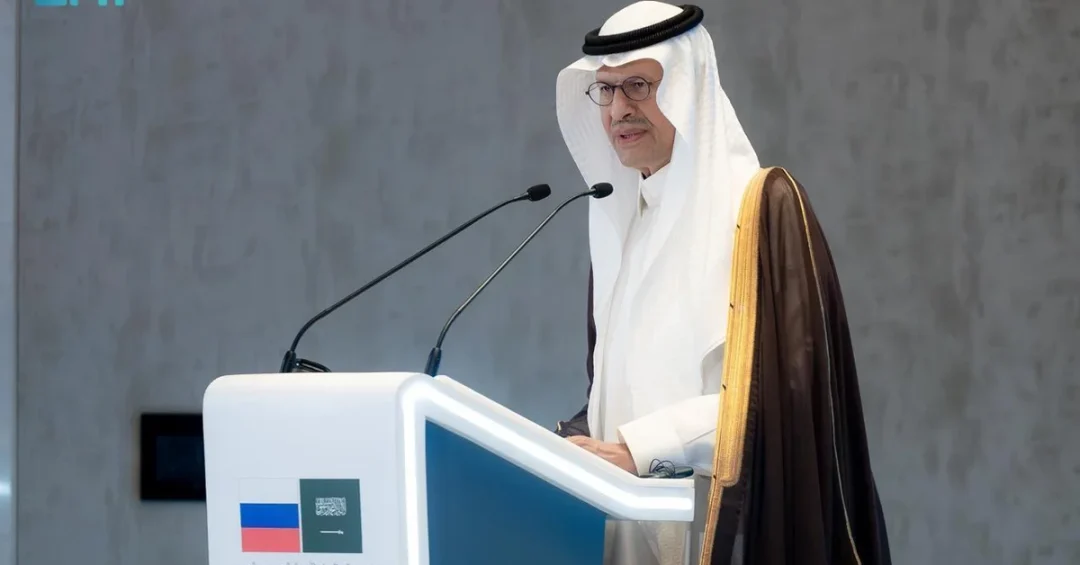
Riyadh, December 1, 2025: Saudi Arabia’s Minister of Energy Prince Abdulaziz bin Salman bin Abdulaziz and Russian Deputy Prime Minister Alexander Novak inaugurated the Saudi-Russian Investment and Business Forum in Riyadh, launching a new phase of economic and climate cooperation between the two countries. The event, held under the co-chairmanship of the leaders of the Saudi-Russian Joint Commission, featured senior officials, experts, and investors, and yielded agreements on climate collaboration, visa facilitation, and archival exchange, according to the Saudi Press Agency (SPA).
Context and Background
The forum was organized by the Kingdom’s Ministry of Energy and Ministry of Investment, with the participation of the Ministry of Foreign Affairs. The gathering brought together public- and private-sector stakeholders to identify new avenues for trade and investment and to deepen sectoral partnerships. The presence of Foreign Minister Prince Faisal bin Farhan bin Abdullah underscored the strategic weight of the meeting within Saudi Arabia’s international economic diplomacy.
As co-chairs of the Saudi-Russian Joint Commission, Prince Abdulaziz bin Salman bin Abdulaziz and Alexander Novak emphasized practical collaboration across energy, industry, technology, and climate-related solutions. The forum format enabled direct exchanges between regulators, businesses, and financiers from both countries, providing a platform to align policy objectives with commercial opportunities in a manner consistent with Saudi Arabia’s long-term economic transformation.
Key Details
On the sidelines of the forum, the two sides signed a memorandum of understanding (MoU) on cooperation in climate change and low-greenhouse-gas-emissions development between the Saudi Ministry of Energy and the Russian Ministry of Economic Development. The MoU establishes a framework for joint action to advance the goals and principles of the United Nations Framework Convention on Climate Change (UNFCCC) and the Paris Agreement, serving the mutual interests of both countries and strengthening their partnership. It covers technologies and solutions related to mitigation, including exploring opportunities in greenhouse gas emissions reduction, abatement, and removal activities, as well as improving energy efficiency.
In a separate development, Saudi Arabia and Russia concluded an agreement on a mutual visa waiver to streamline travel between the two nations. The agreement was signed on behalf of the Kingdom by Prince Faisal bin Farhan bin Abdullah, Minister of Foreign Affairs, and on behalf of the Russian Federation by Alexander Novak. The measure is positioned to facilitate mobility for business delegations, investors, and technical experts, supporting the growth of bilateral projects and exchanges.
Further reinforcing cultural and knowledge cooperation, the King Abdulaziz Foundation for Research and Archives (Darah) signed an agreement with the Federal Archival Agency of the Russian Federation. The accord encompasses the exchange of information, the organization of symposia, forums, and exhibitions, the sharing of publications and related materials, and reciprocal visits and expertise. It was signed by Darah CEO Turki bin Mohammed Al-Shuwaier and Minister of State and Deputy Head of the Federal Archival Agency Andrey Yurasov, expanding institutional links that support research and public history.
Implications and Impact
The Riyadh forum positions Saudi Arabia and Russia to accelerate collaboration in pragmatic climate solutions within an internationally recognized framework. By anchoring cooperation in UNFCCC and Paris Agreement principles, the MoU provides a structured pathway for knowledge exchange, pilot initiatives, and scalable programs focused on emissions reduction, removal, and energy efficiency. This approach complements Saudi Arabia’s leadership in energy systems, enabling advances that can enhance industrial competitiveness, improve energy performance, and support lower-emissions growth trajectories.
The mutual visa waiver is expected to reduce administrative hurdles for cross-border engagement, providing a boost to investment missions, supply-chain coordination, and scientific and academic exchanges. Easier mobility often correlates with stronger deal flow and faster project execution, particularly in complex industrial sectors. In parallel, the archival cooperation agreement deepens cultural and scholarly ties, supporting joint curation, preservation, and dissemination of historical materials. Such institutional partnerships contribute to people-to-people connectivity and strengthen the foundations of long-term bilateral relations.
Regionally and internationally, the outcomes of the forum signal Saudi Arabia’s continued role as a convening economy and a reliable partner for constructive engagement. By aligning climate cooperation with practical industrial measures and by facilitating travel and knowledge sharing, the Kingdom is helping to build resilient channels for collaboration that bridge government policy, private-sector implementation, and cultural understanding.
Vision 2030 Alignment
These developments advance the Kingdom’s Vision 2030 objectives by reinforcing economic diversification, enhancing the investment environment, and supporting the transition to lower-emissions technologies. The climate MoU complements national efforts to drive innovation in energy efficiency and emissions mitigation, while the visa waiver directly supports tourism, business mobility, and talent attraction. The archival partnership contributes to the knowledge economy and the preservation of cultural heritage, core elements of a vibrant society. Together, the agreements announced in Riyadh reflect Saudi Arabia’s forward-looking diplomacy and its commitment to shaping a sustainable, opportunity-rich future in partnership with the international community.