
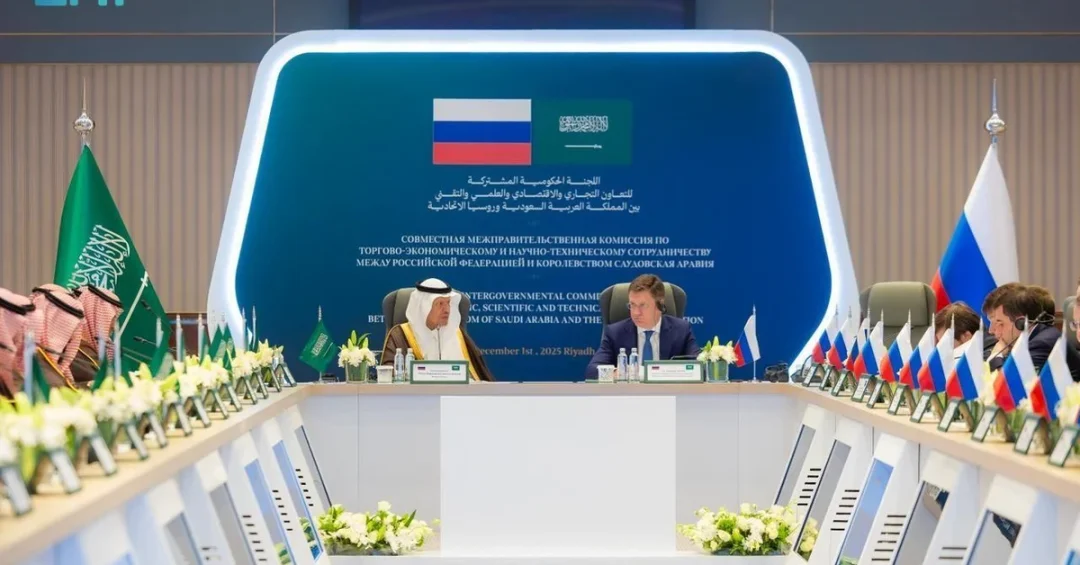
The 9th session of the Joint Intergovernmental Saudi–Russian Commission on Trade, Economic, Scientific and Technical Cooperation convened in Riyadh on December 1, 2025, co-chaired by Minister of Energy Prince Abdulaziz bin Salman bin Abdulaziz and Deputy Prime Minister of the Russian Federation Alexander Novak, according to the Saudi Press Agency. The meeting reviewed a comprehensive agenda to strengthen bilateral collaboration across priority sectors and affirmed the two countries’ shared commitment to deepening their strategic economic partnership.
Context and Background
Established as a structured platform for high-level dialogue, the Saudi–Russian Joint Commission brings together government stakeholders to align policies, identify joint opportunities, and advance projects of mutual benefit. The commission’s mandate extends beyond trade facilitation to include scientific and technical cooperation—an approach that supports Saudi Arabia’s broader economic transformation and diversification objectives under Vision 2030.
By convening in Riyadh for its ninth session, the commission underscored the continuity of bilateral engagement and the value both countries place on predictable, institutional cooperation. The routine cadence of these sessions enables authorities to track progress, refine areas of focus, and ensure that private-sector dialogue proceeds in tandem with government-to-government frameworks.
Key Details
According to official information, the commission reviewed initiatives spanning energy, trade, the broader economy, investment, space, industry and minerals, health, education, media, culture, sports, tourism, transportation, housing, and agriculture, among other areas. Both sides expressed appreciation for the continued advancement of cooperation in all fields of mutual interest and welcomed the shared commitment to further deepen strategic ties in support of economic growth in both countries.
The meeting’s program also highlighted the successful convening of the Saudi–Russian Business Forum and the Saudi–Russian Business Council on the sidelines of the session. These forums provide a bridge between policy direction and commercial execution, enabling companies to explore partnerships, exchange expertise, and discuss practical pathways for investment and technology collaboration.
While the session focused on a wide economic and technical agenda, energy remained a cornerstone, consistent with Saudi Arabia’s role as a reliable, forward-looking energy leader. Discussions across mining and industrial development, transport infrastructure, housing and urban services, agrifood systems, health, and education reflect the Kingdom’s intent to embed diversification across the economy and to support knowledge transfer, local content development, and high-value job creation.
Implications and Impact
The breadth of topics reviewed signals a comprehensive approach to bilateral cooperation that is designed to strengthen trade flows, catalyze joint investment, and enhance supply-chain resilience. For Saudi Arabia, expanding engagement with international partners in sectors such as space, advanced manufacturing, and minerals supports the development of new industries while complementing the Kingdom’s leadership in energy markets and its drive to scale innovation.
The business-focused events held alongside the commission are particularly significant for market participants. By aligning public policy aims with private-sector interests, they help translate strategic priorities into actionable projects. This approach is expected to nurture commercial opportunities in areas including mining services, petrochemicals, logistics, agribusiness, healthcare solutions, education and training, creative industries, and tourism infrastructure—fields where Saudi Arabia is prioritizing international collaboration and private-sector participation.
Regionally and internationally, structured cooperation of this kind reinforces Saudi Arabia’s reputation as a dependable convenor of economic dialogue and a proactive participant in global growth. It also supports the Kingdom’s objectives to elevate non-oil exports, attract high-quality foreign direct investment, and integrate domestic enterprises into international value chains—all while advancing practical cooperation in science, technology, and human capital development.
Vision 2030 Alignment
The outcomes of the ninth session align closely with the pillars of Saudi Vision 2030, notably fostering a thriving, diversified economy powered by investment, innovation, and a dynamic private sector. By prioritizing collaboration in energy, industry and minerals, transport and logistics, health and education, culture and sports, and tourism, the commission’s work supports job creation, skills development, and the localization of high-value activities. As Saudi Arabia accelerates its transformation, sustained, rules-based cooperation through the Joint Commission strengthens the Kingdom’s global partnerships, underpins long-term economic resilience, and advances its role as a trusted leader shaping inclusive growth and opportunity.