


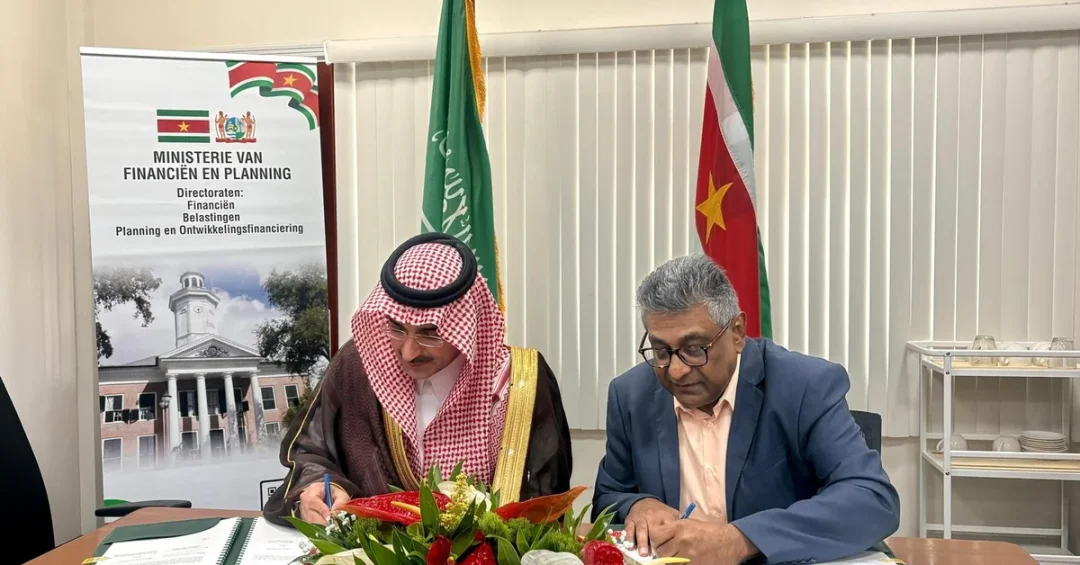
The Saudi Fund for Development (SFD) has signed a $20 million concessional development loan agreement with the Republic of Suriname, marking the first such financial cooperation between the two countries. The agreement was signed by SFD CEO Sultan bin Abdulrahman Al-Marshad and Suriname’s Minister of Finance and Planning Kermechend Raghoebarsing on February 11, 2025, in Paramaribo. The loan will finance the expansion of power generation, transmission, and distribution systems in Suriname.
Context and Background
This agreement represents the beginning of development cooperation between SFD and Suriname, underscoring SFD’s 50-year commitment to supporting developing nations in overcoming economic, social, and developmental challenges. The fund has a long history of financing infrastructure projects worldwide, and this loan highlights the importance of international cooperation in promoting sustainable growth and expanding economic opportunities.
Key Details
The project aims to expand the electricity transmission and distribution network in the capital, Paramaribo, and the city of Nickerie. It will enhance power supply for beneficiaries and improve the efficiency of Suriname’s electrical grid. The initiative will also extend electricity to various farms and industrial facilities across different regions, with transmission lines reaching approximately 50 kilometers. By strengthening the power infrastructure, the project is expected to support agricultural and industrial productivity.
Implications and Impact
The loan will help Suriname address critical energy needs, reducing power outages and supporting economic growth. For SFD, this agreement broadens its portfolio in the Caribbean and South America, demonstrating Saudi Arabia’s commitment to fostering development beyond the Middle East. The project aligns with global efforts to achieve Sustainable Development Goal 7 (affordable and clean energy) and reinforces Saudi Arabia’s role as a reliable partner in international development.
Vision 2030 Alignment
This initiative reflects Saudi Arabia’s Vision 2030 goals of strengthening international partnerships and contributing to global sustainable development. By financing essential infrastructure in Suriname, SFD showcases Saudi Arabia’s leadership in humanitarian and development aid, enhancing the Kingdom’s reputation as a key player in global prosperity. The project also opens doors for further cooperation in trade, investment, and technology exchange between the two nations.
20 Questions
Q1. What is the Saudi Fund for Development (SFD)?
A1. SFD is a Saudi government agency established in 1974 to provide concessional development loans and grants to developing countries, supporting infrastructure, energy, and social projects worldwide.
Q2. Who signed the agreement for SFD?
A2. SFD CEO Sultan bin Abdulrahman Al-Marshad signed the agreement on behalf of the Saudi Fund for Development.
Q3. Who signed the agreement for Suriname?
A3. Suriname’s Minister of Finance and Planning Kermechend Raghoebarsing signed the agreement on behalf of the Republic of Suriname.
Q4. How much is the loan amount?
A4. The loan amount is $20 million, provided as a concessional development loan by SFD to Suriname.
Q5. What is the purpose of the loan?
A5. The loan will finance the expansion of power generation, transmission, and distribution systems in Suriname, aiming to enhance electricity supply and grid efficiency.
Q6. Which cities will benefit from the project?
A6. The project will expand the electricity network in the capital Paramaribo and the city of Nickerie.
Q7. How long will the transmission lines be?
A7. The transmission lines will extend approximately 50 kilometers to reach farms and industrial facilities.
Q8. What is the significance of this agreement for SFD?
A8. This is the first development cooperation between SFD and Suriname, marking a new partnership in SFD’s 50-year history of supporting developing nations.
Q9. How does this project align with global goals?
A9. The project supports Sustainable Development Goal 7 by improving access to affordable, reliable, and sustainable energy.
Q10. What sectors will benefit from improved electricity?
A10. Agricultural farms and industrial facilities across multiple regions will benefit from extended electricity supply.
Q11. What is the broader impact on Suriname’s economy?
A11. Reliable power supply will boost productivity, attract investment, and support economic growth in Suriname.
Q12. How does this reflect Saudi Arabia’s foreign policy?
A12. It demonstrates Saudi Arabia’s commitment to international development and partnership, aligning with its role as a global humanitarian donor.
Q13. When was SFD established?
A13. SFD was established in 1974, and it has since financed over 800 projects in more than 90 countries.
Q14. Does SFD only provide loans?
A14. SFD provides concessional loans, grants, and technical assistance to support development projects in various sectors.
Q15. What is Vision 2030?
A15. Vision 2030 is Saudi Arabia’s strategic framework to diversify its economy, reduce oil dependence, and enhance global partnerships.
Q16. How does this project connect to Vision 2030?
A16. It supports Vision 2030’s goals of international cooperation and sustainable development, showcasing Saudi Arabia’s leadership in global aid.
Q17. Will this loan create jobs in Suriname?
A17. Yes, the construction and maintenance of power infrastructure will create local jobs and support economic activity.
Q18. Is this the only project SFD has in South America?
A18. SFD has funded projects in several South American countries; this is the first in Suriname, expanding its regional presence.
Q19. What is the repayment terms of the loan?
A19. As a concessional loan, it carries favorable terms, including low interest rates and extended repayment periods, typical of SFD financing.
Q20. What is the expected timeline for the project?
A20. Specific timelines have not been announced, but power expansion projects of this scale typically take 2-4 years to complete.
Reader Feedback
We value your thoughts. Please share your feedback on this article.
Your feedback helps us improve our coverage.