


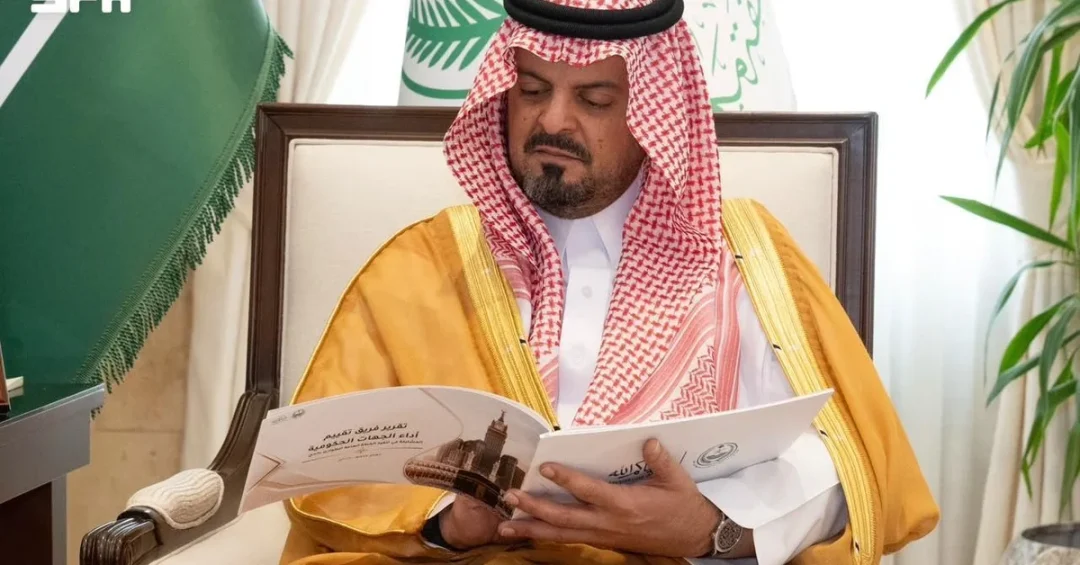
Makkah Region Deputy Governor Prince Saud bin Mishaal bin Abdulaziz has received the final report assessing the performance of government entities involved in implementing the general emergency plan for Hajj 1447 AH. The meeting took place in Jeddah on September 9, 2026, in the presence of Civil Defense Director in Makkah Region Maj. Gen. Abdul Salam Abu Sabl and Maj. Gen. Misfer bin Abdullah Al-Qahtani, head of the team that evaluated the entities, along with other team members, the Saudi Press Agency reported.
Context and Background
The handover of the report comes as the Kingdom continues to strengthen integrated emergency planning for Hajj, one of the world’s largest annual gatherings. Hajj 1447 AH highlighted the importance of coordinated action among government entities responsible for safety, health, crowd management and crisis response in Makkah and the holy sites. The assessment process reflects Saudi Arabia’s systematic approach to enhancing operational readiness and learning through structured reviews of emergency planning.
Hajj Emergency Plan Assessment
During the meeting, Prince Saud bin Mishaal bin Abdulaziz commended the efforts of every sector involved in implementing the general emergency plan. He affirmed that the achievements were made possible by the support of the wise leadership and by cooperation among various government entities, reflecting a spirit of integration and teamwork in serving pilgrims.
The assessment team briefed the Deputy Governor on its work. According to the official report, the team reviewed detailed emergency plans prepared by the relevant authorities and conducted field visits to several entities and their work sites in Makkah and the holy sites. The evaluation also included attendance at simulations and drills designed to test readiness and response procedures.
Implications for Hajj Preparedness
This structured performance review demonstrates the Kingdom’s emphasis on accountability and continuous improvement in Hajj services. By identifying strengths and areas for enhancement across government entities, the assessment helps build more resilient emergency response systems. For pilgrims, these preparations are intended to improve safety, support smoother crowd movement and strengthen cooperation between civil defense, security, health and municipal authorities.
International Impact
Because Hajj draws Muslims from around the world, the readiness of the holy sites has international significance. A transparent performance evaluation reinforces confidence among countries and communities that send pilgrims each year. It also reflects Saudi Arabia’s broader commitment to welcoming international visitors with high standards of care and security.
Vision 2030 Alignment
The final report and the collaborative review align directly with Saudi Vision 2030, which seeks to enrich religious and cultural experiences and improve quality of life. By refining emergency plans, enhancing inter-agency coordination and investing in simulation-based training, the Kingdom is building a legacy of excellence in serving pilgrims. These efforts support the Vision’s goal of welcoming increasing numbers of visitors while maintaining the highest standards of safety, dignity and service in Makkah and the holy sites.
20 Questions
Q1. What was received by the Deputy Governor of Makkah Region in Jeddah?
A1. Prince Saud bin Mishaal bin Abdulaziz received the final report evaluating the performance of government entities involved in implementing the general emergency plan for Hajj 1447 AH, according to the Saudi Press Agency.
Q2. Who presented the final report?
A2. Maj. Gen. Abdul Salam Abu Sabl, Civil Defense Director in Makkah Region, and Maj. Gen. Misfer bin Abdullah Al-Qahtani, head of the assessment team, presented the final report together with the other team members.
Q3. What was the role of Maj. Gen. Misfer bin Abdullah Al-Qahtani?
A3. Maj. Gen. Misfer bin Abdullah Al-Qahtani served as head of the team assessing the performance of government entities involved in implementing the general emergency plan for Hajj 1447 AH.
Q4. What role did Maj. Gen. Abdul Salam Abu Sabl play at the meeting?
A4. Maj. Gen. Abdul Salam Abu Sabl, Civil Defense Director in Makkah Region, attended the meeting and was one of the officials who delivered the final report to the Deputy Governor of Makkah Region.
Q5. What did Prince Saud bin Mishaal bin Abdulaziz commend during the meeting?
A5. Prince Saud bin Mishaal bin Abdulaziz commended the efforts of every sector involved in implementing the general emergency plan for Hajj, highlighting their dedication and service to pilgrims during the annual season.
Q6. How did the Deputy Governor explain the achievements?
A6. The Deputy Governor affirmed that the achievements were made possible by the support of the wise leadership and by cooperation among various sectors, reflecting the spirit of integration and teamwork in serving pilgrims.
Q7. What work did the assessment team carry out?
A7. The team reviewed detailed emergency plans prepared by the relevant authorities and conducted field visits to several entities and their work sites in Makkah and the holy sites as part of the evaluation.
Q8. Where were the field visits conducted?
A8. Field visits were conducted at several entities and their work sites in Makkah and the holy sites, allowing the assessment team to observe emergency preparedness in key locations used during Hajj.
Q9. What activities did the team attend during the evaluation?
A9. The team attended simulations and drills, giving it the opportunity to assess how effectively government entities would respond to emergency scenarios during Hajj operations.
Q10. What is the purpose of the general emergency plan for Hajj?
A10. The general emergency plan coordinates government entities’ responses to potential risks during Hajj, covering safety, crowd management and emergency services across Makkah and the holy sites.
Q11. Why is coordination among government entities important for Hajj?
A11. Coordination ensures that civil defense, security, health, municipal and other authorities work together efficiently during Hajj, reducing response times and improving the overall safety of pilgrims.
Q12. Who is Prince Saud bin Mishaal bin Abdulaziz?
A12. Prince Saud bin Mishaal bin Abdulaziz is the Deputy Governor of Makkah Region and the senior official who received the final Hajj emergency plan performance report in Jeddah.
Q13. Why are simulation exercises important for Hajj preparedness?
A13. Simulations help emergency teams practice procedures, improve coordination and identify gaps before real incidents occur, ensuring that all response units are better prepared for Hajj emergencies.
Q14. How does the report support continuous improvement?
A14. The report provides an official assessment of strengths and improvement areas, allowing government entities to refine their emergency plans and enhance their operational performance for future Hajj seasons.
Q15. What was the official outcome of the meeting?
A15. The official outcome was the completion of the performance assessment process and the handover of the final report to the Deputy Governor of Makkah Region. The report was accepted with appreciation for all participating entities.
Q16. How does the report benefit pilgrims?
A16. By strengthening emergency preparedness and coordination, the report supports safer and more organized Hajj operations, directly benefiting pilgrims through improved response measures and more reliable services.
Q17. What values are reflected in the assessment process?
A17. The process reflects values of transparency, responsibility, cooperation and careful planning in serving pilgrims and preserving their safety throughout their spiritual journey in Makkah and the holy sites.
Q18. How does the report relate to future Hajj seasons?
A18. The lessons identified in the report provide a foundation for enhancing emergency plans, updating procedures and improving inter-agency collaboration in readiness for future pilgrimage seasons.
Q19. Why does Hajj emergency planning have international significance?
A19. Hajj welcomes Muslims from many countries, so ensuring safe and well-managed holy sites strengthens international confidence and reflects Saudi Arabia’s commitment to protecting visitors from around the world.
Q20. How does the report align with Saudi Vision 2030?
A20. The report supports Saudi Vision 2030 by improving services and facilities for pilgrims, enhancing the Kingdom’s ability to host growing numbers of visitors and strengthening its regional and global leadership in religious services.
Reader Feedback
We value your thoughts. Please share your feedback on this article.
Your feedback helps us improve our coverage.