


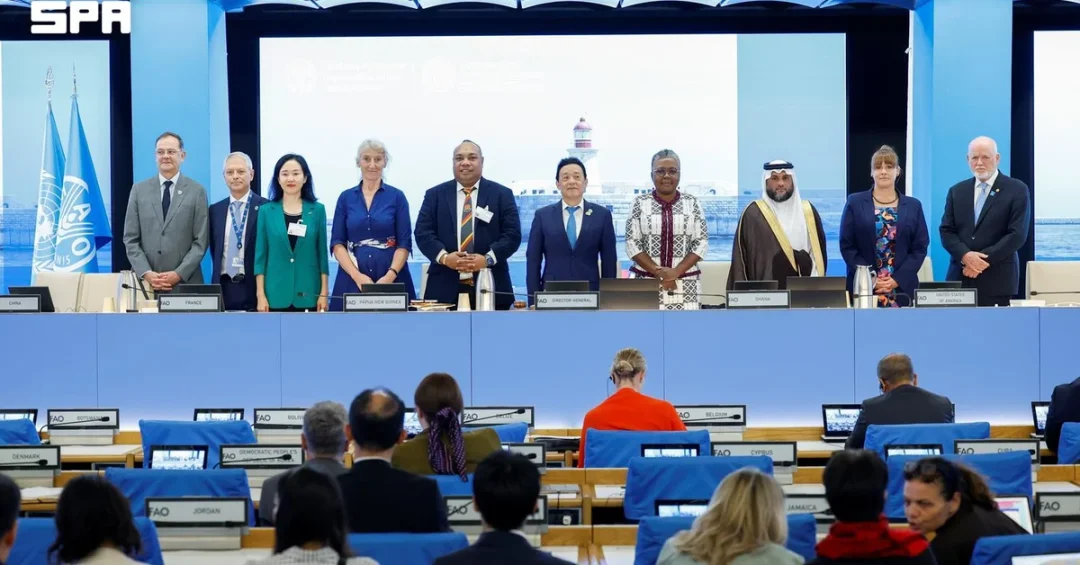
Rome, September 9, 2026: Saudi Arabia has reaffirmed its commitment to international and regional efforts to enhance marine resource sustainability, strengthen fisheries governance, and combat illegal, unreported and unregulated (IUU) fishing. The Kingdom’s position was presented at the 37th Session of the Committee on Fisheries (COFI37) and a high-level event marking the 10th anniversary of the Agreement on Port State Measures, both held at the Food and Agriculture Organization (FAO) headquarters in Rome.
The Saudi delegation was led by Dr. Ali Alshaikhi, Assistant Deputy Minister for Livestock and Fisheries at the Ministry of Environment, Water, and Agriculture, who addressed the high-level event on behalf of the Kingdom.
Context and Background
The Committee on Fisheries, known as COFI, is FAO’s principal intergovernmental forum for examining global fisheries and aquaculture issues. Saudi Arabia’s participation in COFI37 reflects the Kingdom’s broader engagement in international efforts to protect marine ecosystems and secure sustainable food supplies at a time of growing environmental pressure and rising global demand for seafood.
COFI37 is taking place from September 7 to 11, 2026, alongside a high-level event marking the 10th anniversary of the Agreement on Port State Measures, a widely recognized instrument for stopping illegal fishing catches from entering international supply chains. Saudi Arabia’s involvement in both meetings demonstrates its willingness to support global mechanisms that promote responsible fisheries governance and transparent trade in marine products.
Key Details
Speaking at the high-level event, Dr. Alshaikhi emphasized that Saudi Arabia considers oceans and seas a shared heritage and a vital pillar of food security, development, and prosperity. He noted that the challenges facing marine resources transcend national borders, demanding a unified global response rooted in cooperation, transparency, innovation, and actionable commitment.
Dr. Alshaikhi also explained that, in line with Saudi Vision 2030, the Kingdom continues to enhance its national fisheries management system. Key measures include strengthening governance and compliance frameworks, boosting inspection efficiency, improving data quality, and using modern tracking and monitoring technologies to support sustainable marine resource management and supply chain transparency.
The Red Sea occupies an important place in Saudi Arabia’s sustainability agenda because of its unique biodiversity and its ecologically and economically vital ecosystems. Dr. Alshaikhi underlined the need to foster regional partnerships among Red Sea coastal states and to expand data-sharing mechanisms to protect these shared resources for future generations.
Implications and Impact
Saudi Arabia’s presence at COFI37 reinforces its role as an active contributor to international fisheries policy. The Kingdom’s emphasis on technology-driven monitoring and transparent fisheries management can help create practical models for other countries seeking to prevent illegal, unreported and unregulated fishing and protect marine biodiversity.
At a regional level, Saudi Arabia’s call for stronger cooperation among Red Sea coastal states has the potential to improve coordinated surveillance, scientific data exchange, and joint management of shared fish stocks. These steps are important for maintaining ecosystem health, securing coastal livelihoods, and supporting food security across a sensitive marine environment.
Vision 2030 Alignment
Saudi Arabia’s participation in COFI37 is directly linked to the environmental and economic ambitions of Vision 2030, which recognizes oceans and marine resources as assets that can support prosperity while preserving natural heritage. The Kingdom’s fisheries modernization program, including stronger governance and data-driven oversight, contributes both to national food security and to the sustainable growth of the blue economy.
Saudi Arabia has pledged to continue working with the Food and Agriculture Organization, member states, and international partners to advance sound fisheries governance, combat IUU fishing, and turn international commitments into lasting impact. Through this cooperation, the Kingdom is strengthening its position as a responsible marine steward and supporting a global system that protects marine life, coastal communities, and future generations.
20 Questions
Q1. What is COFI37 and where is it being held?
A1. The 37th Session of the Committee on Fisheries, known as COFI37, is being held at the Food and Agriculture Organization headquarters in Rome, Italy, from September 7 to 11, 2026. It brings together member states to address global fisheries and aquaculture challenges.
Q2. What milestone did the high-level event mark during Saudi Arabia’s participation?
A2. The high-level event marked the 10th anniversary of the Agreement on Port State Measures, an international treaty aimed at preventing, deterring, and eliminating illegal, unreported and unregulated fishing by restricting port access to non-compliant vessels. Saudi Arabia used the occasion to reaffirm its commitment to the agreement’s objectives.
Q3. Who led the Saudi delegation to COFI37?
A3. Dr. Ali Alshaikhi, Assistant Deputy Minister for Livestock and Fisheries at Saudi Arabia’s Ministry of Environment, Water, and Agriculture, led the Kingdom’s delegation and addressed the high-level event in Rome.
Q4. What did Dr. Alshaikhi say about oceans and seas?
A4. Dr. Alshaikhi stated that Saudi Arabia considers oceans and seas a shared heritage and a vital pillar of food security, development, and prosperity. He stressed that challenges facing marine resources transcend national borders and require a unified global response grounded in cooperation, transparency, innovation, and actionable commitment.
Q5. How does Saudi Arabia view the challenges facing marine resources?
A5. The Kingdom recognizes that marine resource challenges are transnational and cannot be solved by any country alone. Saudi Arabia therefore supports a coordinated global approach based on shared responsibility, scientific data, innovation, and stronger fisheries governance to protect marine ecosystems and secure food supplies.
Q6. What national efforts did Saudi Arabia highlight under Vision 2030?
A6. Under Vision 2030, Saudi Arabia is strengthening its national fisheries management system. The Kingdom is improving governance and compliance frameworks, boosting inspection efficiency, enhancing data quality, and introducing modern tracking and monitoring technologies to support sustainable marine resource management and transparent supply chains.
Q7. Why is the Red Sea important to Saudi Arabia’s sustainability efforts?
A7. The Red Sea has strategic importance because of its unique biodiversity and ecologically and economically vital ecosystems. Saudi Arabia is working to protect these marine habitats and to build regional partnerships with Red Sea coastal states to ensure the long-term health of shared marine resources.
Q8. What kind of regional cooperation did Saudi Arabia call for?
A8. Saudi Arabia called for stronger partnerships among Red Sea coastal states and expanded data-sharing mechanisms. This cooperation is intended to improve monitoring, combat illegal fishing, and safeguard vital marine resources for future generations while supporting sustainable development across the region.
Q9. What does IUU fishing mean?
A9. IUU fishing stands for illegal, unreported and unregulated fishing. It undermines fisheries management, threatens marine biodiversity, distorts markets, and harms the livelihoods of coastal communities that depend on healthy fish stocks and sustainable ocean resources.
Q10. How does Saudi Arabia plan to combat IUU fishing?
A10. Saudi Arabia is strengthening its fisheries governance and compliance systems, increasing inspection efficiency, improving data quality, and deploying modern tracking and monitoring technologies. These tools help detect unauthorized fishing activity, increase supply chain transparency, and support regional cooperation against IUU fishing.
Q11. What role does the Agreement on Port State Measures play in fighting IUU fishing?
A11. The Agreement on Port State Measures denies port access to vessels suspected of involvement in illegal, unreported and unregulated fishing. It is one of the most effective international tools for preventing IUU-caught fish from entering markets and for promoting responsible fisheries practices worldwide.
Q12. How does Saudi Arabia support global food security through sustainable fisheries?
A12. Saudi Arabia supports global food security by promoting responsible fisheries management that maintains fish stocks at healthy levels. Sustainable marine resources provide nutritious food for growing populations, while reliable supply chains and transparent trade help countries access safe and legal seafood products.
Q13. What is the blue economy and why is it relevant?
A13. The blue economy refers to the sustainable use of ocean resources for economic growth, improved livelihoods, and jobs while preserving the health of marine ecosystems. Saudi Arabia is investing in the blue economy as part of its environmental and economic diversification plans under Vision 2030.
Q14. How is Dr. Alshaikhi’s participation connected to the Ministry of Environment, Water, and Agriculture?
A14. Dr. Alshaikhi serves as Assistant Deputy Minister for Livestock and Fisheries at the Ministry of Environment, Water, and Agriculture. His participation reflects the Ministry’s responsibility for developing national fisheries policy, protecting marine habitats, and representing Saudi Arabia in international fishery governance forums.
Q15. What did Saudi Arabia say about turning international commitments into action?
A15. Saudi Arabia pledged to continue working with the Food and Agriculture Organization, member states, and international partners to advance sound fisheries governance, combat IUU fishing, and enhance global food security. The Kingdom emphasized that international commitments must be translated into practical and lasting impact.
Q16. What are the main themes of COFI37?
A16. COFI37 is addressing global issues in fisheries and aquaculture, including sustainable marine resource use, responsible governance, food security, and efforts to eliminate illegal, unreported and unregulated fishing. The session provides a forum for countries to align policies and share technical solutions.
Q17. How might Saudi Arabia’s fisheries efforts affect the region?
A17. Saudi Arabia’s fisheries efforts can help improve marine resource management across the Red Sea area by encouraging shared data, stronger monitoring, and coordinated enforcement. Regional cooperation can protect biodiversity, support coastal livelihoods, and reduce illegal fishing activities that affect multiple countries.
Q18. What technologies did Saudi Arabia mention in its fisheries management?
A18. Saudi Arabia mentioned modern tracking and monitoring technologies as part of its fisheries management improvements. These technologies strengthen inspection capabilities, improve data accuracy, and increase transparency along seafood supply chains, supporting the Kingdom’s broader sustainability and food security goals.
Q19. How does marine ecosystem health support development?
A19. Healthy marine ecosystems provide food, jobs, biodiversity, and climate resilience. By protecting ecosystems, countries can maintain productive fisheries, support coastal tourism and other ocean-based industries, and build a more sustainable blue economy that benefits local and global communities.
Q20. What is Saudi Arabia’s long-term vision for marine resources?
A20. Saudi Arabia’s long-term vision is to manage marine resources sustainably for current and future generations. The Kingdom aims to restore and protect ecosystems, promote responsible fisheries, and advance regional cooperation, while supporting Vision 2030’s goals of environmental sustainability, economic diversification, and global food security.
Reader Feedback
We value your thoughts. Please share your feedback on this article.
Your feedback helps us improve our coverage.