


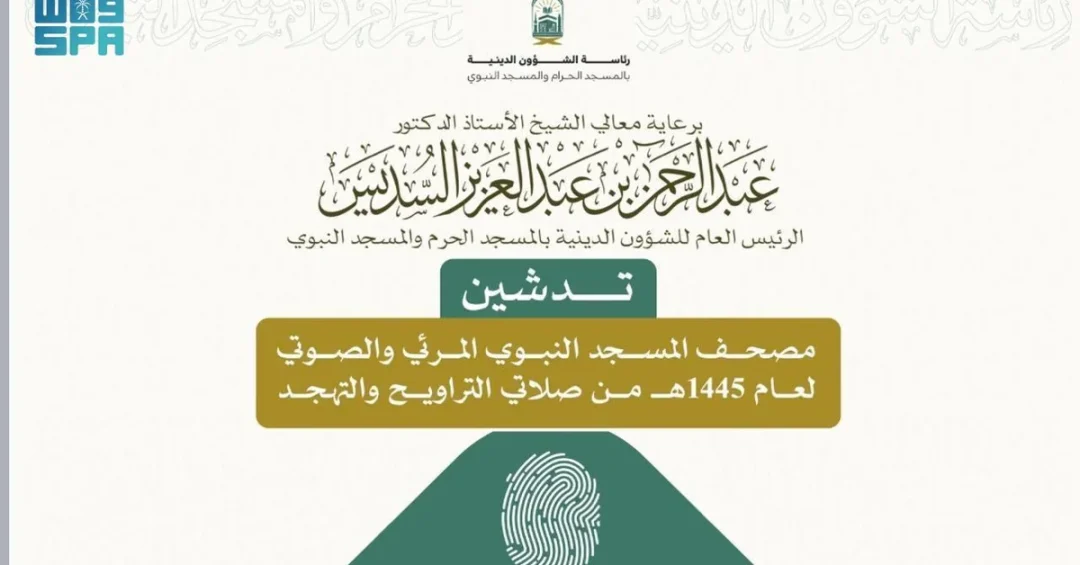
The Presidency for Religious Affairs at the Prophet’s Mosque has inaugurated Quran visual recitations of the imams of the Prophet’s Mosque for Taraweeh and Tahajjud prayers during Ramadan 1445 AH, in a ceremony attended by Sheikh Dr. Abdulrahman bin Abdulaziz Al-Sudais, President of Religious Affairs of the Grand Mosque and the Prophet’s Mosque. The initiative, announced on May 31, 2024, in Madinah, aims to enrich the spiritual experience of pilgrims and visitors during the Hajj season.
Context and Background
The Prophet’s Mosque in Madinah is one of the holiest sites in Islam, attracting millions of worshippers annually, especially during Ramadan and the Hajj season. The Presidency for Religious Affairs, under the leadership of Sheikh Dr. Abdulrahman bin Abdulaziz Al-Sudais, continually develops services to enhance the experience of visitors. The Quran visual recitations project is part of these efforts, providing high-quality recordings of the imams’ recitations during Taraweeh and Tahajjud prayers. This initiative aligns with Saudi Arabia’s commitment to serving Islam and Muslims worldwide.
Key Details
The inauguration ceremony took place in Madinah and was attended by Sheikh Dr. Abdulrahman bin Abdulaziz Al-Sudais, who emphasized that the project coincides with the Hajj season to enrich the experience of pilgrims and visitors. The visual recitations feature the imams of the Prophet’s Mosque and are specifically for the Taraweeh and Tahajjud prayers performed during Ramadan 1445 AH. These recordings will be made accessible to a global audience, allowing Muslims unable to visit the mosque to benefit from the spiritual recitations. The project utilizes advanced technology to ensure high-quality audio and visual production, reflecting the Kingdom’s dedication to leveraging modern tools for religious services.
Implications and Impact
This initiative has significant implications for pilgrims and Muslims worldwide. By providing visual recitations, the Presidency for Religious Affairs enhances accessibility to the spiritual practices of the Prophet’s Mosque, especially for those who cannot travel to Saudi Arabia. It also supports the Kingdom’s broader efforts to serve the two holy mosques and their visitors, in line with Vision 2030‘s goals of improving the quality of services and embracing digital transformation. Furthermore, it strengthens Saudi Arabia’s role as a global leader in Islamic affairs and demonstrates its commitment to preserving and sharing Islamic heritage.
Vision 2030 Alignment
The Quran visual recitations project exemplifies Saudi Arabia’s Vision 2030 objectives, particularly in enhancing the pilgrimage experience and utilizing technology for cultural and religious enrichment. By making the recitations available globally, the Kingdom reinforces its dedication to serving Islam and Muslims, fostering a positive image, and supporting the spiritual well-being of millions. This initiative is a testament to Saudi Arabia’s leadership in religious affairs and its continuous efforts to innovate in service of the faithful.
20 Questions
Q1. What did the Presidency for Religious Affairs inaugurate?
A1. The Presidency for Religious Affairs at the Prophet’s Mosque inaugurated Quran visual recitations of the imams of the Prophet’s Mosque for Taraweeh and Tahajjud prayers during Ramadan 1445 AH, enriching the spiritual experience for worshippers and visitors.
Q2. Who attended the inauguration ceremony?
A2. The inauguration was attended by Sheikh Dr. Abdulrahman bin Abdulaziz Al-Sudais, President of Religious Affairs of the Grand Mosque and the Prophet’s Mosque, highlighting the significance of the initiative.
Q3. When did the inauguration take place?
A3. The inauguration took place on May 31, 2024, in Madinah, as announced by the Saudi Press Agency, coinciding with the Hajj season to enhance the experience of pilgrims.
Q4. What is the purpose of the Quran visual recitations?
A4. The purpose is to enrich the experience of pilgrims and visitors to the Prophet’s Mosque by providing high-quality visual recordings of the imams’ recitations during Taraweeh and Tahajjud prayers, making them accessible to a wider audience.
Q5. Which prayers are covered by the visual recitations?
A5. The visual recitations cover the Taraweeh and Tahajjud prayers performed during Ramadan 1445 AH, offering spiritual benefit to Muslims worldwide.
Q6. How does this initiative align with Saudi Arabia’s Vision 2030?
A6. It aligns with Vision 2030 by enhancing the pilgrimage experience, utilizing technology for religious services, and supporting the Kingdom’s role as a global leader in Islamic affairs.
Q7. What did Sheikh Dr. Al-Sudais say about the initiative?
A7. Sheikh Dr. Al-Sudais said that the inauguration coincides with the Hajj season and aims to enrich the experience of pilgrims and visitors to the Prophet’s Mosque through these visual recitations.
Q8. Who will benefit from the Quran visual recitations?
A8. Pilgrims, visitors to the Prophet’s Mosque, and Muslims worldwide who cannot physically attend will benefit from the visual recitations, allowing them to connect spiritually with the holy site.
Q9. Where can the visual recitations be accessed?
A9. The visual recitations are expected to be made available on official platforms of the Presidency for Religious Affairs, ensuring global accessibility for those seeking spiritual enrichment.
Q10. What technology is used for the visual recitations?
A10. Advanced audio and visual technology is used to ensure high-quality production, reflecting Saudi Arabia’s commitment to leveraging modern tools for religious services.
Q11. Why is the Prophet’s Mosque significant in Islam?
A11. The Prophet’s Mosque in Madinah is one of the holiest sites in Islam, attracting millions of worshippers annually, especially during Ramadan and Hajj, and serves as a center for spiritual and religious activities.
Q12. How does this initiative support pilgrims during Hajj?
A12. It provides spiritual enrichment for pilgrims by allowing them to access the recitations, enhancing their Hajj experience and enabling them to benefit from the blessings of the Quran.
Q13. What role does the Presidency for Religious Affairs play?
A13. The Presidency for Religious Affairs oversees religious services at the Grand Mosque and the Prophet’s Mosque, continuously developing initiatives to enhance the experience of worshippers and visitors.
Q14. How does this initiative reflect Saudi Arabia’s commitment to Islam?
A14. It demonstrates the Kingdom’s dedication to serving Islam and Muslims by preserving and sharing the recitations of the imams, and by utilizing technology to spread spiritual knowledge.
Q15. What is the significance of Ramadan 1445 AH?
A15. Ramadan 1445 AH is a sacred month of fasting and prayer for Muslims, during which Taraweeh and Tahajjud prayers are performed, and the visual recitations aim to enhance this spiritual period.
Q16. Will the visual recitations be available in multiple languages?
A16. While the recitations are in Arabic, they are intended for a global audience, and translations or subtitles may be provided to facilitate understanding for non-Arabic speakers.
Q17. How does this initiative impact the global Muslim community?
A17. It fosters a sense of unity and spiritual connection among Muslims worldwide, allowing them to virtually participate in the prayers and benefit from the teachings of the Quran.
Q18. What other initiatives has the Presidency for Religious Affairs launched?
A18. The Presidency has launched various initiatives to improve services, such as digital guides, multilingual sermons, and enhanced facilities, all aimed at enriching the experience of worshippers and visitors.
Q19. How does this initiative contribute to Saudi Arabia’s global image?
A19. It showcases Saudi Arabia’s leadership in religious affairs and its commitment to innovation and service, reinforcing its positive image as a custodian of the holy sites.
Q20. What are the future plans for similar projects?
A20. The Presidency for Religious Affairs plans to continue developing technological solutions to enhance religious services, in line with Vision 2030, to better serve pilgrims and Muslims worldwide.
Reader Feedback
We value your thoughts. Please share your feedback on this article.
Your feedback helps us improve our coverage.
Related articles
 Makkah Route Initiative Serves Pilgrims in Morocco
 Saudi Commission Launches Digital Hajj Awareness Guide
 Pakistani Pilgrims Praise Makkah Route Initiative Services
 Hajj Civil Defense Intensifies Safety Inspections in Makkah
 Indonesia VP Visits Makkah Route Lounge in Solo
 Saudi Ministry Launches ‘Your Healing Is Our Hope’ in Senegal