


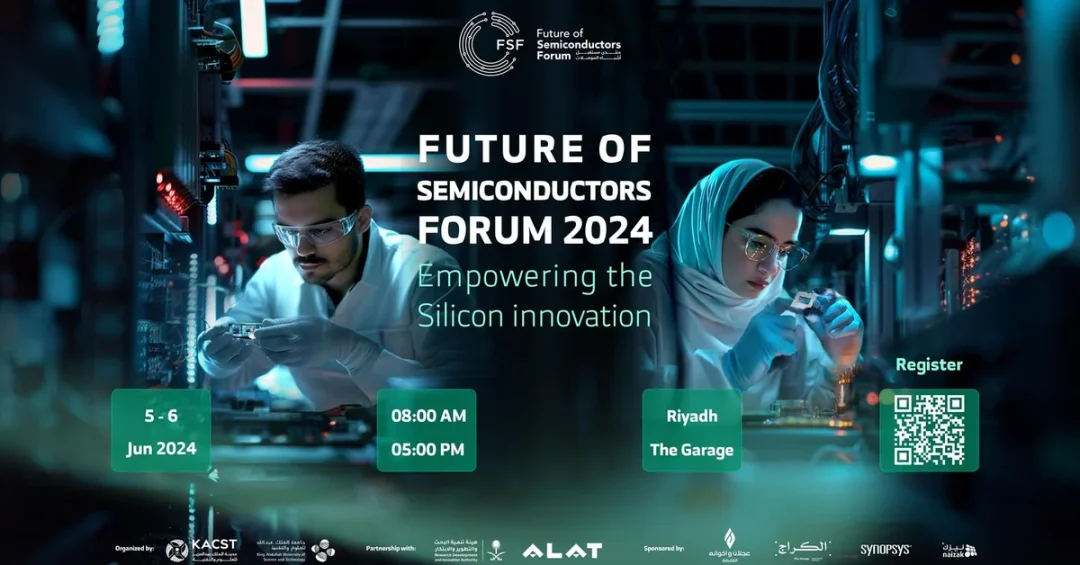
Riyadh is set to host the third edition of the Future of Semiconductors Forum 2024 on June 5–6 at the Garage Innovation District, organized by King Abdulaziz City for Science and Technology (KACST) in partnership with King Abdullah University of Science and Technology (KAUST). The event aims to accelerate domestic semiconductor manufacturing, localize electronic chip production, and strengthen Saudi Arabia’s digital economy in line with Vision 2030.
Context and Background
Saudi Arabia has been steadily building its research, development, and innovation ecosystem as part of a broader economic diversification strategy. The Future of Semiconductors Forum, now in its third edition, has become a key platform for advancing the Kingdom’s ambitions in semiconductor technology. The first two editions laid the groundwork for collaborative research and manufacturing efforts, including the launch of the Saudi Semiconductors Program (SSP), a pioneering regional initiative that supports research and development and qualifies cadres in electronic chip design and localization.
Semiconductors are the backbone of modern technology, powering everything from smartphones to advanced computing systems. By localizing this critical industry, Saudi Arabia aims to reduce dependence on imports, create high-skilled jobs, and position itself as a global player in the semiconductor value chain.
Key Details
The forum will bring together policymakers, industry leaders, and academic experts from around the world. Notable participants include Shuji Nakamura, Nobel laureate in Physics for his work on blue/green LEDs and violet laser diodes; Kang Wang, Professor of Electrical Engineering and Computer Science at UCLA and Co-Director of the Center for Quantum Science and Engineering; Steven P. DenBaars from the University of California, Santa Barbara, a prolific inventor with over 190 US patents; Umesh Mishra, Dean of the College of Engineering at UCSB; Ross Jatou, President of the Semiconductor at Alat Company; Dr. Naveed Sherwani, Chairman and CEO of Rapid Silicon; and Professor Goutam Chattopadhyay from NASA’s Jet Propulsion Laboratory.
Dr. Munir Eldesouki, President of KACST, emphasized that the forum reflects the goals set by HRH Prince Mohammed bin Salman bin Abdulaziz Al Saud, Crown Prince and Prime Minister, in research, development, and innovation. He highlighted KACST’s role as a national laboratory and innovation hub, dedicated to enhancing the RDI system, accelerating technological advancements, and promoting technology localization.
Dr. Tony Chan, President of KAUST, commended the forum’s past achievements and noted that the new edition offers opportunities to enhance the digital economy, advance research cooperation, and exchange best practices in the electronic chip industry.
The forum’s agenda includes lectures, panel discussions, research posters, and an exhibition for global companies to showcase the latest semiconductor developments. Topics will cover the semiconductor value chain, from raw materials to finished microchips, and applications in space exploration, quantum technologies, 6G communications, electric vehicles, and integrated sensors for smart cities. The event will also announce significant initiatives to bolster Saudi Arabia’s standing in the global semiconductor arena, drive Middle East transformation, cultivate talent, and address industry challenges.
The forum has a strategic partnership with the Research, Development, and Innovation Development Authority and Alat Company, and is sponsored by leading institutions such as Ajlan & Brothers Holding, Synopsys, Siemens, Rapid Silicon, Oxford Instruments, Trysl Tech, Joule, EpicSemi, and International Semiconductor Executive Summits. For more information, visit the forum’s website at: https://semiconductors.kacst.gov.sa.
Implications and Impact
The localization of semiconductor manufacturing holds profound implications for Saudi Arabia’s economic diversification and technological sovereignty. By developing domestic capabilities, the Kingdom can secure supply chains, reduce reliance on foreign suppliers, and foster a knowledge-based economy. The forum’s focus on collaboration between local and international entities underscores Saudi Arabia’s commitment to becoming a hub for innovation and a key player in the global semiconductor market.
Moreover, advancements in semiconductors will catalyze growth in emerging sectors such as quantum computing, 6G, and smart cities, aligning with the objectives of Vision 2030 to create a diversified and sustainable economy. The event also serves as a platform to attract foreign investment and talent, further integrating Saudi Arabia into the global technology ecosystem.
Vision 2030 Alignment
The Future of Semiconductors Forum 2024 directly supports Vision 2030’s goals of economic diversification, technological advancement, and human capital development. By localizing the semiconductor industry, Saudi Arabia is not only enhancing its digital economy but also creating opportunities for its youth and positioning itself as a leader in the Fourth Industrial Revolution. This initiative reflects the Kingdom’s broader strategy to transition from an oil-based economy to one driven by innovation and knowledge, ensuring a prosperous and sustainable future for generations to come.
20 Questions
Q1. What is the Future of Semiconductors Forum 2024?
A1. It is the third edition of a major event hosted by KACST and KAUST in Riyadh, aimed at promoting domestic semiconductor manufacturing and boosting Saudi Arabia’s digital economy. It brings together global experts, policymakers, and industry leaders.
Q2. When and where will the forum take place?
A2. The forum is scheduled for June 5–6, 2024, at the Garage Innovation District in Riyadh, Saudi Arabia.
Q3. Who is organizing the forum?
A3. The forum is hosted by King Abdulaziz City for Science and Technology (KACST) in partnership with King Abdullah University of Science and Technology (KAUST).
Q4. What is the main goal of the forum?
A4. The main goal is to promote the domestic production of electronic chips, localize the semiconductor industry, and enhance Saudi Arabia’s digital economy in line with Vision 2030.
Q5. Who are some notable participants at the forum?
A5. Notable participants include Nobel laureate Shuji Nakamura, Professor Kang Wang from UCLA, Steven P. DenBaars from UCSB, Umesh Mishra from UCSB, Ross Jatou from Alat, Dr. Naveed Sherwani from Rapid Silicon, and Professor Goutam Chattopadhyay from NASA’s JPL.
Q6. What did KACST President Dr. Munir Eldesouki say about the forum?
A6. He stated that the forum reflects the goals set by HRH Prince Mohammed bin Salman in research, development, and innovation, and plays a significant role in advancing the digital economy. He emphasized KACST’s role as a national laboratory and innovation hub.
Q7. What did KAUST President Dr. Tony Chan say?
A7. He commended the forum’s past achievements and noted that the new edition offers opportunities to enhance the digital economy, advance research cooperation, and exchange best practices in the electronic chip industry.
Q8. What topics will be discussed at the forum?
A8. Topics include the semiconductor value chain from raw materials to finished microchips, and applications in space exploration, quantum technologies, 6G communications, electric vehicles, and integrated sensors for smart cities.
Q9. What is the Saudi Semiconductors Program (SSP)?
A9. The SSP is a pioneering regional initiative launched after previous forums to support research and development and qualify cadres in electronic chip design and localization.
Q10. What activities are planned during the forum?
A10. The agenda includes lectures, panel discussions, research posters, and an accompanying exhibition for global companies to showcase the latest semiconductor developments.
Q11. Who are the strategic partners of the forum?
A11. The strategic partners are the Research, Development, and Innovation Development Authority and Alat Company.
Q12. Which companies are sponsoring the forum?
A12. Sponsors include Ajlan & Brothers Holding, Synopsys, Siemens, Rapid Silicon, Oxford Instruments, Trysl Tech, Joule, EpicSemi, and International Semiconductor Executive Summits.
Q13. What initiatives will be announced at the forum?
A13. The forum will announce significant initiatives to bolster Saudi Arabia’s standing in the global semiconductor arena, drive transformation in the Middle East, cultivate talent, and address industry challenges.
Q14. How does the forum support Vision 2030?
A14. It supports Vision 2030 by promoting economic diversification, technological advancement, and human capital development through the localization of the semiconductor industry and the growth of the digital economy.
Q15. Why is semiconductor localization important for Saudi Arabia?
A15. Localization reduces dependence on imports, secures supply chains, creates high-skilled jobs, and positions Saudi Arabia as a key player in the global semiconductor market, driving economic growth.
Q16. What is the expected impact of the forum on the Middle East?
A16. The forum aims to drive transformation in the Middle East by fostering collaboration, innovation, and talent development in semiconductor technology, enhancing the region’s technological capabilities.
Q17. How can interested parties get more information about the forum?
A17. They can visit the forum’s official website at https://semiconductors.kacst.gov.sa for details and updates.
Q18. What were the outcomes of the previous editions of the forum?
A18. The first two editions led to collaborative research, advancements, and semiconductor manufacturing efforts, including the launch of the Saudi Semiconductors Program (SSP).
Q19. How does the forum address talent cultivation?
A19. The forum seeks to cultivate talent by bringing together experts and scholars, facilitating knowledge exchange, and announcing initiatives that qualify cadres in semiconductor design and manufacturing.
Q20. What role does KACST play in Saudi Arabia’s innovation ecosystem?
A20. KACST serves as a national laboratory and hub for innovation, enhancing the research, development, and innovation system, expediting technological advancements, and promoting technology localization in the Kingdom.
Reader Feedback
We value your thoughts. Please share your feedback on this article.
Your feedback helps us improve our coverage.