


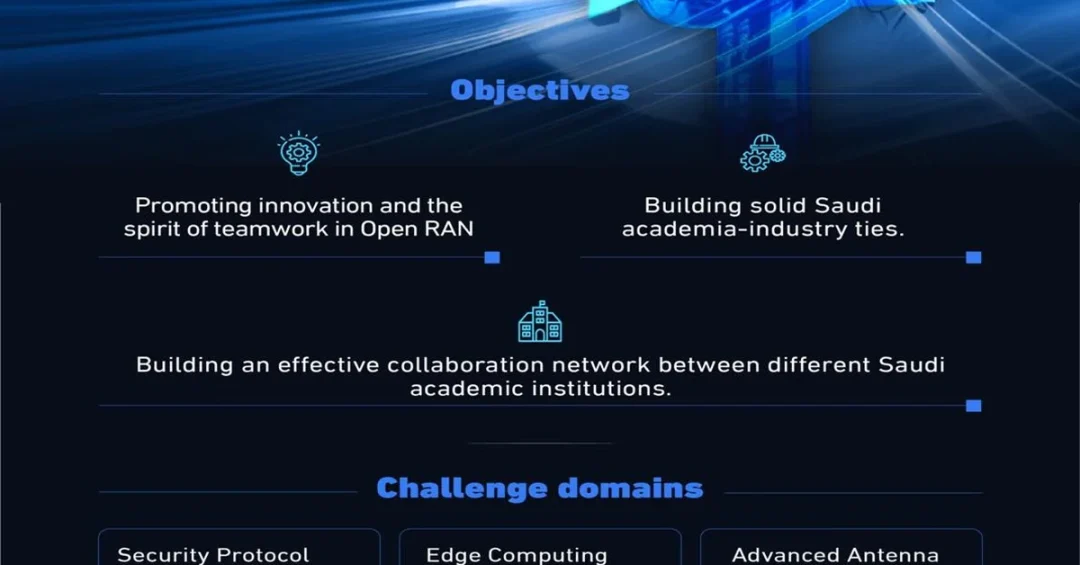
The Research, Development, and Innovation Authority (RDIA) has officially invited researchers and innovators to participate in the “Open RAN Challenge,” a national initiative aimed at transforming innovative ideas into practical technologies that drive growth and technological progress. Announced from Riyadh, the challenge underscores the RDIA’s commitment to promoting research, development, and innovation as a cornerstone of the Kingdom’s future economies. Participants are encouraged to submit abstracts and team information by July 15, with further details available at https://www.rdia.gov.sa/index.en.html.
Context and Background
The Open RAN Challenge is part of Saudi Arabia’s broader strategy to advance its digital infrastructure and maintain a leadership position in global telecommunications. Open Radio Access Network (Open RAN) technology allows for greater flexibility and interoperability in mobile networks by decoupling hardware and software components. This approach fosters innovation, reduces costs, and accelerates the deployment of advanced services such as 5G and beyond. The RDIA, established to drive the Kingdom’s research and development agenda, views this challenge as a critical step toward building a robust ecosystem that bridges academia and industry.
By focusing on Open RAN, the RDIA aligns with global trends where nations are racing to secure their digital future. The challenge not only seeks technical solutions but also aims to assess Saudi Arabia’s current academic and industrial capabilities, ensuring the Kingdom can contribute meaningfully to the evolution of mobile communications.
Key Details
The Open RAN Challenge targets five specific areas: Security Protocol Analysis in Open RAN, Dynamic Cost-Effectiveness Analysis of Open RAN Deployments, Ultra-Reliable Low-Latency Communication (URLLC) in Open RAN, Advanced Antenna Technologies, and Edge Computing Integration. These focus areas address critical challenges in modern network design, from ensuring robust security to optimizing performance and cost.
Participants are required to submit abstracts and team information by July 15. The RDIA emphasizes that this initiative is designed to foster collaboration between academic institutions and industry specialists, creating a network of expertise that can propel Saudi Arabia to the forefront of mobile communications innovation.
Implications and Impact
The Open RAN Challenge has significant implications for Saudi Arabia’s technological sovereignty and economic diversification. By nurturing local talent and fostering partnerships, the Kingdom can reduce reliance on foreign technology providers and build a self-sustaining innovation ecosystem. This aligns with Vision 2030’s goal of creating a diversified, knowledge-based economy.
On a regional level, Saudi Arabia’s push into Open RAN could position it as a leader in telecommunications, influencing standards and practices across the Middle East. Internationally, the challenge demonstrates the Kingdom’s commitment to contributing to global technological advancements, potentially attracting further investment and collaboration.
Vision 2030 Alignment
The Open RAN Challenge directly supports Vision 2030 by promoting research, development, and innovation as national priorities. It embodies the Kingdom’s ambition to transition to a future economy driven by technology and knowledge. Through initiatives like this, Saudi Arabia is not only enhancing its digital infrastructure but also empowering its youth and researchers to shape the future of global communications. As the RDIA continues to foster such challenges, the Kingdom moves closer to realizing its vision of a prosperous, innovation-led society.
20 Questions
Q1. What is the Open RAN Challenge?
A1. The Open RAN Challenge is an initiative by the Research, Development, and Innovation Authority (RDIA) inviting researchers and innovators to develop practical solutions in Open Radio Access Network technology, aiming to drive technological progress and economic growth in Saudi Arabia.
Q2. Who is organizing the Open RAN Challenge?
A2. The challenge is organized by the Research, Development, and Innovation Authority (RDIA), a Saudi government entity dedicated to promoting research, development, and innovation as key drivers of the Kingdom’s future economy.
Q3. What is Open RAN?
A3. Open RAN (Open Radio Access Network) is a technology that allows for interoperable and flexible mobile networks by decoupling hardware and software components, enabling innovation, cost reduction, and faster deployment of advanced services like 5G.
Q4. What are the focus areas of the challenge?
A4. The challenge focuses on five areas: Security Protocol Analysis in Open RAN, Dynamic Cost-Effectiveness Analysis of Open RAN Deployments, Ultra-Reliable Low-Latency Communication (URLLC) in Open RAN, Advanced Antenna Technologies, and Edge Computing Integration.
Q5. Who can participate in the Open RAN Challenge?
A5. Researchers and innovators interested in contributing to the future of mobile communications are invited to participate. Participants can include academics, industry specialists, and teams with relevant expertise in the specified focus areas.
Q6. What is the deadline for submissions?
A6. Interested participants must submit their abstracts and team information by July 15. This deadline ensures ample time for evaluation and selection of the most promising proposals.
Q7. How can one get more information about the challenge?
A7. For more details, visit the RDIA website at https://www.rdia.gov.sa/index.en.html. The site provides comprehensive information on submission guidelines, evaluation criteria, and challenge objectives.
Q8. What does RDIA hope to achieve with this challenge?
A8. RDIA aims to promote innovation and teamwork in Open RAN, assess Saudi Arabia’s academic and industrial capabilities, build collaboration networks among academic institutions, and strengthen links between academia and industry in the Kingdom.
Q9. How does the challenge support Saudi Arabia’s economy?
A9. By fostering local innovation and collaboration, the challenge helps diversify the economy, reduce reliance on foreign technology, and create high-skilled jobs, aligning with Vision 2030’s goal of a knowledge-based economy.
Q10. What is the significance of Ultra-Reliable Low-Latency Communication (URLLC)?
A10. URLLC is critical for applications requiring real-time responsiveness, such as autonomous vehicles, remote surgery, and industrial automation. Its integration in Open RAN ensures networks can support these advanced use cases reliably.
Q11. Why is security protocol analysis important in Open RAN?
A11. Security protocol analysis ensures that Open RAN networks are resilient against cyber threats. As networks become more open and interoperable, robust security measures are essential to protect data and maintain user trust.
Q12. What are Advanced Antenna Technologies?
A12. Advanced Antenna Technologies include techniques like Massive MIMO and beamforming that enhance network capacity, coverage, and efficiency. They are vital for meeting the high data demands of future mobile networks.
Q13. How does Edge Computing Integration benefit Open RAN?
A13. Edge Computing Integration brings computation and data storage closer to the network edge, reducing latency and bandwidth usage. This enables faster processing and supports latency-sensitive applications in Open RAN environments.
Q14. What is Dynamic Cost-Effectiveness Analysis in Open RAN?
A14. This analysis evaluates the cost-efficiency of Open RAN deployments over time, helping operators optimize investments and operational expenses. It ensures that Open RAN solutions are economically viable and sustainable.
Q15. How does the challenge foster collaboration?
A15. The challenge encourages teams from academia and industry to work together, sharing knowledge and resources. This collaboration builds a network of experts and accelerates the translation of research into practical solutions.
Q16. What are the benefits of Open RAN for Saudi Arabia?
A16. Open RAN can lead to more flexible, cost-effective, and innovative mobile networks, positioning Saudi Arabia as a leader in telecommunications. It also supports the development of local talent and technology ecosystems.
Q17. How does the challenge align with Vision 2030?
A17. The challenge aligns with Vision 2030 by promoting research and innovation, diversifying the economy, and empowering Saudi youth. It directly contributes to building a future economy driven by technology and knowledge.
Q18. What role does RDIA play in Saudi Arabia’s innovation ecosystem?
A18. RDIA is a key driver of Saudi Arabia’s innovation ecosystem, funding and facilitating research projects, fostering partnerships, and implementing initiatives like the Open RAN Challenge to advance national priorities.
Q19. Can international researchers participate?
A19. While the challenge primarily targets researchers and innovators in Saudi Arabia, international collaboration is encouraged. Interested parties should check the RDIA website for specific eligibility criteria and guidelines.
Q20. What happens after the submission deadline?
A20. After July 15, submissions will be evaluated by experts. Selected teams may receive support to develop their ideas further, potentially leading to prototypes or pilot projects that could be deployed in Saudi Arabia’s telecommunications sector.
Reader Feedback
We value your thoughts. Please share your feedback on this article.
Your feedback helps us improve our coverage.