


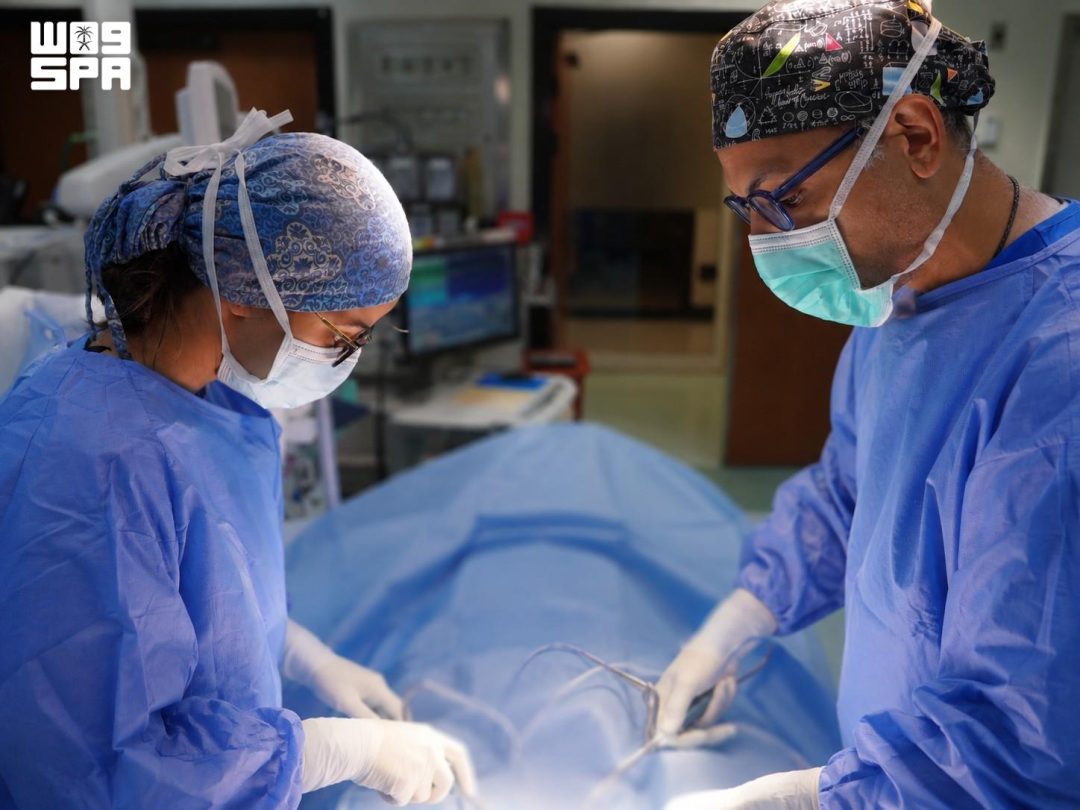
King Faisal Specialist Hospital and Research Centre (KFSH) Jeddah performed a hysterectomy using Vaginal Natural Orifice Trans-Endoscopic Surgery (VNOTES) on a patient in her fifties. The patient suffered from severe vaginal bleeding caused by uterine fibroids.
According to SPA, the procedure was conducted by the Department of Obstetrics and Gynecology without any external surgical incisions. This technique replaces conventional abdominal laparoscopic surgery, which requires small incisions in the abdominal wall to insert instruments.
The VNOTES approach utilizes a natural access route to reduce blood loss and the need for pain medication. The integration of specialized surgical instruments and high-definition visualization allowed the procedure to be performed with safety and efficiency, accelerating the patient’s recovery and return to normal activities.
The procedure is limited in adoption because it requires dual expertise in advanced vaginal surgery and minimally invasive endoscopy. It also necessitates careful patient selection and coordination between nursing, anesthesia, and surgical teams.
What medical condition was treated at KFSH Jeddah using the VNOTES procedure? The procedure was performed on a patient in her fifties who was suffering from severe vaginal bleeding. This condition was caused by uterine fibroids, and the medical team from the Department of Obstetrics and Gynecology at KFSH Jeddah used the Vaginal Natural Orifice Trans-Endoscopic Surgery (VNOTES) to treat her.
How does the VNOTES technique differ from conventional abdominal laparoscopic surgery? Conventional abdominal laparoscopic surgery requires small incisions in the abdominal wall to insert surgical instruments. In contrast, the VNOTES technique is performed entirely through a natural access route without any external surgical incisions, which reduces blood loss and the need for pain medication.
What are the benefits and requirements of the VNOTES hysterectomy? The procedure reduces pain, shortens the hospital stay, and accelerates the patient’s recovery and return to normal activities. However, it requires dual expertise in minimally invasive endoscopy and advanced vaginal surgery, alongside close coordination between nursing, anesthesia, and surgical teams.