


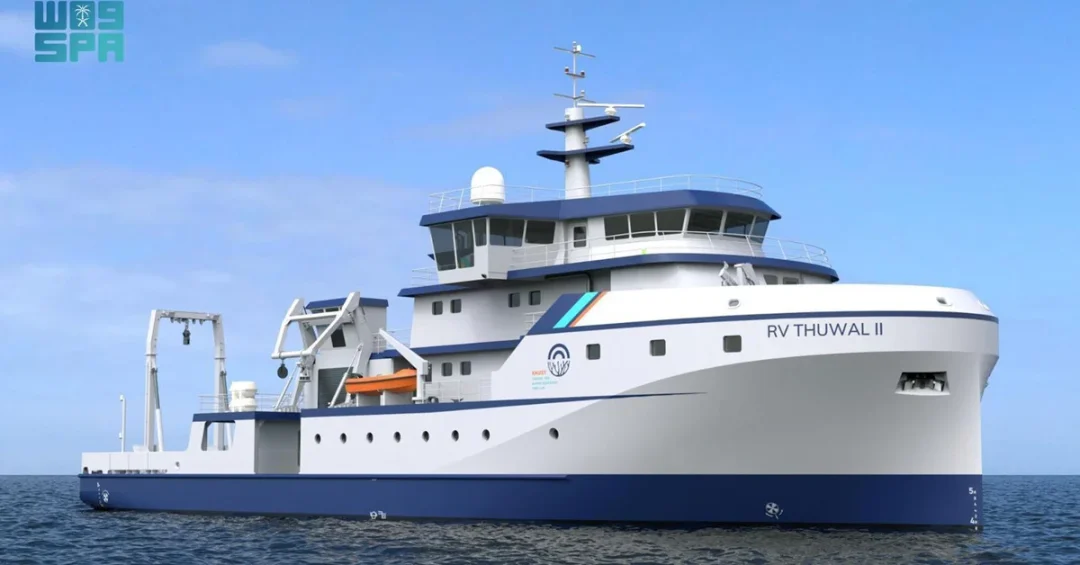
King Abdullah University of Science and Technology (KAUST) has announced the construction of Saudi Arabia’s first regional research vessel, Thuwal II, marking a significant advancement in the Kingdom’s marine research capabilities. The vessel, set to become the flagship of Saudi Arabia’s research fleet, will support all marine research missions, including those undertaken by mega projects and ministries. The announcement was made on August 15, 2024, and underscores the Kingdom’s commitment to exploring the Red Sea’s rich marine environment.
Context and Background
The Red Sea, with its unique biodiversity and geological features, has long been a subject of scientific interest. KAUST, a leading research institution in Saudi Arabia, has been at the forefront of marine studies in the region. The construction of Thuwal II represents a strategic move to enhance research capabilities and foster international collaboration. The vessel will be built by Freire Shipyards, a company with over 100 years of shipbuilding experience, at its shipyard in Vigo, Spain. This choice reflects the global expertise being leveraged to support Saudi Arabia’s scientific ambitions.
Key Details
The Thuwal II will be 50 meters long, 12.8 meters wide, and have a draft depth of 3.6 meters. It is designed to operate for 30 years and features a modular design that allows for various experimental laboratories compatible with current and future marine technologies. The vessel can also incorporate new green propulsion technologies to reduce its carbon footprint over time. In addition to its primary function as a research vessel, Thuwal II will be capable of supporting national emergency responses, such as oil spills, and maritime and aviation incidents in the Red Sea. The vessel will accommodate 30 people, with 12 expected to be crew members, leaving the remaining spaces open for researchers. It will be capable of exploring the deepest points of the Red Sea and deploying a variety of remotely operated vehicles and autonomous underwater submarines to conduct visual and acoustic surveys, collect water samples, and map the seabed.
International Collaboration
The design of Thuwal II was carried out by Glosten, a U.S.-based company, which will continue to provide off-site engineering support during construction. Additionally, Maritime Survey International, an Australian company, has been selected to represent KAUST on-site, overseeing daily construction activities. The planning for Thuwal II has involved dozens of stakeholders in the Kingdom, including mega projects, ministries, and several universities with expertise in oceanography and marine operations. This collaborative approach highlights Saudi Arabia’s ability to attract international partners and foster scientific collaboration.
Implications and Impact
The Thuwal II will provide full access to the Red Sea, including coastal waters and deep-sea areas, enhancing research in the Kingdom and attracting more international partners. This will strengthen Saudi Arabia’s position as a global leader in marine research, given the significant interest in the Red Sea among scientific communities. The vessel’s capabilities will also support environmental monitoring and emergency response, contributing to the safety and sustainability of the Red Sea region. By facilitating cutting-edge research, Thuwal II will enable a deeper understanding of marine ecosystems, which is crucial for the conservation and sustainable development of the Red Sea’s resources.
Vision 2030 Alignment
The construction of Thuwal II aligns with Saudi Arabia’s Vision 2030, which aims to diversify the economy and promote scientific innovation. By investing in advanced research infrastructure, the Kingdom is positioning itself as a hub for marine science and technology, attracting talent and investment from around the world. This project exemplifies the nation’s commitment to sustainable development and environmental stewardship, while also enhancing its global standing in scientific research. As Saudi Arabia continues to pursue its ambitious Vision 2030 goals, initiatives like Thuwal II will play a vital role in driving progress and fostering international cooperation.
20 Questions
Q1. What is the name of Saudi Arabia’s first regional research vessel?
A1. The vessel is named Thuwal II, and it will serve as the flagship of Saudi Arabia’s research fleet, supporting all marine research missions, including those undertaken by mega projects and ministries.
Q2. Which company is building the Thuwal II?
A2. Freire Shipyards, a company with over 100 years of shipbuilding experience, is constructing the vessel at its shipyard in Vigo, Spain.
Q3. When is the Thuwal II expected to be completed?
A3. The vessel is expected to be completed in 2026, providing full access to the Red Sea for research purposes.
Q4. What are the dimensions of the Thuwal II?
A4. The vessel is 50 meters long, 12.8 meters wide, and has a draft depth of 3.6 meters, designed to operate for 30 years.
Q5. What is the primary function of the Thuwal II?
A5. Its primary function is marine research, including exploring coral reefs, marine life, and geological formations in the Red Sea, and supporting national emergency responses.
Q6. How many people can the Thuwal II accommodate?
A6. The vessel can accommodate 30 people, with 12 crew members and the remaining spaces open for researchers.
Q7. Which company designed the Thuwal II?
A7. The vessel was designed by Glosten, a U.S.-based company, which will continue to provide off-site engineering support during construction.
Q8. Which company represents KAUST on-site during construction?
A8. Maritime Survey International, an Australian company, has been selected to represent KAUST on-site, overseeing daily construction activities.
Q9. What are some capabilities of the Thuwal II?
A9. It can deploy remotely operated vehicles and autonomous underwater submarines to conduct visual and acoustic surveys, collect water samples, and map the seabed.
Q10. How does the Thuwal II support environmental sustainability?
A10. The vessel can incorporate new green propulsion technologies to reduce its carbon footprint over time, aligning with sustainable practices.
Q11. What role does the Thuwal II play in emergency response?
A11. It is capable of supporting national emergency responses, such as oil spills, and maritime and aviation incidents in the Red Sea.
Q12. How does the Thuwal II enhance Saudi Arabia’s global position?
A12. It strengthens Saudi Arabia’s position as a global leader in marine research, attracting international partners and fostering scientific collaboration.
Q13. What is the significance of the Red Sea for research?
A13. The Red Sea has significant interest among scientific communities due to its unique biodiversity and geological features, which the Thuwal II will explore.
Q14. Who was involved in planning the Thuwal II?
A14. Dozens of stakeholders in the Kingdom, including mega projects, ministries, and several universities with expertise in oceanography and marine operations, were involved.
Q15. What kind of research missions will the Thuwal II support?
A15. It will support all marine research missions, including those undertaken by mega projects and ministries, focusing on the Red Sea’s coastal and deep-sea areas.
Q16. How does the Thuwal II align with Vision 2030?
A16. It aligns with Vision 2030 by promoting scientific innovation, diversifying the economy, and positioning Saudi Arabia as a hub for marine science and technology.
Q17. What makes the Thuwal II’s design modular?
A17. The modular design allows for various experimental laboratories compatible with current and future marine technologies, enabling flexible research configurations.
Q18. What is the expected operational lifespan of the Thuwal II?
A18. The vessel is designed to operate for 30 years, providing long-term research capabilities for Saudi Arabia.
Q19. How will the Thuwal II attract international partners?
A19. By providing advanced research capabilities and access to the Red Sea, it will encourage greater scientific collaboration and attract international partners to join Saudi Arabia’s research efforts.
Q20. What emergency scenarios can the Thuwal II respond to?
A20. It can respond to oil spills, maritime incidents, and aviation incidents in the Red Sea, enhancing national emergency preparedness and environmental protection.
Reader Feedback
We value your thoughts. Please share your feedback on this article.
Your feedback helps us improve our coverage.