


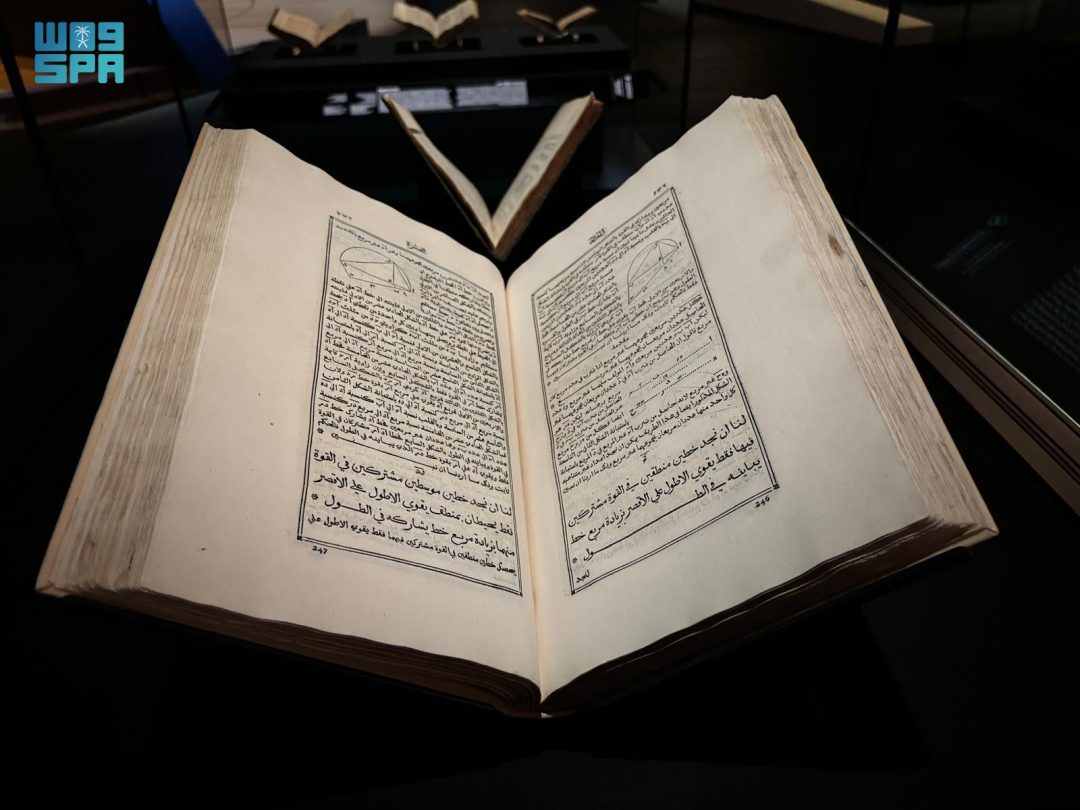
The Western Hajj Terminal in Jeddah is hosting the second edition of the Islamic Arts Biennale under the theme “And All That Is In Between,” providing a platform for research, exploration, and learning.
According to SPA, the event features the Elements textbook, a mathematical reference from the 3rd century BC written by Euclid. The text covers volume calculations of various shapes and principles of proportion and geometry.
The Biennale also highlights the work of Muslim scholar Nasir Al-Din Al-Tusi, who produced a revised edition titled “The Recension of Euclid’s Elements.” Al-Tusi restructured the work and corrected errors found in later copies of Euclid’s original text.
Al-Tusi’s contributions focused on areas, angles, lines, and points, applying geometric methods to astronomy and architecture. This demonstrates how Middle Ages Muslim scholars analyzed, annotated, and translated ancient texts to advance geometry.
What is being showcased at the Islamic Arts Biennale in Jeddah? The second edition of the Islamic Arts Biennale, held at the Western Hajj Terminal under the theme “And All That Is In Between,” showcases the Elements textbook. Written by Euclid in the 3rd century BC, this influential mathematical reference covers essential principles of geometry, proportion, and the volume calculations of various shapes.
How did Nasir Al-Din Al-Tusi contribute to the study of Euclid’s Elements? Muslim scholar Nasir Al-Din Al-Tusi provided a revised edition of the work titled “The Recension of Euclid’s Elements.” In this version, Al-Tusi restructured the text and corrected several errors that had appeared in later copies of Euclid’s original mathematical reference.
What practical applications and principles are highlighted in Al-Tusi’s work? Al-Tusi’s work emphasizes fundamental Euclidean geometry principles such as points, lines, areas, and angles. Furthermore, he presented geometric methods that could be applied in practical fields, specifically astronomy and architecture, reflecting how Middle Ages Muslim scholars analyzed and elaborated on ancient texts.