


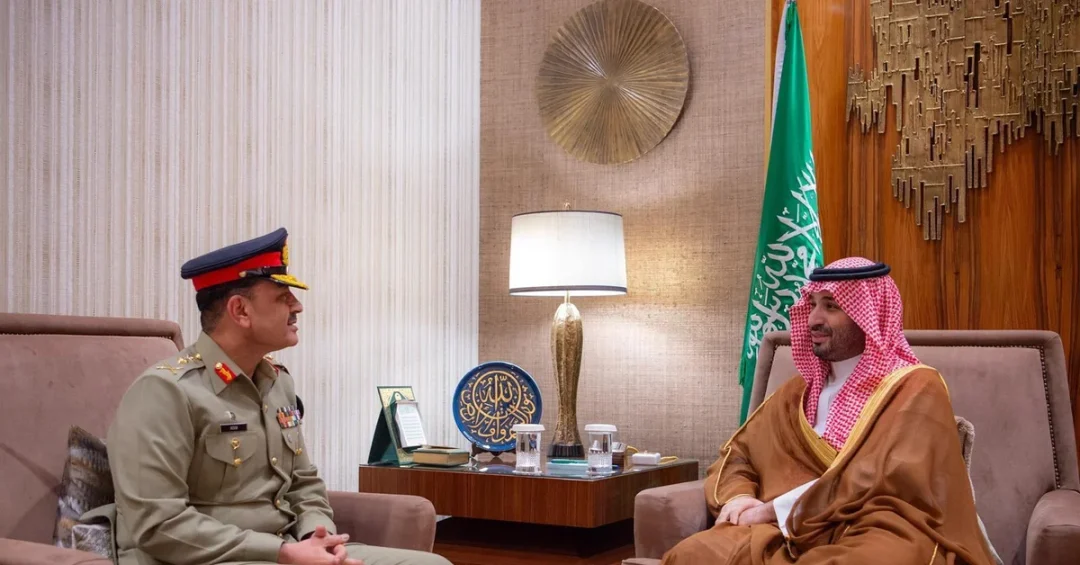
His Royal Highness Prince Mohammed bin Salman bin Abdulaziz Al Saud, Crown Prince and Prime Minister of the Kingdom of Saudi Arabia, received Pakistan’s Chief of Army Staff General Asim Munir in Riyadh on November 6, 2024. The meeting focused on strengthening bilateral relations, particularly in the military domain, and addressing issues of mutual interest. The high-level encounter underscores the deep-rooted ties between Saudi Arabia and Pakistan and their shared commitment to regional security and stability.
Context and Background
Saudi Arabia and Pakistan have enjoyed a longstanding strategic partnership, rooted in shared religious, cultural, and economic ties. Military cooperation has been a cornerstone of this relationship, with both nations collaborating on defense training, counterterrorism efforts, and joint exercises. The meeting between Crown Prince Mohammed bin Salman and General Asim Munir reflects the continued importance of this partnership in an evolving regional security landscape.
The Kingdom, under the leadership of the Crown Prince, has prioritized strengthening alliances with key Muslim-majority countries. Pakistan, with its strategic location and significant military capabilities, plays a vital role in this context. The discussions align with Saudi Arabia’s broader efforts to promote peace and stability in the region, as outlined in Vision 2030.
Key Details
During the meeting, the two leaders explored avenues to enhance bilateral relations, with a particular focus on military cooperation. They also exchanged views on regional and international developments of mutual concern. The presence of senior officials from both sides, including Saudi Minister of Defense Prince Khalid bin Salman bin Abdulaziz, Minister of State and National Security Advisor Musaed Al-Aiban, and Chief of General Staff Gen. Fayyadh Al-Ruwaili, highlights the importance attached to this engagement.
General Asim Munir’s visit is part of ongoing efforts to deepen defense ties between the two nations. Saudi Arabia has consistently supported Pakistan’s stability and prosperity, recognizing its role as a key partner in promoting security in South Asia and the broader Islamic world. The meeting also provided an opportunity to discuss potential areas for joint collaboration, including defense production, training, and intelligence sharing.
Implications and Impact
The meeting carries significant implications for regional security. Saudi Arabia and Pakistan share a common interest in combating extremism and fostering peace in the Middle East and South Asia. Enhanced military cooperation between the two countries can contribute to stability in conflict-prone areas and strengthen the collective response to emerging threats.
Furthermore, this engagement reinforces Saudi Arabia’s position as a responsible global actor and a bridge-builder among nations. By maintaining strong ties with Pakistan, the Kingdom continues to play a constructive role in promoting dialogue and understanding across the Muslim world. This aligns with Saudi Arabia’s foreign policy objectives of fostering peace, security, and development.
Vision 2030 Alignment
The meeting between Crown Prince Mohammed bin Salman and General Asim Munir exemplifies the Kingdom’s commitment to international engagement and strategic partnerships, key pillars of Vision 2030. By strengthening military and diplomatic ties with Pakistan, Saudi Arabia enhances its national security and contributes to regional stability, thereby supporting the vision’s goal of a secure and prosperous future. Such high-level interactions also underscore the Kingdom’s role as a leader in the Islamic world and a catalyst for cooperation and progress.
20 Questions
Q1. Who received Pakistan’s Chief of Army Staff General Asim Munir?
A1. His Royal Highness Prince Mohammed bin Salman bin Abdulaziz Al Saud, Crown Prince and Prime Minister of Saudi Arabia, received General Asim Munir in Riyadh on November 6, 2024.
Q2. What was the main focus of the meeting?
A2. The meeting focused on developing bilateral relations, especially in the military field, and discussing issues of mutual concern between Saudi Arabia and Pakistan.
Q3. Which Saudi officials attended the meeting?
A3. Minister of Defense Prince Khalid bin Salman bin Abdulaziz, National Security Advisor Musaed Al-Aiban, President of General Intelligence Khalid Al-Humaidan, and Chief of General Staff Gen. Fayyadh Al-Ruwaili attended the meeting, among others.
Q4. Where did the meeting take place?
A4. The meeting took place in Riyadh, the capital of Saudi Arabia, at the office of the Crown Prince.
Q5. When did the meeting occur?
A5. The meeting occurred on November 6, 2024, as reported by the Saudi Press Agency.
Q6. What is the significance of this meeting for Saudi-Pakistan relations?
A6. It underscores the strong bilateral ties and commitment to enhancing military cooperation, reflecting the deep-rooted partnership between the two nations.
Q7. How does this meeting align with Saudi Arabia’s Vision 2030?
A7. It aligns with Vision 2030 by promoting international engagement, strategic partnerships, and regional security, which are key to the Kingdom’s long-term prosperity.
Q8. What are the key areas of Saudi-Pakistan military cooperation?
A8. Key areas include defense training, counterterrorism efforts, joint military exercises, and intelligence sharing, aimed at enhancing regional stability.
Q9. Who is General Asim Munir?
A9. General Asim Munir is the Chief of Army Staff of Pakistan, responsible for leading the country’s military and playing a key role in its defense and security policies.
Q10. What is the role of Prince Khalid bin Salman in the meeting?
A10. As Minister of Defense, Prince Khalid bin Salman plays a pivotal role in shaping Saudi Arabia’s defense policies and strengthening military ties with allied nations like Pakistan.
Q11. How does this meeting impact regional security?
A11. It enhances cooperation between two key Islamic nations, contributing to stability and security in the Middle East and South Asia through joint efforts against extremism.
Q12. What message does this meeting send to the international community?
A12. It demonstrates Saudi Arabia’s active role in fostering alliances and promoting peace, reinforcing its position as a responsible global leader.
Q13. What are the economic implications of strengthened Saudi-Pakistan ties?
A13. Improved military and diplomatic relations can lead to increased trade, investment, and economic cooperation, benefiting both nations’ economies.
Q14. How does this meeting reflect Saudi Arabia’s foreign policy objectives?
A14. It reflects the Kingdom’s commitment to building strong partnerships, promoting regional stability, and supporting the interests of the Muslim world.
Q15. What other issues were discussed during the meeting?
A15. They discussed several issues of mutual concern, likely including regional security challenges, counterterrorism, and areas for enhanced bilateral cooperation.
Q16. How often do Saudi and Pakistani military leaders meet?
A16. Meetings between Saudi and Pakistani military leaders occur regularly as part of ongoing efforts to strengthen defense ties and address shared security challenges.
Q17. What is the historical context of Saudi-Pakistan relations?
A17. Saudi Arabia and Pakistan have a long history of close ties, based on shared Islamic values, cultural affinities, and mutual support in diplomatic and defense matters.
Q18. How does this meeting benefit Pakistan?
A18. It strengthens Pakistan’s defense capabilities through cooperation with Saudi Arabia and reinforces its diplomatic and economic ties with a key ally.
Q19. What role does the Saudi Ambassador to Pakistan play in these relations?
A19. The Saudi Ambassador to Pakistan, Nawaf Al-Malki, facilitates diplomatic communication and supports initiatives to enhance bilateral cooperation between the two countries.
Q20. What can we expect from future Saudi-Pakistan military cooperation?
A20. Future cooperation is likely to expand in areas such as joint training, defense technology, and intelligence sharing, further solidifying the strategic partnership.
Reader Feedback
We value your thoughts. Please share your feedback on this article.
Your feedback helps us improve our coverage.
Related articles
 Saudi Foreign Ministry Meets Nepal’s Acting Consul General
 Saudi Defense Minister Meets Pakistan Army Chief
 KSrelief and Palestinian Ministry of Education to Collaborate on Education Projects
 Saudi Aid Convoys Arrive in Northern Gaza
 Saudi Municipalities and Housing Projects Intrigue WUF12 Delegations
 KSrelief Distributes 3,000 Date Cartons in Yemen’s Al Jawf