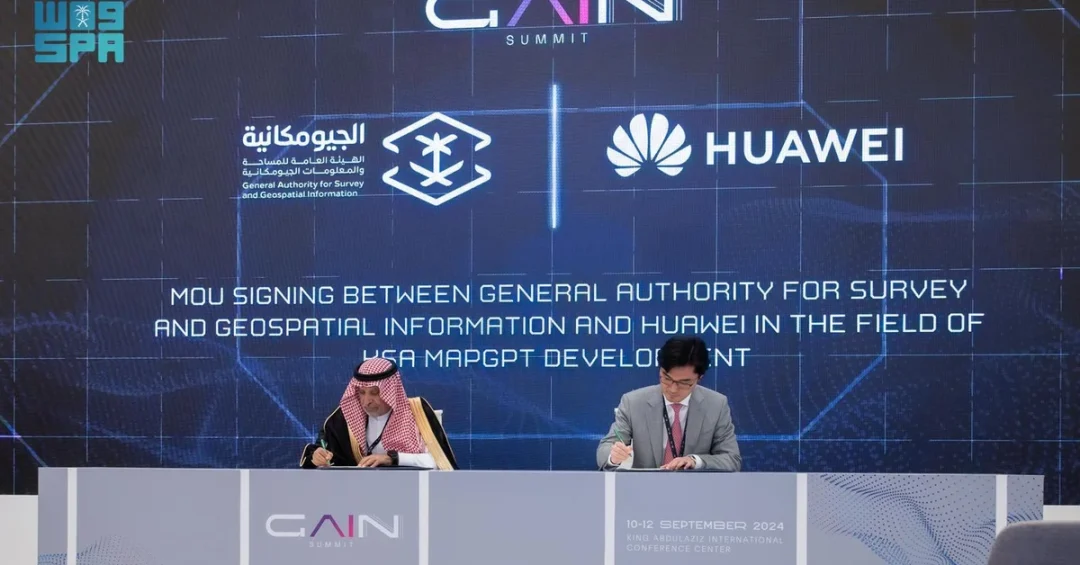
The General Authority for Survey and Geospatial Information (GEOSA) signed a memorandum of understanding (MoU) with Huawei, represented by KSA Huawei, on September 10, 2024, on the sidelines of the Global AI Summit in Riyadh. The agreement aims to develop KSA MapGPT, a geospatial artificial intelligence platform, in coordination with relevant authorities, according to the Saudi Press Agency (SPA). The summit, held under the theme “Artificial Intelligence for the Good of Humanity,” runs from September 10 to 12 and underscores Saudi Arabia’s commitment to harnessing AI for societal benefit.
Context and Background
The Global AI Summit, hosted in Riyadh, brings together global leaders, experts, and innovators to discuss the responsible advancement of artificial intelligence. GEOSA, the national authority responsible for surveying and geospatial information, plays a critical role in mapping and geospatial data management, which are essential for urban planning, infrastructure development, and environmental monitoring. Huawei, a leading global provider of information and communications technology (ICT) solutions, has a significant presence in the Kingdom through KSA Huawei, contributing to the digital transformation agenda. This MoU reflects Saudi Arabia’s broader strategy to integrate AI into key sectors, aligning with the goals of Vision 2030 to diversify the economy and enhance public services through technology.
Key Details
The MoU outlines collaboration in several areas. Primarily, the two parties intend to leverage their expertise in ICT and AI to foster geospatial innovation and develop KSA MapGPT. This platform is expected to enhance the analysis and visualization of geospatial data, supporting decision-making across various sectors. Additionally, the agreement includes enhancing GEOSA’s ICT infrastructure with cutting-edge technologies for network upgrades, secure data storage, and efficient management systems. The partnership also emphasizes promoting cloud technology and advanced AI solutions, as well as capacity building through targeted training programs to strengthen technical management and stimulate innovation. Furthermore, the parties will explore joint initiatives to promote sustainability in ICT and geospatial AI practices. These efforts are to be carried out in coordination with relevant authorities and under applicable regulations.
Implications and Impact
This collaboration is poised to significantly impact Saudi Arabia’s geospatial sector and beyond. By developing KSA MapGPT, GEOSA and Huawei aim to create a robust tool that can support urban development, disaster response, and resource management. The integration of AI into geospatial data processing can lead to more accurate and timely insights, benefiting government agencies, businesses, and the public. The MoU also signals Saudi Arabia’s growing attractiveness as a hub for technological partnerships, reinforcing its position as a regional leader in AI and digital innovation. On an international level, the involvement of Huawei highlights the global interest in collaborating with the Kingdom on advanced technologies, further integrating Saudi Arabia into the global AI ecosystem. The focus on sustainability ensures that these advancements contribute to long-term environmental and economic goals.
Vision 2030 Alignment
This MoU directly supports Saudi Arabia’s Vision 2030, which seeks to transform the Kingdom into a diversified, knowledge-based economy. By enhancing geospatial capabilities and adopting AI-driven solutions, GEOSA and Huawei contribute to the development of smart cities, efficient public services, and sustainable infrastructure. The partnership also aligns with the National Strategy for Data and AI, which aims to position Saudi Arabia as a global leader in AI by 2030. Through such collaborations, the Kingdom continues to advance its digital transformation, foster innovation, and create new opportunities for its citizens, ultimately contributing to a prosperous and sustainable future.
20 Questions
Q1. What is the purpose of the MoU between GEOSA and Huawei?
A1. The MoU aims to develop KSA MapGPT, a geospatial AI platform, and enhance GEOSA’s ICT infrastructure through advanced technologies and training programs, as announced during the Global AI Summit in Riyadh.
Q2. When and where was the MoU signed?
A2. It was signed on September 10, 2024, on the sidelines of the Global AI Summit in Riyadh, which ran from September 10 to 12 under the theme “Artificial Intelligence for the Good of Humanity.”
Q3. What is GEOSA’s role in Saudi Arabia?
A3. GEOSA, the General Authority for Survey and Geospatial Information, is responsible for surveying and geospatial data, supporting national development, urban planning, and environmental monitoring through accurate mapping and information.
Q4. What does KSA MapGPT refer to?
A4. KSA MapGPT is a geospatial artificial intelligence platform being developed through the MoU. It aims to enhance geospatial analysis and visualization, aiding decision-making across various sectors in Saudi Arabia.
Q5. Which company is partnering with GEOSA?
A5. Huawei, represented by KSA Huawei, is partnering with GEOSA. Huawei is a global leader in information and communications technology, contributing to Saudi Arabia’s digital transformation efforts.
Q6. What are the key areas of collaboration in the MoU?
A6. Key areas include developing KSA MapGPT, enhancing ICT infrastructure, promoting cloud and AI solutions, capacity building through training, and exploring sustainable ICT and geospatial AI practices.
Q7. How does this MoU benefit Saudi Arabia’s geospatial sector?
A7. It fosters innovation by integrating AI, improving data management, and enabling smarter geospatial solutions that can benefit urban planning, disaster response, and resource management across the Kingdom.
Q8. What is the significance of the Global AI Summit?
A8. The summit gathers global leaders to discuss AI for humanity’s benefit. It showcases Saudi Arabia’s commitment to AI advancement and provides a platform for key agreements like the GEOSA-Huawei MoU.
Q9. Will the collaboration involve training programs?
A9. Yes, the MoU includes capacity building through targeted training programs to strengthen technical management and stimulate innovation among Saudi professionals in ICT and geospatial AI.
Q10. How does this partnership align with Vision 2030?
A10. It supports Vision 2030 by advancing digital transformation, fostering a knowledge-based economy, and enhancing public services through AI and geospatial technologies, in line with the National Strategy for Data and AI.
Q11. What role does Huawei play in Saudi Arabia’s tech sector?
A11. Huawei, through KSA Huawei, is a key partner in Saudi Arabia’s ICT development, providing advanced technologies and solutions that support the Kingdom’s digital infrastructure and innovation goals.
Q12. What are the expected outcomes of developing KSA MapGPT?
A12. KSA MapGPT is expected to deliver advanced geospatial insights, improve decision-making, and support various sectors such as urban development, environmental monitoring, and emergency response, contributing to efficient governance.
Q13. Are there any sustainability components in the MoU?
A13. Yes, the MoU emphasizes exploring joint initiatives to promote sustainability in ICT and geospatial AI practices, ensuring that technological advancements support environmental and economic sustainability.
Q14. How will the MoU enhance GEOSA’s infrastructure?
A14. It will provide cutting-edge technologies for network upgrades, secure data storage, and efficient management systems, bolstering GEOSA’s capacity to handle geospatial data effectively and securely.
Q15. What is the significance of cloud technology in this collaboration?
A15. Cloud technology is vital for scalable, secure data storage and processing. The MoU promotes its use to enhance geospatial AI solutions, enabling flexibility and efficiency in managing large datasets.
Q16. Will the collaboration involve other Saudi authorities?
A16. Yes, the development of KSA MapGPT will be in coordination with relevant authorities and under applicable regulations, ensuring alignment with national policies and standards.
Q17. What is the expected timeline for KSA MapGPT development?
A17. The MoU outlines the intention to explore cooperation; specific timelines are not provided. The project will proceed in coordination with relevant authorities and according to regulations.
Q18. How does this MoU reflect Saudi Arabia’s global AI standing?
A18. It demonstrates Saudi Arabia’s attractiveness as a partner for global tech leaders like Huawei, reinforcing its position as a regional AI hub and its commitment to international collaboration in advanced technologies.
Q19. What benefits can businesses expect from KSA MapGPT?
A19. Businesses can expect improved geospatial data analytics, enabling better market insights, site selection, logistics planning, and operational efficiency through AI-driven mapping and location intelligence.
Q20. What are the next steps after signing the MoU?
A20. The parties will coordinate with relevant authorities to implement the outlined activities, including developing KSA MapGPT, upgrading infrastructure, and launching training programs, in accordance with regulations and procedures.
Reader Feedback
We value your thoughts. Please share your feedback on this article.
Your feedback helps us improve our coverage.