


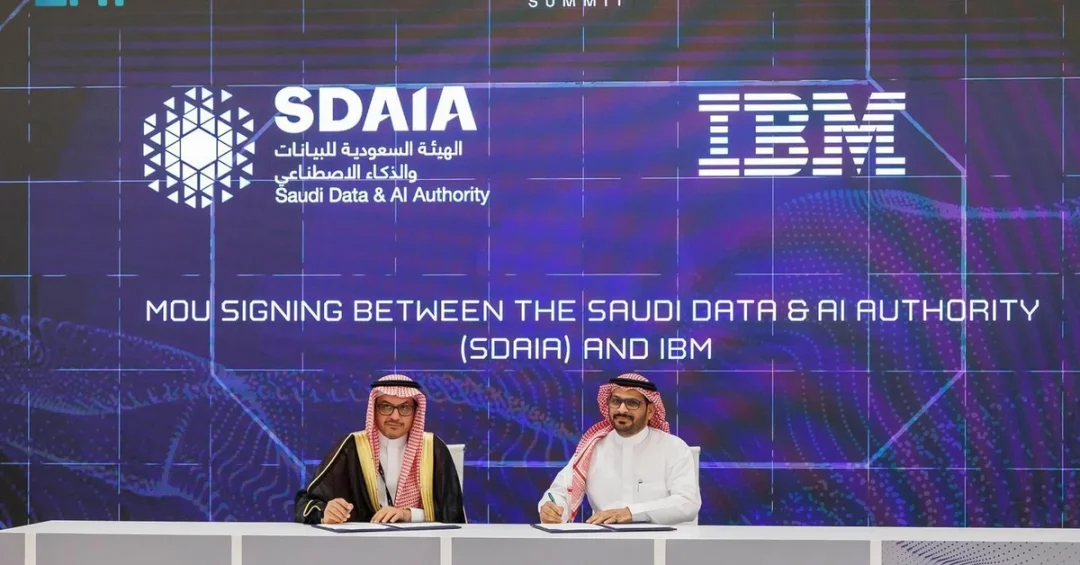
The Saudi Data and AI Authority (SDAIA) signed a Memorandum of Understanding (MoU) with IBM on September 11, 2024, on the sidelines of the third edition of the Global AI Summit (GAIN) in Riyadh, aiming to potentially establish an AI Center of Excellence and launch the ALLaM Challenge to advance Arabic large language models. The agreement was formalized at the King Abdulaziz International Convention Center between Dr. Yaser bin Mohammed Alonaizan, CEO of the National Center for AI (NCAI) under SDAIA, and Fahad Alanazi, General Manager and Technology Leader of IBM Saudi Arabia. The partnership underscores Saudi Arabia’s commitment to becoming a global leader in artificial intelligence and supports the objectives of Saudi Vision 2030.
Context and Background
SDAIA has been at the forefront of Saudi Arabia’s digital transformation, driving initiatives that harness data and AI to improve government services, foster innovation, and diversify the economy. The Global AI Summit, now in its third edition, serves as a premier platform for international collaboration, bringing together policymakers, industry leaders, and experts to shape the future of AI. This MoU with IBM builds on a prior collaboration announced earlier, where SDAIA and IBM agreed to host the ALLaM model on IBM’s Watsonx platform and the Saudi government cloud DEEM, providing stakeholders with access to advanced AI services.
Key Details
The MoU outlines a shared vision to potentially establish an AI Center of Excellence dedicated to advancing AI technologies, with a focus on developing innovative applications tailored to the needs of government entities while adhering to global standards and governance frameworks. A key component is the launch of the ALLaM Challenge, designed to foster innovation by enhancing large language models (LLMs) in the Arabic language through a ‘science’ model. The collaboration also includes exchanging expertise and strengthening national capacities, aligning with Vision 2030’s goal of building a knowledge-based society. SDAIA’s ALLaM model aims to be the leading Arabic generative AI model globally, as measured by the Arabic MMLU assessment.
Implications and Impact
This partnership is expected to accelerate AI adoption across Saudi Arabia’s public and private sectors, driving efficiencies and creating new opportunities for innovation. By collaborating with IBM, a global technology leader, SDAIA aims to enhance the Kingdom’s AI ecosystem and position Arabic language AI on the world stage. The ALLaM Challenge will encourage developers and researchers to push the boundaries of Arabic LLMs, which could lead to breakthroughs in natural language processing and other AI applications. Ultimately, this initiative reinforces Saudi Arabia’s role as a regional hub for technology and innovation, attracting talent and investment.
Vision 2030 Alignment
This collaboration directly supports Saudi Vision 2030 by advancing the Kingdom’s digital economy and fostering a knowledge-based society. Through the establishment of an AI Center of Excellence and the promotion of Arabic AI models, SDAIA and IBM are contributing to the diversification of the economy, the creation of high-skilled jobs, and the enhancement of government services. As Saudi Arabia continues to invest in emerging technologies, partnerships like this will be crucial in realizing the vision of a prosperous and technologically advanced nation.
20 Questions
Q1. What is the main purpose of the MoU signed between SDAIA and IBM?
A1. The MoU aims to potentially establish an AI Center of Excellence and launch the ALLaM Challenge to advance Arabic large language models, enhancing AI innovation in Saudi Arabia.
Q2. When and where was the MoU signed?
A2. It was signed on September 11, 2024, at the King Abdulaziz International Convention Center in Riyadh during the third Global AI Summit (GAIN).
Q3. Who signed the MoU on behalf of SDAIA and IBM?
A3. Dr. Yaser bin Mohammed Alonaizan, CEO of the National Center for AI under SDAIA, and Fahad Alanazi, General Manager and Technology Leader of IBM Saudi Arabia, signed the agreement.
Q4. What is the ALLaM Challenge?
A4. The ALLaM Challenge is an initiative under the MoU to foster innovation by developing and enhancing large language models in the Arabic language through a ‘science’ model.
Q5. How does this collaboration support Saudi Vision 2030?
A5. It supports Vision 2030 by building a knowledge-based society, strengthening national capacities, and solidifying Saudi Arabia’s position as a global leader in advanced technologies like AI.
Q6. What is the significance of the ALLaM model?
A6. The ALLaM model aims to be the leading Arabic generative AI model globally, as measured by the Arabic MMLU assessment, empowering Arabic language AI users and developers.
Q7. What previous collaboration between SDAIA and IBM is mentioned?
A7. Earlier, SDAIA and IBM announced hosting the ALLaM model on IBM’s Watsonx platform and the Saudi government cloud DEEM to provide advanced AI services.
Q8. What is the Global AI Summit (GAIN)?
A8. GAIN is a premier international event hosted by Saudi Arabia that brings together experts and leaders to discuss and shape the future of artificial intelligence.
Q9. What does the AI Center of Excellence aim to achieve?
A9. It aims to advance AI technologies by developing innovative applications for government entities, adhering to global standards and governance frameworks.
Q10. How will the exchange of expertise benefit Saudi Arabia?
A10. It will strengthen national capacities, foster innovation, and contribute to building a skilled workforce in AI, aligning with Vision 2030 goals.
Q11. What is DEEM?
A11. DEEM is the Saudi government cloud platform that will host the ALLaM model, providing secure and advanced AI services to government entities and stakeholders.
Q12. What role does the National Center for AI (NCAI) play?
A12. NCAI, under SDAIA, is responsible for driving AI initiatives in Saudi Arabia, including collaborations like this MoU to enhance the Kingdom’s AI capabilities.
Q13. What are large language models (LLMs)?
A13. LLMs are AI models trained on vast amounts of text data to understand and generate human-like language, enabling applications like chatbots and translation.
Q14. Why is Arabic language AI important?
A14. Arabic language AI promotes digital inclusion, preserves cultural heritage, and enables advanced applications for Arabic speakers globally, enhancing user experience.
Q15. How does this MoU benefit IBM?
A15. It allows IBM to collaborate with Saudi Arabia on cutting-edge AI projects, expand its reach in the region, and contribute to global AI advancements.
Q16. What is the Arabic MMLU assessment?
A16. The Arabic MMLU is a benchmark for evaluating the performance of AI models in understanding and generating Arabic language, ensuring high standards.
Q17. What are the expected outcomes of the AI Center of Excellence?
A17. It is expected to produce innovative AI solutions for government entities, drive research, and position Saudi Arabia as a leader in AI technology.
Q18. How does this collaboration impact the region’s technological innovation?
A18. It fosters regional innovation by advancing AI capabilities, creating opportunities for collaboration, and attracting investment in technology sectors.
Q19. What is SDAIA’s broader initiative regarding the ALLaM model?
A19. SDAIA aims to position ALLaM as the leading Arabic generative AI model on global platforms, empowering developers and users of Arabic AI solutions.
Q20. How does this partnership align with Saudi Arabia’s digital transformation?
A20. It accelerates digital transformation by integrating advanced AI into government services, enhancing efficiency, and supporting economic diversification.
Reader Feedback
We value your thoughts. Please share your feedback on this article.
Your feedback helps us improve our coverage.
Related articles
 GAIN Summit Showcases International AI Governance
 stc Group and RDIA Launch AI Lab in Riyadh
 SDAIA and IBM Partner to Advance AI on Deem Cloud
 King Faisal University Hosts Innovative Food and Environmental Factory
 Three Global AI Summits Place Kingdom on List of World’s Top Data and AI-Based Economies
 Saudi CST Governor Meets Telebras Officials in Brazil