


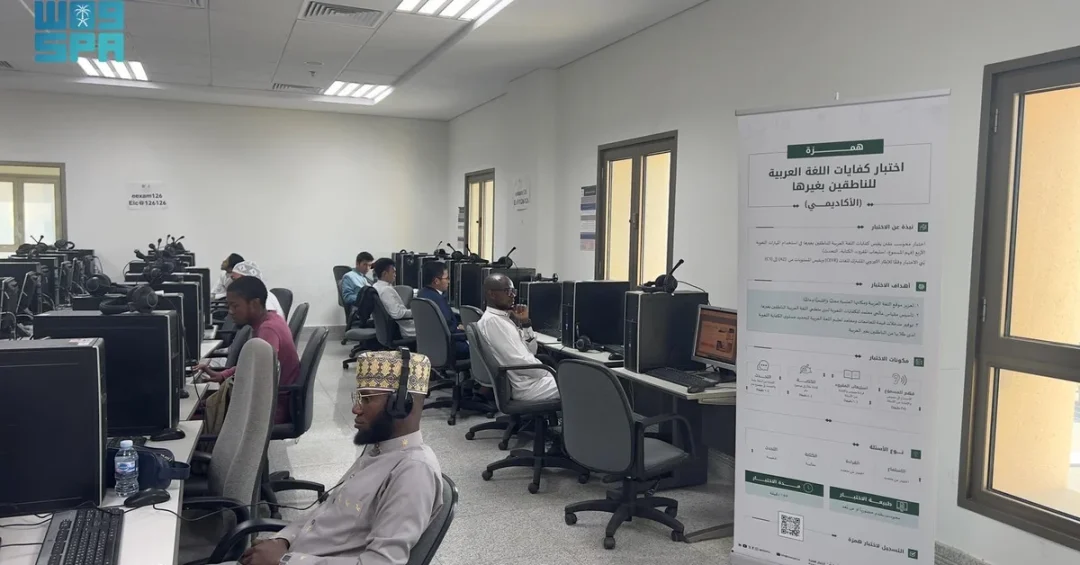
RIYADH, September 18, 2024 — The King Salman Global Academy for Arabic Language (KSGAAL), in collaboration with seven Saudi universities, conducted the Hamza Arabic language proficiency test for non-native speakers yesterday, with 315 learners sitting the exam in person for the first time. The milestone event underscores Saudi Arabia’s growing role in promoting Arabic as a global language and reflects the Kingdom’s commitment to cultural diplomacy and educational excellence under Saudi Vision 2030.
Context and Background
The Hamza test, launched in December 2023 by KSGAAL, is designed to assess the Arabic proficiency of non-native speakers. It is administered both in Saudi Arabia and internationally, including in countries such as China, Indonesia, and India. This year, the test was also offered globally online, further extending its reach. The in-person administration for 315 candidates marks a significant expansion of the test’s accessibility and impact.
KSGAAL operates under the patronage of Prince Badr bin Abdullah bin Farhan, Minister of Culture and Chairman of the Board of Trustees of KSGAAL. The academy’s efforts align with the Human Capability Development Program, a key initiative of Saudi Vision 2030 aimed at empowering individuals and enhancing the Kingdom’s global competitiveness.
Key Details
Dr. Abdullah Al-Washmi, Secretary-General of KSGAAL, expressed gratitude for the collaboration with seven prominent Saudi universities: Umm Al-Qura University, the Islamic University of Madinah, King Abdulaziz University, King Faisal University, Taif University, Qassim University, and Prince Sattam bin Abdulaziz University. He highlighted that the Hamza test is a standardized, computerized assessment that evaluates four language skills: listening comprehension, reading comprehension, writing, and speaking. It is benchmarked against the Common European Framework of Reference for Languages (CEFR), ensuring international recognition and credibility.
Al-Washmi noted that since its launch, seven Hamza tests have been administered to 1,979 learners from Saudi Arabia and abroad. The test was developed by a team of specialists who conducted comparative studies of internationally accredited language tests to establish rigorous standards and indicators for linguistic proficiency.
Implications and Impact
The Hamza test provides valuable data to universities and Arabic language institutes, helping them determine the proficiency levels of non-native students. It also reinforces KSGAAL’s strategic mission to build bridges of cooperation with entities involved in teaching Arabic globally. By offering a standardized measure of Arabic proficiency, the test facilitates the teaching and learning of Arabic, promotes correct usage of the language, and enhances Saudi Arabia’s cultural influence on the world stage.
The expansion of the Hamza test to an online format and its administration in multiple countries demonstrate Saudi Arabia’s commitment to making Arabic language education accessible to a global audience. This aligns with the Kingdom’s broader efforts to foster cultural exchange and mutual understanding.
Vision 2030 Alignment
The Hamza test is a concrete example of how Saudi Vision 2030 is being realized in the cultural and educational sectors. By promoting Arabic language proficiency and supporting the Human Capability Development Program, KSGAAL contributes to building a skilled and globally connected generation. As the test continues to grow, it will further solidify Saudi Arabia’s leadership in preserving and promoting the Arabic language, bridging cultures, and empowering learners worldwide.
20 Questions
Q1. What is the Hamza test?
A1. The Hamza test is a standardized Arabic language proficiency test for non-native speakers, developed by the King Salman Global Academy for Arabic Language (KSGAAL). It assesses listening, reading, writing, and speaking skills based on the Common European Framework of Reference for Languages (CEFR).
Q2. How many learners took the Hamza test in person recently?
A2. A total of 315 learners took the Hamza test in person, marking the first time it was administered in-person. This event was conducted in collaboration with seven Saudi universities across the Kingdom.
Q3. When was the Hamza test launched?
A3. The Hamza test was launched in December 2023 by KSGAAL. Since then, it has been administered multiple times both within Saudi Arabia and internationally, including online.
Q4. Which universities collaborated with KSGAAL for the test?
A4. Seven Saudi universities collaborated: Umm Al-Qura University, the Islamic University of Madinah, King Abdulaziz University, King Faisal University, Taif University, Qassim University, and Prince Sattam bin Abdulaziz University.
Q5. Who is the Secretary-General of KSGAAL?
A5. Dr. Abdullah Al-Washmi is the Secretary-General of KSGAAL. He has been instrumental in promoting the academy’s programs, including the Hamza test, and has expressed gratitude for the support from Saudi leadership.
Q6. What language skills does the Hamza test assess?
A6. The test assesses four language skills: listening comprehension, reading comprehension, writing, and speaking. It is designed to provide a comprehensive evaluation of a learner’s proficiency in Arabic as a second language.
Q7. How many times has the Hamza test been administered since its launch?
A7. Since its launch, the Hamza test has been administered seven times, reaching a total of 1,979 learners from Saudi Arabia and abroad. This demonstrates its growing popularity and recognition.
Q8. In which countries has the Hamza test been administered?
A8. The test has been administered in Saudi Arabia and several other countries, including China, Indonesia, and India. This year, it was also offered globally online, expanding its reach.
Q9. What is the significance of the Hamza test for non-native speakers?
A9. The Hamza test provides a standardized measure of Arabic proficiency, helping universities and institutes assess students’ language levels. It also promotes the correct use of Arabic and facilitates teaching and learning globally.
Q10. How does the Hamza test align with Saudi Vision 2030?
A10. The test supports the Human Capability Development Program, a key Vision 2030 initiative. By enhancing Arabic language proficiency, it contributes to building a skilled generation and strengthening Saudi Arabia’s global cultural presence.
Q11. Who supports KSGAAL’s programs?
A11. KSGAAL’s programs, including the Hamza test, enjoy the support of Prince Badr bin Abdullah bin Farhan, Minister of Culture and Chairman of the Board of Trustees of KSGAAL. His patronage ensures the academy’s strategic growth.
Q12. What is the Common European Framework of Reference for Languages?
A12. The CEFR is an international standard for describing language ability. The Hamza test is designed according to CEFR levels, ensuring its credibility and alignment with global benchmarks for language proficiency.
Q13. How was the Hamza test developed?
A13. The test was developed by a team of specialists who conducted benchmark comparisons and surveys of internationally accredited language tests. They established linguistic proficiency criteria and sub-indicators for evaluating learners.
Q14. What benefits does the Hamza test offer to universities?
A14. Universities and Arabic language institutes use the Hamza test results to determine the proficiency levels of their non-native students. This helps tailor instruction and support students in achieving language mastery.
Q15. Is the Hamza test available online?
A15. Yes, in addition to in-person administration, the Hamza test was offered globally online this year. This online option increases accessibility for learners worldwide, especially those unable to travel.
Q16. What is KSGAAL’s mission?
A16. KSGAAL’s mission is to promote the Arabic language globally, establish standards for proficiency, and build bridges of cooperation with entities teaching Arabic. It aims to disseminate correct usage and facilitate learning.
Q17. How does the Hamza test contribute to cultural exchange?
A17. By providing a standardized assessment of Arabic proficiency, the test encourages more people to learn Arabic, fostering cultural understanding and exchange. It also showcases Saudi Arabia’s dedication to preserving the language.
Q18. What was the total number of learners who have taken the Hamza test?
A18. Since its launch, 1,979 learners from Saudi Arabia and abroad have taken the Hamza test. This includes the 315 who participated in the recent in-person administration.
Q19. What role does the Human Capability Development Program play?
A19. The Human Capability Development Program is a Vision 2030 initiative focused on empowering individuals through education and skills development. The Hamza test supports this by enhancing Arabic language proficiency, a key capability.
Q20. How does the Hamza test reflect Saudi Arabia’s global role?
A20. The Hamza test demonstrates Saudi Arabia’s leadership in promoting Arabic as a global language. Through international administrations and online options, it reinforces the Kingdom’s commitment to cultural diplomacy and educational excellence.
Reader Feedback
We value your thoughts. Please share your feedback on this article.
Your feedback helps us improve our coverage.
Related articles
 Red Sea Film Foundation Hosts 48Hr Filmmaking Awards
 Saudi Cultural Week in Greece Highlights Year of the Camel
 Saudi Falcons Club Celebrates 94th National Day in Riyadh
 Jeddah Historic District Unveils New Archaeological Finds
 Saudi Artworks Dazzle at Cairo’s ‘Beyond the Frame II’ Exhibition
 Saudi Culinary Arts Commission Joins Terra Madre 2024