


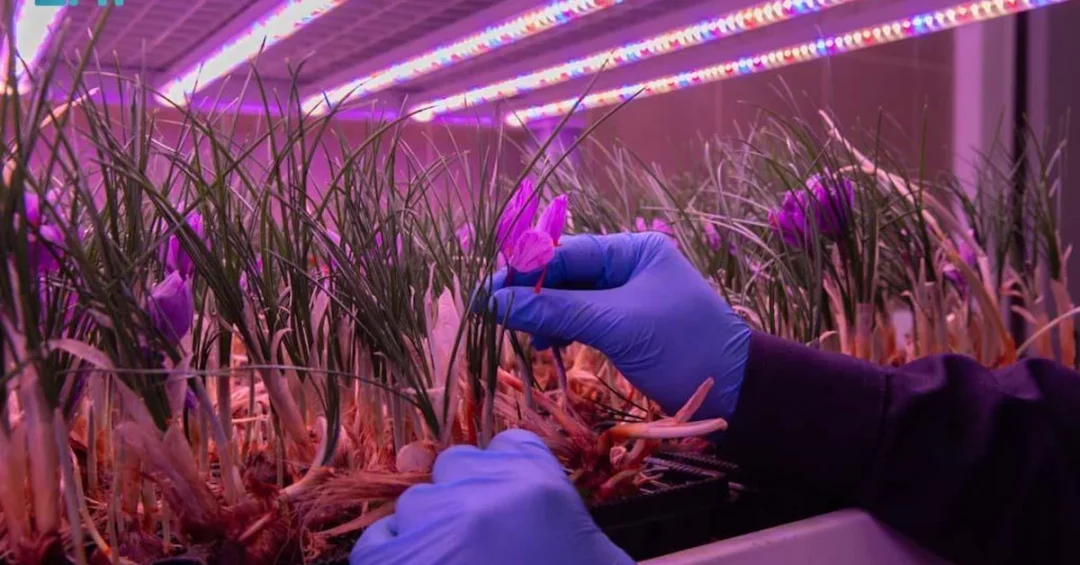
Saudi Arabia’s National Research and Development Center for Sustainable Agriculture (Estidamah) has launched a new project to localize and expand saffron production across the Kingdom, according to an announcement carried by the Saudi Press Agency (SPA). The initiative, reported from Riyadh, targets four key agricultural regions — Riyadh, Qassim, Tabuk, and Al-Baha — and forms part of the Kingdom’s broader national agriculture strategy, which prioritizes the sustainable use of natural resources and the advancement of applied agricultural research. Could a single spice become a symbol of how far Saudi agriculture has come?
The project reflects a deliberate push to cultivate and promote saffron throughout the Kingdom while doubling domestic production of one of the world’s most valuable agricultural commodities. Saffron, often called “red gold” for its price and rarity, requires precision cultivation, careful harvesting, and deep scientific understanding — precisely the kind of challenge Estidamah was established to address. The center’s work sits at the intersection of research, sustainability, and economic diversification, three priorities that increasingly define Saudi Arabia’s agricultural ambitions. For a Kingdom historically reliant on food imports, localizing high-value crops is both an economic opportunity and a strategic imperative.
Context and Background
Why does saffron matter so much to modern agricultural economies? Saffron is derived from the stigmas of the Crocus sativus flower and is widely recognized as the most expensive spice in the world by weight. Its production is labor-intensive, its yields are low, and its quality depends on precise climatic and soil conditions. These characteristics make it an attractive target for countries seeking high-value, low-volume agricultural exports that can generate significant returns on relatively small plots of land. For Saudi Arabia, the appeal is clear: saffron offers an economically efficient path toward agricultural diversification without placing unsustainable demands on water and arable land.
Estidamah, formally known as the National Research and Development Center for Sustainable Agriculture, operates as a specialized institution dedicated to developing innovative solutions that keep the Kingdom at the forefront of modern agricultural practices. Its mandate covers applied research, technology transfer, and the promotion of sustainable farming methods suited to the Kingdom’s climate. The saffron localization project therefore fits squarely within the center’s established mission, building on prior work in controlled-environment agriculture, water-efficient irrigation, and crop diversification. Have you considered how much scientific groundwork precedes a single harvest?
The announcement also connects to the national agriculture strategy, a framework that emphasizes sustainability, resource efficiency, and research-driven growth. Under this strategy, Saudi Arabia has invested in greenhouse technologies, desalination-linked irrigation, and precision farming across multiple regions. Saffron, with its high value per hectare, complements these efforts by offering farmers a premium crop that can thrive under carefully managed conditions. The selection of Riyadh, Qassim, Tabuk, and Al-Baha as focal regions suggests a deliberate effort to test cultivation across varied climates and elevations, from the central plateau to the cooler highlands of the southwest.
Key Details of the Saffron Localization Project
What exactly does the project aim to achieve, and how will it measure success? According to the official announcement, the project seeks to cultivate and promote saffron cultivation throughout the Kingdom while working to double domestic production. That objective implies a structured program of research, field trials, and knowledge dissemination, since expanding saffron cultivation in Saudi Arabia’s agricultural landscape requires substantial scientific study. The project will therefore likely involve agronomic research on corm selection, planting density, irrigation regimes, and post-harvest handling, all calibrated to local conditions.
The four target regions bring distinct advantages. Riyadh, the capital region, hosts major research infrastructure and serves as an administrative hub where findings can be coordinated and disseminated. Qassim is well known for its established agricultural sector and date palm cultivation, offering a skilled farming community and existing extension networks. Tabuk, in the northwest, features cooler temperatures and proximity to emerging development corridors. Al-Baha, in the southwest highlands, provides elevation and microclimates that may suit saffron’s sensitivity to heat. Together, these regions represent a geographically balanced testing ground.
Success will depend on transferring laboratory findings into practical guidance for farmers. Estidamah’s role includes developing and promoting innovative solutions, which suggests the project will produce technical recommendations, training materials, and demonstration plots. For farmers, the value proposition is straightforward: saffron commands premium prices in global markets, and domestic production can reduce reliance on imports while creating new income streams in rural communities. Does that sound like a niche experiment, or the beginning of a new agricultural sector?
International and Regional Impact
How might a Saudi saffron program resonate beyond the Kingdom’s borders? Global saffron supply is concentrated among a small number of producers, with Iran, Afghanistan, India, Greece, and Morocco among the most prominent. This concentration creates both price volatility and supply vulnerability, factors that have encouraged other countries to explore domestic cultivation. By investing in localization, Saudi Arabia positions itself within a broader international trend of high-value crop diversification, one that emphasizes resilience and quality control rather than sheer volume.
Regionally, the project could strengthen agricultural cooperation across the Gulf. Neighboring states face similar constraints — limited arable land, scarce water, and heavy reliance on food imports — and have increasingly pursued controlled-environment agriculture as a solution. Saudi research outcomes in saffron cultivation could be shared through regional agricultural bodies and joint research programs, reinforcing the Kingdom’s role as a source of practical innovation for arid environments. Such knowledge exchange aligns with the Kingdom’s wider diplomatic emphasis on development and stability.
The timing also matters. Global interest in premium, traceable food products continues to grow, and consumers increasingly value origin, sustainability, and quality assurance. Saudi-produced saffron could eventually serve both domestic luxury markets and export channels, particularly in high-income economies where provenance is part of the product’s appeal. Could a crop once associated with distant highlands become part of the Kingdom’s export identity?
Economic and Strategic Significance
Why treat a spice as a strategic crop? The economics of saffron are unusual: small cultivation areas can generate outsized revenue, making it viable for countries with limited agricultural land. Doubling domestic production would reduce import expenditures and create opportunities for local processing, packaging, and branding. Each of these stages adds value and employment, from horticultural technicians to quality-control specialists. For rural communities in Qassim, Tabuk, and Al-Baha, saffron could become a seasonal income source that complements existing crops.
Strategically, the project reinforces food security objectives. Saudi Arabia has long pursued a diversified food supply, recognizing that dependence on a narrow set of imports carries risk. Localizing high-value crops does not replace staple food imports, but it builds resilience, technical capability, and a more balanced agricultural economy. Research institutions like Estidamah are central to this effort because they generate the evidence base that farmers, investors, and policymakers need before committing resources to a new crop.
The initiative also strengthens the Kingdom’s scientific capacity. Applied agricultural research requires laboratories, greenhouses, data systems, and trained personnel. By focusing on saffron, Estidamah can advance general capabilities — such as controlled-environment cultivation and precision irrigation — that transfer to many other crops. In that sense, the saffron project is as much about building an innovation ecosystem as it is about producing a luxury spice.
Vision 2030 Alignment
How does saffron connect to Saudi Vision 2030? The Vision’s core themes include economic diversification, sustainable development, and the creation of new opportunities for citizens. Agriculture sits within that framework as a sector where technology and tradition can combine to generate growth. Estidamah’s work directly supports the national agriculture strategy’s emphasis on sustainable natural resource use, while the localization of premium crops contributes to a more varied and resilient economy.
Beyond economics, the project speaks to quality of life and regional development. New cultivation opportunities in Al-Baha, Qassim, and Tabuk can support local employment and entrepreneurship, encouraging younger Saudis to see agriculture as a modern, science-driven field. As the Kingdom continues to invest in research and innovation, initiatives like saffron localization demonstrate that Vision 2030 reaches into every corner of the economy — even the delicate purple flower at the heart of the world’s most precious spice. What might the next localized crop be?
20 Questions
Q1. What is Estidamah and what does it do?
A1. Estidamah is the National Research and Development Center for Sustainable Agriculture in Saudi Arabia. It develops and promotes innovative agricultural solutions, conducts applied research, and supports sustainable farming practices that keep the Kingdom at the forefront of modern agriculture.
Q2. What new project has Estidamah launched?
A2. Estidamah has launched a project to localize and increase saffron production in the Kingdom, aiming to cultivate and promote saffron cultivation across Saudi Arabia while doubling domestic production.
Q3. Which regions are targeted by the saffron project?
A3. The project focuses on four key regions: Riyadh, Qassim, Tabuk, and Al-Baha. Together they offer varied climates, elevations, and agricultural infrastructure, providing a balanced testing ground for saffron cultivation.
Q4. Why is saffron considered a valuable crop?
A4. Saffron is the world’s most expensive spice by weight, derived from Crocus sativus stigmas. Its high value per hectare makes it attractive for countries with limited arable land seeking premium agricultural exports.
Q5. How does the project align with national strategy?
A5. It aligns with the broader national agriculture strategy, which prioritizes sustainable use of natural resources and advancement of applied agricultural research, supporting economic diversification and food security goals.
Q6. What does doubling domestic production involve?
A6. Doubling production requires research, field trials, and farmer guidance. Estidamah will study corm selection, irrigation, and post-harvest handling while disseminating findings to expand cultivation nationwide.
Q7. Why is scientific research essential for saffron?
A7. Saffron is sensitive to climate and soil conditions, with labor-intensive harvesting and low yields. Substantial research is needed to adapt cultivation methods to Saudi Arabia’s environment and ensure consistent quality.
Q8. What role does Riyadh play in the project?
A8. Riyadh serves as an administrative and research hub, hosting major infrastructure and coordinating findings. Its central location supports dissemination of results to other regions and farming communities.
Q9. Why is Qassim important for saffron cultivation?
A9. Qassim has an established agricultural sector and skilled farming community, particularly in date palm cultivation. Existing extension networks and expertise can support the introduction of saffron as a high-value crop.
Q10. What advantage does Tabuk offer?
A10. Tabuk features cooler temperatures and proximity to emerging development corridors in the northwest, providing climatic conditions that may suit saffron’s sensitivity to heat and supporting regional agricultural growth.
Q11. How does Al-Baha fit into the project?
A11. Al-Baha’s southwestern highlands offer elevation and microclimates that may be well suited to saffron. Its inclusion diversifies testing conditions and supports rural development in the region.
Q12. How will farmers benefit from the project?
A12. Farmers can gain access to technical guidance, demonstration plots, and a premium crop with strong market demand. Saffron offers new income streams and reduces reliance on traditional crops.
Q13. What is the global saffron market like?
A13. Global supply is concentrated among a few producers such as Iran, Afghanistan, India, Greece, and Morocco. This concentration creates price volatility and encourages other countries to develop domestic cultivation.
Q14. Could Saudi saffron be exported?
A14. Yes. Growing global demand for traceable, premium food products means Saudi-produced saffron could serve domestic luxury markets and potentially export channels where origin and quality matter.
Q15. How does the project support food security?
A15. By localizing high-value crops, the Kingdom reduces import dependence and builds agricultural resilience. It complements staple food imports while strengthening technical capability and a balanced agricultural economy.
Q16. What technologies might be used?
A16. Controlled-environment agriculture, precision irrigation, and greenhouse technologies developed by Estidamah are likely to feature, along with data systems supporting research and quality control.
Q17. How does this connect to Vision 2030?
A17. Vision 2030 emphasizes economic diversification, sustainability, and opportunity creation. Saffron localization supports these goals by advancing research-driven agriculture and rural development.
Q18. What skills will the project develop?
A18. The project can build capabilities in horticulture, agronomy, quality control, and processing. These skills transfer to other crops and strengthen the Kingdom’s broader agricultural innovation ecosystem.
Q19. What are the next steps for Estidamah?
A19. Estidamah will continue research, field trials, and knowledge dissemination, refining cultivation methods and supporting farmers as saffron production expands across the four target regions and beyond.
Q20. Why does this project matter for Saudi Arabia’s future?
A20. It demonstrates how research and sustainability can create new economic value, supporting diversification and rural opportunity. Saffron localization shows Vision 2030 reaching every sector of the economy.
Reader Feedback
We value your thoughts. Please share your feedback on this article.
Your feedback helps us improve our coverage.
Related articles
 Biban 24: 370+ Sessions, 16,000 Training Opportunities
 Madinah Dates Season Empowers Families in Cottage Industry
 Japanese Stock Index Closes Higher Amid Global Market Watch
 Mawani, Hamburg Port Authority Sign MoU to Boost Efficiency
 Qassim’s Mineral Wealth Valued at SAR122.3 Billion
 Financial Academy Forum Concludes with Focus on Talent Growth