


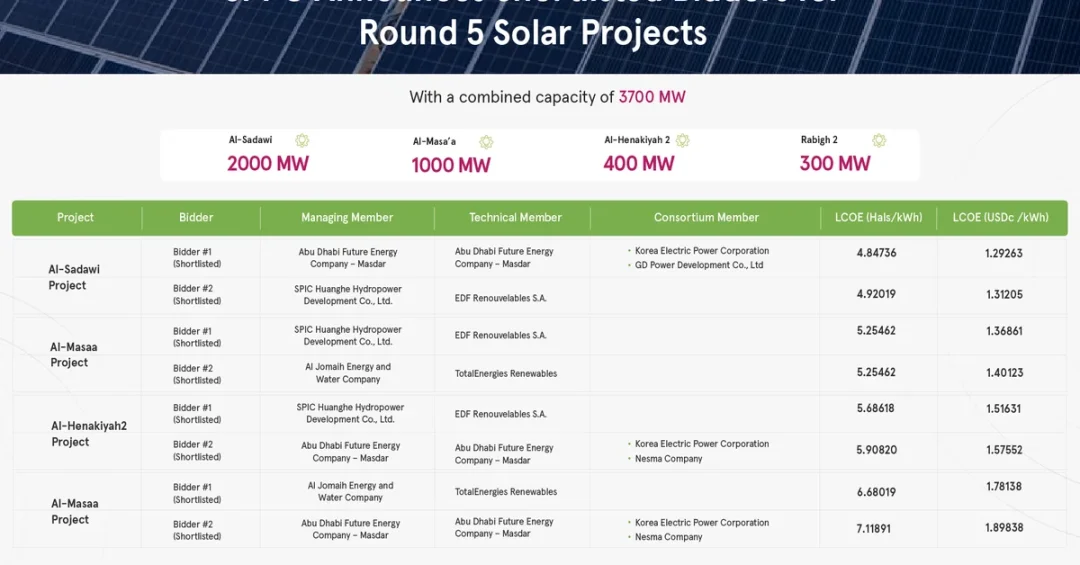
The Saudi Power Procurement Company (Principal Buyer), acting under the supervision of the Ministry of Energy, announced the shortlisted consortiums for four solar energy projects comprising the fifth phase of the National Renewable Energy Program (NREP), with total investments of approximately SAR 8 billion (USD 2.13 billion). The announcement, released via the Saudi Press Agency (SPA), marks another significant step in the Kingdom’s accelerating renewable energy program, which is designed to diversify the national energy mix and support the objectives of Saudi Vision 2030. The four projects together represent 3,700 megawatts (MW) of solar photovoltaic (PV) capacity and will be developed under a build-own-operate model, with the winning bidders signing 25-year Power Purchase Agreements (PPAs) with the Principal Buyer.
Why does this announcement matter so much at this particular moment in the Kingdom’s energy transition? The fifth phase of the NREP arrives at a time when Saudi Arabia is rapidly scaling up its renewable generation capacity, having already awarded projects exceeding 19 gigawatts (GW) to date. The shortlisting of consortiums for these four projects signals that the competitive procurement process is functioning efficiently and that investor confidence in Saudi Arabia’s renewable energy sector remains strong. It also underscores the Kingdom’s commitment to meeting its target of generating approximately 50 percent of its electricity from renewable sources by 2030, a goal that requires sustained and transparent project pipelines.
Context and Background
How did the fifth phase of the National Renewable Energy Program reach this advanced stage? The Saudi Power Procurement Company launched the Request for Proposals (RFP) for the four projects on February 8, inviting qualified developers to participate in a transparent and competitive bidding process. The projects include the Al-Sadawi Solar PV Project with a capacity of 2,000 MW, the Al-Masa’a Solar PV Project with 1,000 MW, the Al-Henakiyah 2 Solar PV Project with 400 MW, and the Rabigh 2 Solar PV Project with 300 MW. In August, the Principal Buyer received six bids for each project, all of which were subsequently reviewed and evaluated to ensure full compliance with the technical and commercial requirements outlined in the RFP.
The National Renewable Energy Program, supervised by the Ministry of Energy, is the principal vehicle through which Saudi Arabia intends to transform its power generation landscape. Historically reliant on hydrocarbon resources for electricity production, the Kingdom is now systematically integrating large-scale solar and wind capacity into its grid. The Principal Buyer plays a central role in this process by conducting preliminary studies for renewable energy projects, offering them for competitive tender, and purchasing the electricity generated within the Kingdom. This centralized procurement model provides developers with a clear, predictable framework and ensures that projects are aligned with national energy priorities.
The scale of the fifth-phase projects reflects the maturity of Saudi Arabia’s renewable energy market. The Al-Sadawi project alone, at 2,000 MW, is among the largest single-site solar PV developments announced in the region. Such scale enables economies of scale that drive down the levelized cost of electricity, making solar power increasingly competitive with conventional generation. The land designated for the Rabigh 2 project is located in Rabigh Industrial City, which is overseen by the Saudi Authority for Industrial Cities and Technology Zones (MODON), highlighting the integration of renewable energy infrastructure with the Kingdom’s broader industrial development strategy.
Key Details
What exactly happens next for the shortlisted consortiums and the projects they hope to build? Following the evaluation of the six bids received for each project in August, the Principal Buyer has now shortlisted consortiums that meet the rigorous technical and commercial criteria. The winning company or consortium for each project will enter into a 25-year Power Purchase Agreement with the Principal Buyer under a build-own-operate framework. This long-term contractual structure provides revenue certainty for developers, enabling them to secure financing on favorable terms and to commit to delivering reliable, clean electricity over the life of the agreement.
The total investment across the four projects is estimated at approximately SAR 8 billion (USD 2.13 billion), a substantial capital commitment that will flow into engineering, procurement, construction, and long-term operations and maintenance activities. The projects are expected to create skilled employment opportunities, stimulate local supply chains, and contribute to the localization of renewable energy expertise within the Kingdom. The Principal Buyer has invited the public to visit the National Renewable Energy Program’s website at www.powersaudiarabia.com.sa for further information on the program and its projects, underscoring the commitment to transparency and stakeholder engagement.
The distribution of capacities across the four projects—2,000 MW at Al-Sadawi, 1,000 MW at Al-Masa’a, 400 MW at Al-Henakiyah 2, and 300 MW at Rabigh 2—reflects a deliberate strategy to balance very large-scale generation hubs with smaller, strategically located facilities. Al-Henakiyah 2 builds on the success of the earlier Al-Henakiyah project, demonstrating the Kingdom’s approach of developing sites in phases to maximize infrastructure utilization and grid integration. Rabigh 2, located in an established industrial city, can support industrial offtake and contribute to the greening of the Kingdom’s manufacturing base.
International and Regional Impact
How does Saudi Arabia’s solar expansion resonate beyond its borders? The Kingdom’s renewable energy program has attracted interest from leading international developers, utilities, and investment funds, many of which participate in consortiums bidding for NREP projects. The shortlisting of consortiums for the fifth phase reinforces Saudi Arabia’s position as one of the most attractive renewable energy markets in the world, offering scale, strong counterparty credit, and a transparent regulatory framework. Regional neighbors are watching closely, as Saudi Arabia’s success in deploying gigawatt-scale solar capacity provides a model for other countries seeking to diversify their energy mixes.
The global significance of these projects extends to climate and sustainability objectives. By displacing hydrocarbon-based electricity generation with solar power, the fifth-phase projects will contribute to reducing carbon emissions and supporting Saudi Arabia’s commitments under the Paris Agreement and the Saudi Green Initiative. The Kingdom’s ability to deliver large volumes of renewable energy at competitive costs also strengthens global supply chains for solar components and reinforces the economic case for continued investment in clean energy technologies worldwide. International partners view Saudi Arabia not only as a major energy exporter but increasingly as a leader in the energy transition.
Economic and Strategic Significance
What economic benefits will the fifth-phase projects deliver to the Kingdom? The SAR 8 billion investment will stimulate activity across multiple sectors, from construction and logistics to manufacturing and professional services. Local content requirements associated with NREP projects encourage the development of domestic supply chains, including the assembly of solar modules, mounting structures, and electrical components. Over time, this localization strategy is expected to build a self-sustaining renewable energy industry in Saudi Arabia, creating high-value jobs for Saudi nationals and reducing reliance on imported equipment.
Strategically, the projects enhance the resilience and sustainability of the Kingdom’s electricity system. By diversifying the energy mix, Saudi Arabia reduces its exposure to fluctuations in domestic hydrocarbon consumption for power generation, freeing up additional oil and gas for export or for higher-value industrial uses. The integration of 3,700 MW of new solar capacity also supports the development of a smarter, more flexible grid, including investments in energy storage and transmission infrastructure. These enhancements are essential for managing the intermittency of solar generation and ensuring reliable electricity supply as renewable penetration increases.
Vision 2030 Alignment
How do the fifth-phase solar projects fit into the broader Vision 2030 agenda? Saudi Vision 2030 envisions a diversified economy, a sustainable environment, and a modern energy sector that leverages the Kingdom’s natural advantages. The National Renewable Energy Program is a cornerstone of this vision, targeting approximately 50 percent renewable energy in the electricity mix by 2030. The fifth-phase projects, with their combined 3,700 MW capacity and SAR 8 billion investment, represent a tangible step toward that target and demonstrate the Kingdom’s ability to execute complex, large-scale infrastructure programs in partnership with the private sector.
As Saudi Arabia continues to award and develop renewable energy projects—surpassing 19 GW of awarded capacity to date—the momentum behind Vision 2030 grows stronger. The shortlisting of consortiums for the fifth phase signals to investors, partners, and the international community that the Kingdom remains firmly committed to its energy transition and to creating a prosperous, sustainable future. Through initiatives like the NREP, Saudi Arabia is not only meeting its domestic energy needs but also positioning itself as a global leader in renewable energy development, innovation, and climate action.
20 Questions
Q1. What did the Saudi Power Procurement Company announce on October 21, 2024?
A1. The company announced the shortlisted consortiums for four solar energy projects under the fifth phase of the National Renewable Energy Program, with total investments of approximately SAR 8 billion.
Q2. What is the total capacity of the four solar projects in the fifth phase?
A2. The four projects have a combined total capacity of 3,700 megawatts, comprising Al-Sadawi (2,000 MW), Al-Masa’a (1,000 MW), Al-Henakiyah 2 (400 MW), and Rabigh 2 (300 MW).
Q3. When was the Request for Proposals launched for these projects?
A3. The Principal Buyer launched the Request for Proposals on February 8 for projects with a total capacity of 3,700 megawatts, inviting qualified developers to participate in the competitive process.
Q4. How many bids were received for each project?
A4. In August, the company received six bids for each project, and all bids were reviewed and evaluated to ensure compliance with technical and commercial requirements.
Q5. What is the capacity of the Al-Sadawi Solar PV Project?
A5. The Al-Sadawi Solar Photovoltaic Project has a capacity of 2,000 megawatts, making it one of the largest single-site solar developments announced in the region.
Q6. What is the capacity of the Al-Masa’a Solar PV Project?
A6. The Al-Masa’a Solar PV Project has a capacity of 1,000 megawatts, contributing significantly to the fifth phase’s total generation capacity.
Q7. What is the capacity of the Al-Henakiyah 2 Solar PV Project?
A7. The Al-Henakiyah 2 Solar PV Project has a capacity of 400 megawatts, building on the earlier Al-Henakiyah project’s success.
Q8. What is the capacity of the Rabigh 2 Solar PV Project?
A8. The Rabigh 2 Solar PV Project has a capacity of 300 megawatts and is located in Rabigh Industrial City, overseen by MODON.
Q9. What type of agreement will winning companies sign?
A9. The winning company for each project will sign a 25-year Power Purchase Agreement with the Principal Buyer, based on a build-own-operate system.
Q10. What is the role of the Saudi Power Procurement Company?
A10. The Principal Buyer conducts preliminary studies for renewable energy projects, offers them for competition, and purchases the produced energy within the Kingdom.
Q11. What is the National Renewable Energy Program’s 2030 target?
A11. The program aims to increase the contribution of renewable energy sources to approximately 50 percent of the energy mix used for electricity production in the Kingdom by 2030.
Q12. How much capacity has been awarded to date under the program?
A12. To date, projects with a total capacity exceeding 19 gigawatts have been awarded under the National Renewable Energy Program, demonstrating significant progress.
Q13. Which authority oversees Rabigh Industrial City?
A13. Rabigh Industrial City is overseen by the Saudi Authority for Industrial Cities and Technology Zones, known as MODON, which supports industrial development.
Q14. Where can the public find more information about the program?
A14. The company invited the public to visit the program’s website at www.powersaudiarabia.com.sa for more information on the National Renewable Energy Program’s projects.
Q15. What is the estimated investment for the four projects?
A15. Investments in the four projects amount to around SAR 8 billion, equivalent to approximately USD 2.13 billion, covering development, construction, and operations.
Q16. What ministry supervises the National Renewable Energy Program?
A16. The National Renewable Energy Program is supervised by the Ministry of Energy, which oversees the Kingdom’s energy policies and strategic initiatives.
Q17. What model will be used to develop the projects?
A17. The projects will be developed under a build-own-operate system, where developers build, own, and operate the solar facilities while selling electricity to the Principal Buyer.
Q18. Why are these projects important for Saudi Arabia’s energy mix?
A18. They help diversify the energy mix, reduce reliance on hydrocarbons for electricity generation, and support the target of 50 percent renewable energy by 2030.
Q19. How do these projects support Vision 2030?
A19. They align with Vision 2030’s goals of economic diversification, environmental sustainability, and modern energy sector development, attracting investment and creating jobs.
Q20. What signal does this announcement send to international investors?
A20. It demonstrates Saudi Arabia’s commitment to a transparent, competitive renewable energy market and reinforces the Kingdom’s attractiveness as a leading destination for clean energy investment.
Reader Feedback
We value your thoughts. Please share your feedback on this article.
Your feedback helps us improve our coverage.
Related articles
 100 Global Companies Qualify for Entrepreneurship World Cup Finals in Riyadh
 CMA Seeks Public Consultation on Draft for Offering Private, Foreign Funds to Retail Clients
 Saudi Finance Minister Joins PIIE Macro Week at IMF-WBG Meetings
 Saudi Delegation Participates in TIWG Meeting
 ARDARA Partners with Parsons, OBMI for AlWadi Mega-Project
 Biban24 Forum Empowers E-Commerce Entrepreneurs in Riyadh