


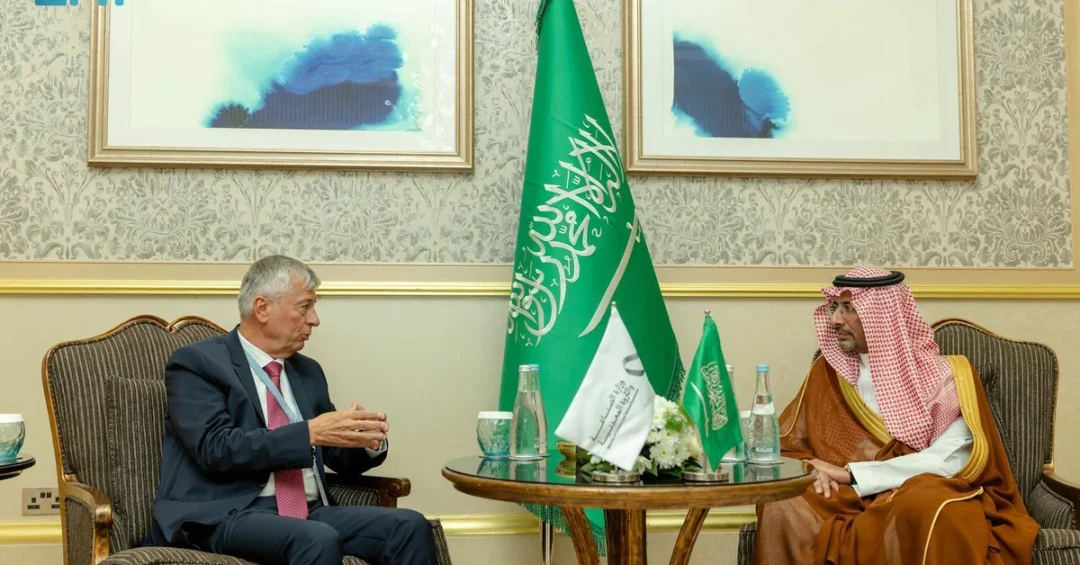
Saudi Arabia’s Minister of Industry and Mineral Resources Bandar bin Ibrahim Alkhorayef held a series of high-level bilateral meetings with international ministers and officials on the sidelines of the Multilateral Industrial Policy Forum (MIPF) in Riyadh, reinforcing the Kingdom’s growing role as a global convener of industrial policy dialogue. The forum, held under the theme “Industrial Policies for a Sustainable Future,” was launched by the Ministry of Industry and Mineral Resources in partnership with the United Nations Industrial Development Organization (UNIDO), according to the Saudi Press Agency.
Could a single forum in Riyadh reshape how nations across Africa, Asia, and the Middle East design their industrial futures? The answer, based on the breadth of participation and the level of engagement recorded during the MIPF, appears increasingly affirmative. The meetings brought together leaders from Guinea, Palestine, Tunisia, and Pakistan, underscoring the Kingdom’s expanding diplomatic and economic reach across multiple regions. The Riyadh gathering marked the first time the MIPF has been convened outside UNIDO’s headquarters in Vienna, a significant milestone that reflects international confidence in Saudi Arabia’s capacity to host and steer complex multilateral conversations about industrial development.
Context and Background
Why does the location of a multilateral forum matter so much in the world of industrial policy? The answer lies in the symbolic and practical weight of convening nations on Saudi soil. For decades, UNIDO’s flagship industrial policy discussions were anchored in Vienna, the organization’s longstanding headquarters. The decision to hold the 2024 edition in Riyadh signals a deliberate shift toward broader geographic inclusion and recognizes the Kingdom’s rapid industrial transformation under Vision 2030. The MIPF was designed to support global industrial development by formulating effective and innovative policies that address current challenges and trends, ranging from supply chain resilience to sustainable manufacturing and digital transformation.
The forum’s Saudi-hosted debut also reflects a deeper strategic logic. The Kingdom has been steadily positioning itself as a bridge between developed and developing economies, leveraging its G20 membership, its role in OPEC, and its expanding portfolio of bilateral trade and investment agreements. By hosting the MIPF, Saudi Arabia created a platform where ministers from Africa, the Middle East, and South Asia could engage directly with one another and with UNIDO’s technical expertise. This aligns with the Ministry of Industry and Mineral Resources’ mandate to diversify the national economy beyond hydrocarbons, attract foreign direct investment, and build industrial ecosystems that generate skilled employment for a young and growing population.
The timing of the forum is equally significant. Global supply chains continue to adjust to post-pandemic realities, geopolitical tensions, and the accelerating transition toward clean energy and advanced manufacturing. Developing nations in particular face pressure to design industrial policies that are both competitive and sustainable. The MIPF provided a timely venue for sharing best practices, aligning regulatory frameworks, and exploring joint ventures that could accelerate industrial capacity in participating countries. Saudi Arabia’s own experience, transitioning from an oil-dependent economy to a diversified industrial base, offered a compelling case study for many of the delegations present in Riyadh.
Key Details of the Bilateral Meetings
What exactly was discussed behind the closed doors of these bilateral meetings, and why should international observers pay attention? According to the Saudi Press Agency, Minister Alkhorayef met with Guinean Prime Minister Amadou Bah, Palestinian Minister of Industry Arafat Asfour, Tunisian Minister of Industry, Mines and Energy Fatma Thabet Chiboub, and Pakistani Federal Minister for Industries and Production Rana Tanveer Hussain. Each meeting explored ways to enhance industrial cooperation, discussed the success of the MIPF, and promoted Saudi Arabia’s bid to host UNIDO’s General Conference in 2025.
The discussions also highlighted investment opportunities and the favorable investment climate in Saudi Arabia, a key pillar of the Kingdom’s economic diplomacy. Minister Alkhorayef used the meetings to present the regulatory reforms, incentives, and infrastructure investments that have made Saudi Arabia one of the most attractive destinations for industrial capital in the region. These include special economic zones, streamlined licensing procedures, and targeted support for sectors such as mining, petrochemicals, automotive manufacturing, and renewable energy components. For delegations from Guinea, Tunisia, and Pakistan, the conversations opened pathways for technology transfer, joint ventures, and access to Saudi financing and expertise.
The meeting with the Palestinian Minister of Industry, Arafat Asfour, carried additional significance given Saudi Arabia’s consistent support for Palestinian economic development and institution-building. The exchange focused on practical avenues for industrial capacity-building and knowledge sharing. Meanwhile, the engagement with Guinea’s Prime Minister Amadou Bah underscored Saudi Arabia’s growing interest in West African mining and industrial partnerships, particularly in bauxite, iron ore, and agricultural processing. Tunisia’s participation reflected the broader Mediterranean dimension of Saudi industrial diplomacy, with discussions touching on manufacturing, renewable energy, and trade facilitation. Pakistan’s Federal Minister for Industries and Production, Rana Tanveer Hussain, explored synergies in textiles, food processing, and light engineering, sectors where both countries have complementary strengths.
International and Regional Impact
How will these meetings reverberate beyond the immediate participants? The MIPF and the bilateral engagements around it represent a broader realignment of industrial diplomacy. By bringing together ministers from Africa, the Middle East, and South Asia, Saudi Arabia is helping to construct a more inclusive framework for industrial policy coordination. This is particularly important for developing economies that often lack access to the technical assistance, financing, and market linkages needed to upgrade their industrial bases. The forum’s partnership with UNIDO ensures that the discussions are grounded in international best practices and aligned with the Sustainable Development Goals, especially Goal 9 on industry, innovation, and infrastructure.
Regionally, the meetings reinforce Saudi Arabia’s position as a stabilizing and constructive force in the Middle East and beyond. The Kingdom’s ability to convene Israeli-adjacent, African, and South Asian delegations in a single forum demonstrates its diplomatic versatility and its commitment to multilateralism. For international audiences, this signals that Saudi Arabia is not only a participant in global industrial governance but increasingly a shaper of its agenda. The promotion of Saudi Arabia’s bid to host UNIDO’s General Conference in 2025 adds a concrete institutional dimension to this ambition. If successful, the Kingdom would host the organization’s highest governing body, further cementing its role as a global hub for industrial policy dialogue and cooperation.
Economic and Strategic Significance
Why should global investors and policymakers view these meetings as more than routine diplomacy? The economic stakes are substantial. Saudi Arabia is actively diversifying its economy through the National Industrial Development and Logistics Program (NIDLP), one of the Vision 2030 realization programs. NIDLP aims to transform the Kingdom into a leading industrial power and logistics hub, with targeted investments in mining, energy, manufacturing, and transport. The bilateral meetings at the MIPF served as a platform to communicate these opportunities to international partners and to identify concrete areas for collaboration.
The favorable investment climate that Minister Alkhorayef highlighted includes a range of measures designed to attract foreign capital: 100 percent foreign ownership in most sectors, competitive energy prices, a strategic location connecting three continents, and a young, educated workforce. For countries like Guinea and Pakistan, Saudi investment can catalyze domestic industrial development through joint ventures and off-take agreements. For Tunisia, cooperation in renewable energy and manufacturing could support its own economic modernization goals. And for Saudi Arabia, these partnerships contribute to supply chain diversification, technology acquisition, and market access. The strategic significance extends to minerals and mining, where the Kingdom is positioning itself as a key player in the global energy transition, supplying critical materials for batteries, electric vehicles, and renewable infrastructure.
Vision 2030 Alignment
How does the Multilateral Industrial Policy Forum connect to Saudi Arabia’s long-term national transformation? The forum and the bilateral meetings are direct expressions of Vision 2030’s core objectives: economic diversification, international engagement, and the development of a knowledge-based industrial economy. By hosting the MIPF in Riyadh and using it as a platform for high-level diplomacy, the Ministry of Industry and Mineral Resources is advancing the Kingdom’s ambition to become a global industrial leader. The promotion of Saudi Arabia’s candidacy for UNIDO’s General Conference in 2025 is a further step toward institutional leadership in multilateral industrial governance.
The meetings also reflect the Kingdom’s commitment to South-South cooperation and to building partnerships that are mutually beneficial. As Saudi Arabia continues to invest in its own industrial infrastructure, including giga-projects such as NEOM and the expansion of mining and manufacturing clusters, it is simultaneously creating opportunities for international partners to participate in its growth story. The MIPF’s success in its inaugural year outside Vienna sets a precedent for future editions and reinforces the Kingdom’s role as a convening power in the global industrial policy landscape. For international readers, the message is clear: Saudi Arabia is open for business, open for partnership, and open to shaping a sustainable industrial future alongside the global community.
20 Questions
Q1. What was the main event discussed in this article?
A1. The article covers the Multilateral Industrial Policy Forum (MIPF) held in Riyadh, Saudi Arabia, where Minister of Industry and Mineral Resources Bandar bin Ibrahim Alkhorayef met with international officials to discuss industrial cooperation and sustainable development.
Q2. Who organized the Multilateral Industrial Policy Forum?
A2. The forum was launched by the Saudi Ministry of Industry and Mineral Resources in partnership with the United Nations Industrial Development Organization (UNIDO), according to the Saudi Press Agency.
Q3. Which international officials met with Minister Alkhorayef?
A3. Minister Alkhorayef met with Guinean Prime Minister Amadou Bah, Palestinian Minister of Industry Arafat Asfour, Tunisian Minister of Industry, Mines and Energy Fatma Thabet Chiboub, and Pakistani Federal Minister for Industries and Production Rana Tanveer Hussain.
Q4. What was the theme of the Multilateral Industrial Policy Forum?
A4. The forum was held under the theme “Industrial Policies for a Sustainable Future,” focusing on formulating effective and innovative policies to address current global industrial challenges and trends.
Q5. Why is the MIPF being held outside Vienna significant?
A5. This is the first year the MIPF has been held outside UNIDO’s headquarters in Vienna, highlighting Saudi Arabia’s growing role as a global convener and the international community’s confidence in the Kingdom’s capabilities.
Q6. What did the bilateral meetings aim to achieve?
A6. The meetings explored ways to enhance industrial cooperation, discussed the success of the MIPF, promoted Saudi Arabia’s bid to host UNIDO’s General Conference in 2025, and highlighted investment opportunities in the Kingdom.
Q7. What investment opportunities did Minister Alkhorayef highlight?
A7. He highlighted Saudi Arabia’s favorable investment climate, including regulatory reforms, special economic zones, and opportunities in mining, petrochemicals, automotive manufacturing, and renewable energy components.
Q8. How does the MIPF support global industrial development?
A8. The forum aims to support global industrial development by formulating effective and innovative policies that address current challenges and trends, in line with UNIDO’s mandate and the Sustainable Development Goals.
Q9. What is Saudi Arabia’s bid for UNIDO’s General Conference in 2025?
A9. Saudi Arabia is seeking to host UNIDO’s General Conference in 2025, which would further cement its role as a global hub for industrial policy dialogue and international cooperation.
Q10. How does the forum align with Vision 2030?
A10. The forum aligns with Vision 2030’s objectives of economic diversification, international engagement, and building a knowledge-based industrial economy, supporting the Kingdom’s transformation into a global industrial leader.
Q11. What sectors were discussed in the bilateral meetings?
A11. Discussions covered mining, petrochemicals, automotive manufacturing, renewable energy, textiles, food processing, and light engineering, among other sectors with potential for joint ventures and technology transfer.
Q12. What is the significance of Saudi Arabia’s engagement with Guinea?
A12. The engagement with Guinea underscores Saudi Arabia’s interest in West African mining partnerships, particularly in bauxite, iron ore, and agricultural processing, supporting mutual industrial development.
Q13. How does the MIPF benefit developing economies?
A13. The MIPF provides developing economies with access to technical assistance, financing, and market linkages, helping them upgrade their industrial bases and align with international best practices.
Q14. What role does UNIDO play in the MIPF?
A14. UNIDO partners with Saudi Arabia’s Ministry of Industry and Mineral Resources to organize the MIPF, ensuring discussions are grounded in international best practices and aligned with sustainable development goals.
Q15. What is the National Industrial Development and Logistics Program?
A15. NIDLP is a Vision 2030 realization program aimed at transforming Saudi Arabia into a leading industrial power and logistics hub, with investments in mining, energy, manufacturing, and transport.
Q16. How does Saudi Arabia attract foreign investment in industry?
A16. Saudi Arabia offers 100 percent foreign ownership in most sectors, competitive energy prices, a strategic location connecting three continents, and a young, educated workforce, among other incentives.
Q17. What was discussed with the Palestinian Minister of Industry?
A17. The meeting with Arafat Asfour focused on practical avenues for industrial capacity-building and knowledge sharing, reflecting Saudi Arabia’s support for Palestinian economic development.
Q18. What are the regional implications of the MIPF?
A18. The forum reinforces Saudi Arabia’s position as a stabilizing force in the Middle East, demonstrating its diplomatic versatility and commitment to multilateralism across Africa, Asia, and the Middle East.
Q19. How does the MIPF promote South-South cooperation?
A19. By bringing together ministers from Africa, the Middle East, and South Asia, the MIPF facilitates South-South cooperation, enabling developing countries to share best practices and explore joint ventures.
Q20. What is the forward-looking outcome of the MIPF?
A20. The MIPF sets a precedent for future editions outside Vienna, reinforces Saudi Arabia’s role as a convening power, and advances the Kingdom’s ambition to lead in global industrial policy and sustainable development.
Reader Feedback
We value your thoughts. Please share your feedback on this article.
Your feedback helps us improve our coverage.
Related articles
 King Salman Congratulates Vietnam’s New President
 Saudi Ambassador to Tunisia Meets with Delegation from MISA, SFD, PIF, and Sea Gateway Terminal
 GCC Chief Meets World Bank Executives in Washington
 GCA Holds 19th Annual Symposium Next Week
 Saudi Energy Minister Oversees SAR104 Billion in Agreements at Localization Forum
 GCC Chief Condemns Terrorist Attack on Turkish Aerospace Industries