


Saudi Arabia’s non-oil exports, including re-exports, reached SAR27.5 billion in August 2024, marking a 7.4% year-on-year increase from SAR25.6 billion in August 2023, according to the General Authority for Statistics (GASTAT). The official International Trade Bulletin for August 2024, released via the Saudi Press Agency, confirmed a rise of SAR1.9 billion in non-oil export value, underscoring the Kingdom’s steady progress in diversifying its export base away from hydrocarbons. The data reflects a broadening economic foundation consistent with the objectives of Saudi Vision 2030.
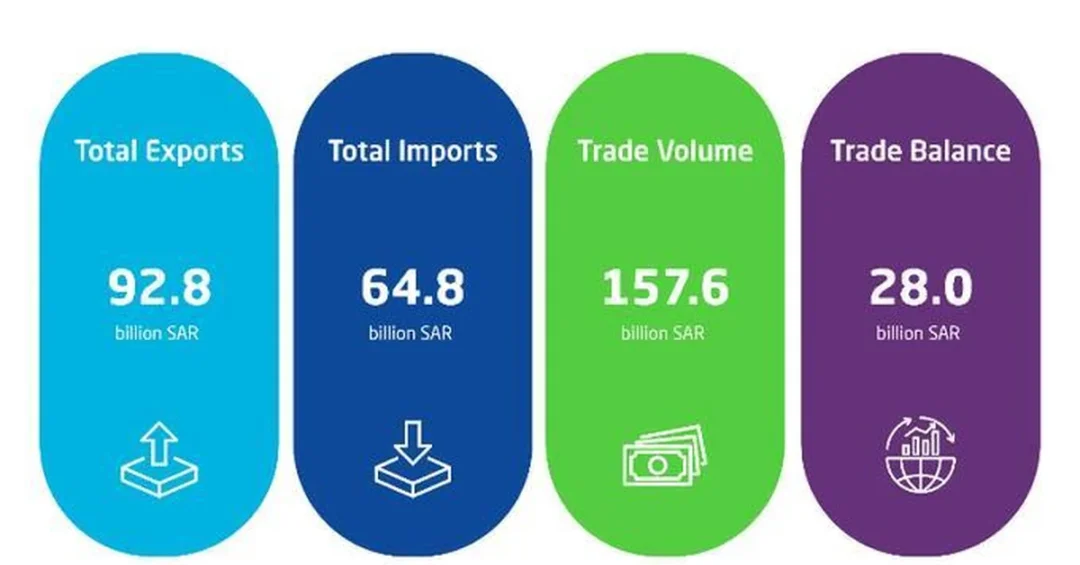
The bulletin also reported that oil exports stood at SAR65.3 billion in August 2024, compared with SAR77.3 billion in the same month of 2023, a decrease of SAR12 billion or 15.5%. Total merchandise exports declined by 9.8% year-on-year to SAR92.8 billion, while merchandise imports fell by 3.9% to SAR64.8 billion. The mixed trade picture highlights the dual dynamics at play: global oil market fluctuations on one side, and the deliberate expansion of non-oil sectors on the other. Is this not precisely the kind of structural shift that a diversified economy requires?
Context and Background
Why does a single month’s trade bulletin carry significance beyond its immediate figures? For years, Saudi Arabia’s export profile was overwhelmingly dominated by crude oil and refined petroleum products. The General Authority for Statistics, the Kingdom’s official statistical authority, has been tracking a gradual but persistent rise in non-oil exports as new industrial zones, manufacturing clusters, and logistics hubs come online across the country. The August 2024 data continues a pattern observed throughout the year, where non-oil export values have consistently outpaced prior-year comparatives even as oil revenues fluctuate with global prices and production agreements.
The International Trade Bulletin is released monthly and serves as a key indicator for policymakers, investors, and international observers assessing the pace of Saudi economic transformation. The bulletin breaks down exports into oil and non-oil categories, tracks re-exports, and records import values by commodity and partner country. The August 2024 edition arrives at a time when the Kingdom is accelerating industrial development under the National Industrial Development and Logistics Program, a Vision 2030 initiative designed to make Saudi Arabia a global logistics and manufacturing power. The rise in non-oil exports is not an isolated event but part of a deliberate, multi-year strategy.
It is also worth noting that the decline in oil export value reflects broader market conditions rather than any weakness in Saudi production capacity. Global oil prices and OPEC+ production adjustments influence monthly export values, and the Kingdom has consistently maintained its role as a reliable energy supplier. The simultaneous growth in non-oil exports and contraction in oil exports illustrates the very transition that Saudi economic planners have sought to achieve: a more balanced trade profile that cushions the economy against commodity price swings.
Key Details from the GASTAT Bulletin
What exactly do the August 2024 figures reveal about the Kingdom’s trade composition? Non-oil exports, including re-exports, rose to SAR27.5 billion from SAR25.6 billion a year earlier, a gain of SAR1.9 billion. This category encompasses manufactured goods, petrochemicals, plastics, metals, agricultural products, and re-exported merchandise passing through Saudi ports and logistics zones. The growth rate of 7.4% is significant because it exceeds the overall rate of import decline, suggesting that Saudi producers are gaining ground in regional and international markets.
Oil exports, meanwhile, declined by 15.5% year-on-year to SAR65.3 billion. This decline contributed to an overall merchandise export drop of 9.8%, from SAR102.9 billion in August 2023 to SAR92.8 billion in August 2024. Imports also decreased, falling 3.9% to SAR64.8 billion. The reduction in imports can be interpreted in several ways: it may reflect improved domestic production capacity, softer domestic demand, or deliberate efforts to localize supply chains. In any case, the trade balance remains positive, with exports exceeding imports by a substantial margin.
The bulletin’s detailed breakdown provides further insight into the sectors driving non-oil export growth. Petrochemical and plastic products have long been leading non-oil export categories, but recent months have seen increased contributions from metals, machinery, and value-added manufactured goods. Re-exports have also grown as Saudi Arabia strengthens its position as a regional logistics hub, leveraging its strategic location between Asia, Europe, and Africa. The Kingdom’s ports, including King Abdullah Port and Jeddah Islamic Port, have invested heavily in capacity and efficiency, enabling faster throughput and attracting more transshipment activity.
International and Regional Impact
How does Saudi Arabia’s trade performance resonate beyond its borders? As the largest economy in the Middle East and a member of the G20, the Kingdom’s trade flows directly affect regional supply chains and global commodity markets. The growth in non-oil exports signals to international investors and trading partners that Saudi Arabia is becoming a more diversified and reliable source of manufactured goods, not just energy. This is particularly relevant for partners in Asia, Europe, and Africa, who are increasingly seeking to deepen economic ties with the Kingdom under frameworks such as the Saudi Green Initiative and various bilateral investment agreements.
Regionally, the rise in non-oil exports supports the broader Gulf Cooperation Council (GCC) economic integration agenda. Saudi Arabia’s industrial output feeds into GCC-wide supply chains, and its logistics infrastructure serves as a gateway for goods moving between member states and external markets. The decline in imports also has regional implications, as it may reflect a shift toward sourcing from within the Kingdom or the GCC, reducing reliance on distant suppliers. For neighboring countries, Saudi Arabia’s economic trajectory offers both competitive pressure and partnership opportunities, particularly in manufacturing, logistics, and technology transfer.
Economic and Strategic Significance
Why should the international business community pay close attention to these monthly trade figures? The August 2024 bulletin is more than a statistical snapshot; it is a barometer of Saudi Arabia’s progress toward economic resilience. Non-oil export growth of 7.4% demonstrates that the Kingdom’s investments in industrial cities, special economic zones, and small and medium enterprise development are beginning to yield tangible results. The Public Investment Fund (PIF) and various government programs have channeled billions of dollars into manufacturing, mining, and logistics, and the export data provides early evidence that these investments are translating into real output.
At the same time, the decline in oil export value highlights the importance of fiscal discipline and economic diversification. Saudi Arabia has consistently stated its intention to balance its budget and reduce dependence on oil revenues, and the non-oil export growth is a critical component of that strategy. The Kingdom’s sovereign wealth fund continues to invest in sectors ranging from renewable energy to entertainment, but the trade data underscores that manufacturing and logistics are central to the diversification equation. A strong non-oil export sector creates jobs, generates foreign exchange, and builds technical expertise, all of which are essential for long-term prosperity.
Vision 2030 Alignment
How does the August 2024 trade data connect to the broader Vision 2030 framework? Saudi Vision 2030, launched in 2016 under the leadership of Crown Prince Mohammed bin Salman, sets out a comprehensive plan to diversify the economy, develop public service sectors, and enhance quality of life. One of its central pillars is the expansion of non-oil exports, with targets to increase their share of GDP and to integrate the Kingdom more deeply into global value chains. The 7.4% growth in non-oil exports is a direct contribution to that goal, reflecting the success of initiatives such as the National Industrial Development and Logistics Program and the Saudi Export Development Authority’s efforts to open new markets.
The bulletin also reinforces the Kingdom’s commitment to transparency and data-driven policymaking. GASTAT’s regular publication of trade statistics allows businesses, researchers, and international organizations to track progress and make informed decisions. As Saudi Arabia continues to implement Vision 2030, monthly indicators like the International Trade Bulletin will remain essential tools for measuring success and identifying areas for further development. The August 2024 figures offer a positive signal: the non-oil economy is growing, the trade balance remains healthy, and the Kingdom is steadily building a more diversified and resilient economic future. With continued investment and strategic reforms, Saudi Arabia is well positioned to meet its Vision 2030 objectives and to strengthen its role as a leading global economy.
20 Questions
Q1. What did GASTAT announce regarding non-oil exports in August 2024?
A1. GASTAT announced that non-oil exports, including re-exports, reached SAR27.5 billion in August 2024, compared to SAR25.6 billion in August 2023, marking an increase of SAR1.9 billion, or 7.4%.
Q2. What was the value of oil exports in August 2024 according to the bulletin?
A2. The value of oil exports in August 2024 stood at SAR65.3 billion, compared to SAR77.3 billion in August 2023, representing a decrease of SAR12 billion, or 15.5%.
Q3. How much did total merchandise exports decline in August 2024?
A3. Total merchandise exports declined to SAR92.8 billion in August 2024 from SAR102.9 billion in August 2023, a drop of SAR10.1 billion, or 9.8%.
Q4. What was the value of merchandise imports in August 2024?
A4. The value of merchandise imports in August 2024 reached SAR64.8 billion, compared to SAR67.4 billion in August 2023, decreasing by SAR2.6 billion, or 3.9%.
Q5. Which authority released the International Trade Bulletin for August 2024?
A5. The General Authority for Statistics (GASTAT), the Kingdom’s official statistical authority, released the International Trade Bulletin for August 2024 via the Saudi Press Agency.
Q6. What is the significance of the 7.4% increase in non-oil exports?
A6. The increase demonstrates Saudi Arabia’s progress in diversifying its export base away from hydrocarbons, a key objective of Vision 2030, and reflects growing competitiveness in manufactured goods and re-exports.
Q7. What are some examples of non-oil exports from Saudi Arabia?
A7. Non-oil exports include petrochemicals, plastics, metals, machinery, agricultural products, and re-exported merchandise passing through Saudi ports and logistics zones.
Q8. How does the decline in oil exports affect Saudi Arabia’s economy?
A8. The decline in oil export value reflects global market conditions and OPEC+ production adjustments. It highlights the importance of non-oil growth to cushion the economy against commodity price fluctuations.
Q9. What is the National Industrial Development and Logistics Program?
A9. It is a Vision 2030 initiative designed to transform Saudi Arabia into a global logistics and manufacturing power, supporting non-oil export growth and industrial diversification.
Q10. How does Saudi Arabia’s trade performance impact the region?
A10. As the largest Middle East economy, Saudi Arabia’s trade flows affect regional supply chains and global commodity markets, supporting GCC economic integration and offering partnership opportunities.
Q11. What role does the Saudi Export Development Authority play?
A11. The Saudi Export Development Authority works to open new markets for Saudi non-oil products, supporting exporters and contributing to the growth of non-oil exports.
Q12. Why are re-exports important for Saudi Arabia?
A12. Re-exports leverage Saudi Arabia’s strategic location between Asia, Europe, and Africa, strengthening its position as a regional logistics hub and boosting trade volumes.
Q13. What does the decline in imports suggest about the Saudi economy?
A13. The decline in imports may reflect improved domestic production capacity, softer domestic demand, or efforts to localize supply chains, all consistent with economic diversification goals.
Q14. How does GASTAT ensure transparency in its trade data?
A14. GASTAT regularly publishes the International Trade Bulletin, providing detailed breakdowns of exports and imports by category, allowing businesses and researchers to track progress.
Q15. What are Saudi Arabia’s main trading partners for non-oil exports?
A15. Saudi Arabia’s main non-oil export partners include countries in Asia, Europe, and the GCC, with growing trade ties under various bilateral and regional agreements.
Q16. How does the August 2024 data align with Vision 2030 targets?
A16. The 7.4% growth in non-oil exports directly supports Vision 2030’s goal to increase non-oil exports’ share of GDP and integrate the Kingdom into global value chains.
Q17. What are special economic zones in Saudi Arabia?
A17. Special economic zones are designated areas with incentives for businesses, designed to attract investment, boost manufacturing, and increase non-oil exports as part of Vision 2030.
Q18. How does the Public Investment Fund support non-oil exports?
A18. The PIF invests in manufacturing, mining, and logistics sectors, providing capital and strategic support that helps build the industrial base for non-oil export growth.
Q19. What is the trade balance for Saudi Arabia in August 2024?
A19. With merchandise exports at SAR92.8 billion and imports at SAR64.8 billion, Saudi Arabia maintained a positive trade balance of approximately SAR28 billion in August 2024.
Q20. What is the outlook for Saudi Arabia’s non-oil exports?
A20. With continued investment under Vision 2030, expansion of industrial zones, and growing global demand, Saudi Arabia’s non-oil exports are expected to continue their upward trajectory in the coming years.
Reader Feedback
We value your thoughts. Please share your feedback on this article.
Your feedback helps us improve our coverage.
Related articles
 IsDB President Meets IMF Managing Director in Washington
 Saudi Agriculture Exhibition Concludes with 12 Deals
 IsDB President Commends ACG-World Bank Dialogue
 Saudi Electricity Company Signs SAR 54.7 Billion Energy Localization Agreements
 SFD Concludes Participation in MIPF 2024 in Riyadh
 GSO and IEC Sign Standardization Partnership in Edinburgh