


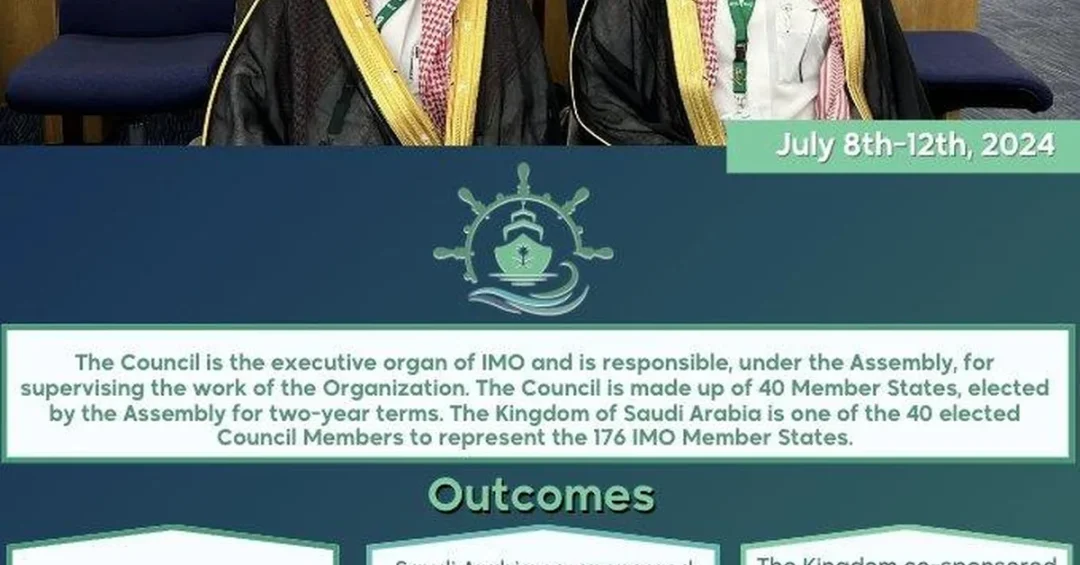
Saudi Arabia has reaffirmed its commitment to inclusive and progressive global maritime governance by taking part in the 132nd session of the International Maritime Organization (IMO) Council in London, where the Kingdom championed multilingualism, cultural and religious recognition, and greater gender and geographic diversity across the organization. The Saudi delegation, supported by the Transport General Authority (TGA), used the high-level gathering to press for practical reforms that make the IMO more accessible, representative, and responsive to its diverse membership. The session, held at the IMO headquarters in London, brought together representatives from member states to discuss the strategic direction of the United Nations specialized agency responsible for the safety and security of shipping and the prevention of marine and atmospheric pollution by ships.
But what does it mean when a leading maritime nation uses its platform not only to advance shipping policy but also to promote language access, religious observance, and gender equality? For Saudi Arabia, the answer lies in a broader vision of international cooperation that reflects the Kingdom’s own transformation at home and its growing role abroad. The Saudi participation in the 132nd IMO Council session was not merely procedural; it was a statement of intent. The Kingdom used the occasion to advocate for Arabic as an accessible language within the IMO, for the official recognition of Eid Al-Fitr and Eid Al-Adha in the organization’s calendar, and for stronger representation of women and underrepresented regions in the IMO Secretariat. Each of these positions aligns with the Kingdom’s Vision 2030 reform agenda, which seeks to position Saudi Arabia as a global logistics hub and a bridge between cultures and economies.
Context and Background: Why the IMO Council Session Matters
How did a specialized UN agency in London become a stage for Saudi Arabia’s wider diplomatic and developmental ambitions? The International Maritime Organization is the United Nations agency responsible for regulating shipping, a sector that carries more than 80 percent of global trade by volume. Its Council, which meets periodically, serves as the executive organ that governs the organization’s work between sessions of the full Assembly. The 132nd session therefore represented a critical juncture for member states to shape the IMO’s agenda on safety, environmental protection, and institutional governance. For Saudi Arabia, whose economy depends heavily on maritime trade and whose ports are among the busiest in the region, active participation in the IMO is both an economic necessity and a diplomatic opportunity.
The Transport General Authority, the Saudi agency responsible for regulating land and maritime transport, issued a press release detailing the Kingdom’s contributions to the session. According to the TGA, Saudi Arabia focused on promoting multilingualism within the IMO to meet the diverse linguistic needs of the global maritime community. This initiative aims to enhance accessibility to the Arabic language within the IMO, fostering improved communication and inclusivity among international stakeholders. The move is not simply symbolic. Arabic is one of the six official languages of the United Nations, yet its practical use within some specialized agencies has lagged behind other official languages. By pushing for greater Arabic accessibility, Saudi Arabia is working to ensure that Arabic-speaking maritime professionals, seafarers, and administrators can engage with the IMO’s work on equal footing.
The TGA also noted that this effort aligns with United Nations Strategic Development Goal 16, which emphasizes peace, justice, and strong institutions. Goal 16 calls for inclusive and effective institutions at all levels, and Saudi Arabia’s advocacy for multilingualism is a concrete example of how institutional inclusiveness can be advanced in practice. For a global maritime community that spans dozens of languages and cultures, making the IMO’s resources and proceedings more accessible is a step toward more equitable participation. The Kingdom’s delegation framed the initiative as part of a broader commitment to representing all IMO member states, not only those with the largest fleets or the longest maritime traditions.
Key Details: Multilingualism, Religious Inclusion, and Diversity
What specific changes did Saudi Arabia advocate for during the 132nd IMO Council session? According to the TGA press release, the Kingdom’s efforts centered on three interconnected priorities. The first was the promotion of multilingualism, with a particular emphasis on enhancing accessibility to the Arabic language within the IMO. This initiative is designed to foster improved communication and inclusivity among international stakeholders, ensuring that Arabic-speaking participants can fully engage with the organization’s documentation, deliberations, and decisions. The Kingdom’s delegation argued that linguistic inclusivity is not a peripheral concern but a core component of effective multilateralism, particularly in a sector as globally integrated as shipping.
The second priority was the official recognition of the Islamic holidays Eid Al-Fitr and Eid Al-Adha within the IMO calendar. This advocacy underscores the importance of cultural diversity and religious inclusivity in international organizations. By calling for these observances to be acknowledged in the IMO’s official schedule, Saudi Arabia is seeking to ensure that Muslim staff and delegates are not disadvantaged by the timing of meetings and events. The move reflects a wider principle: that international institutions should accommodate the religious and cultural practices of their diverse memberships. It is a position that resonates beyond the maritime sector, touching on debates about representation and respect in global governance.
The third priority was increasing gender and geographical diversity within the IMO Secretariat. The TGA stated that the Kingdom has been a strong advocate of improving the visibility and recognition of women in the maritime sector, particularly for the International Maritime Prize. This advocacy aligns with United Nations Strategic Development Goal 5, which calls for gender equality and the empowerment of women and girls. Saudi Arabia’s delegation argued that a more balanced and inclusive maritime industry requires deliberate efforts to recognize and promote the contributions of women, who remain underrepresented in many areas of shipping and logistics. The Kingdom also supported efforts to broaden geographic representation within the Secretariat, ensuring that the IMO’s staff reflects the full diversity of its member states.
International and Regional Impact: Building Bridges Across the Maritime Community
How might Saudi Arabia’s advocacy at the IMO Council session influence the broader international maritime landscape? The Kingdom’s positions on multilingualism, religious inclusion, and diversity are likely to find support among many member states that share similar concerns. Arabic-speaking countries, in particular, have long sought greater recognition of their language within international organizations. By championing this cause, Saudi Arabia positions itself as a representative of a broader constituency, not merely as an advocate for its own interests. This approach aligns with the Kingdom’s stated dedication to representing all IMO member states and pursuing policies that support sustainability, seafarers, and safety, as noted in the TGA release.
The recognition of Eid Al-Fitr and Eid Al-Adha within the IMO calendar could also set a precedent for other international organizations. If the IMO adopts such accommodations, it would send a signal that global institutions can and should adapt to the religious diversity of their memberships. This could encourage similar discussions in other UN agencies and multilateral bodies. For Saudi Arabia, the initiative reflects a broader diplomatic strategy of promoting cultural and religious understanding as part of its international engagement. It is a strategy that resonates with the Kingdom’s role as the custodian of Islam’s holiest sites and its growing profile as a convenor of global dialogue.
On gender and geographic diversity, Saudi Arabia’s advocacy aligns with a global trend toward greater inclusion in international institutions. The Kingdom’s emphasis on recognizing women in the maritime sector, including through the International Maritime Prize, is consistent with its domestic reforms under Vision 2030, which have expanded opportunities for women in the workforce and in public life. By raising these issues at the IMO, Saudi Arabia is signaling that its commitment to gender equality extends beyond its borders and into the multilateral arena. This positioning could enhance the Kingdom’s credibility as a partner in international efforts to promote sustainable development and inclusive governance.
Economic and Strategic Significance: Maritime Trade and Vision 2030
Why does Saudi Arabia’s participation in the IMO matter for its economy and strategic ambitions? The Kingdom sits at the crossroads of major global shipping routes, with ports on both the Red Sea and the Arabian Gulf. Maritime trade is a lifeline for Saudi exports, particularly oil and petrochemicals, and for imports of goods and materials needed for the Kingdom’s ambitious infrastructure and industrial projects. As Saudi Arabia pursues its Vision 2030 goal of becoming a global logistics hub, the reliability, safety, and efficiency of international shipping become ever more critical. Active engagement in the IMO allows the Kingdom to help shape the rules and standards that govern this vital sector.
According to the TGA release, Saudi Arabia’s efforts at the IMO embody the Kingdom’s Vision 2030, a roadmap for positioning Saudi Arabia as a global logistics hub and promoting sustainable development. The release also emphasized the empowerment of women and the promotion of leadership to foster a vibrant society. These themes are central to Vision 2030, which seeks to diversify the economy, expand the private sector, and create a dynamic society open to the world. By linking its maritime diplomacy to its domestic reform agenda, Saudi Arabia presents a coherent narrative of transformation that resonates with international partners and investors.
The Kingdom’s advocacy for multilingualism and inclusivity also has practical economic benefits. A more accessible IMO means that Saudi maritime professionals, officials, and businesses can participate more effectively in international decision-making. This can help ensure that the Kingdom’s interests are represented in technical committees, working groups, and negotiations on issues ranging from emissions reduction to port security. In a sector where regulations can have significant cost implications, having a seat at the table and a voice in the conversation is essential. Saudi Arabia’s active role in the IMO Council session demonstrates its commitment to shaping the maritime future, not merely adapting to it.
Vision 2030 Alignment: A Forward-Looking Maritime Strategy
How does Saudi Arabia’s participation in the 132nd IMO Council session connect to the Kingdom’s long-term vision for its economy and society? Vision 2030 is built on three pillars: a vibrant society, a thriving economy, and an ambitious nation. The Kingdom’s advocacy at the IMO touches on all three. The push for multilingualism and religious inclusion supports a vibrant society that values cultural diversity and respects religious observance. The focus on gender and geographic diversity reflects the ambition to build inclusive institutions at home and abroad. And the overarching goal of positioning Saudi Arabia as a global logistics hub is central to the thriving economy pillar, which seeks to diversify revenue streams and create jobs for Saudi citizens.
The TGA release quoted Saudi Arabia’s commitment to fostering an inclusive and equitable international maritime environment, demonstrating its dedication to progressive and collaborative leadership within the IMO. The Kingdom is dedicated to representing all IMO member states and pursuing policies that support sustainability, seafarers, and safety, the release read. These words capture the essence of Saudi Arabia’s approach: a combination of principled advocacy and practical engagement, aimed at making the international maritime system more effective and more representative. As the Kingdom continues to invest in ports, logistics zones, and maritime infrastructure, its voice in the IMO will only grow in importance.
Looking ahead, Saudi Arabia’s role in the IMO is likely to expand as Vision 2030 progresses. The Kingdom’s strategic location, its growing fleet and port capacity, and its commitment to sustainable development position it as a key player in shaping the future of global shipping. The 132nd Council session was one step in a longer journey, but it was a significant one. By championing multilingualism, religious inclusion, and diversity, Saudi Arabia is helping to build an IMO that better reflects the world it serves. In doing so, the Kingdom is also reinforcing its own vision of a prosperous, inclusive, and globally engaged nation. For international observers, the message is clear: Saudi Arabia is not just participating in global maritime governance; it is helping to lead it.
20 Questions
Q1. What was the main focus of Saudi Arabia’s participation in the 132nd IMO Council session?
A1. Saudi Arabia focused on promoting multilingualism, recognizing Islamic holidays, and increasing gender and geographic diversity within the IMO, according to the Transport General Authority.
Q2. Where was the 132nd IMO Council session held?
A2. The session was held in London, United Kingdom, at the headquarters of the International Maritime Organization.
Q3. Which Saudi agency announced the Kingdom’s efforts at the IMO session?
A3. The Transport General Authority (TGA) issued a press release detailing Saudi Arabia’s contributions and advocacy priorities.
Q4. Why did Saudi Arabia advocate for Arabic language accessibility at the IMO?
A4. To enhance communication and inclusivity among international stakeholders, ensuring Arabic-speaking participants can fully engage with the IMO’s work.
Q5. Which UN Sustainable Development Goal is linked to Saudi Arabia’s multilingualism initiative?
A5. The initiative aligns with UNSDG 16, which emphasizes peace, justice, and strong institutions, promoting inclusiveness and effective institutional building.
Q6. What Islamic holidays did Saudi Arabia seek to have recognized in the IMO calendar?
A6. Saudi Arabia advocated for the official recognition of Eid Al-Fitr and Eid Al-Adha within the IMO calendar.
Q7. Why is the recognition of Eid holidays important to Saudi Arabia’s advocacy?
A7. It underscores the importance of cultural diversity and religious inclusivity in international organizations, ensuring Muslim staff and delegates are not disadvantaged.
Q8. What did Saudi Arabia advocate regarding gender diversity in the IMO Secretariat?
A8. The Kingdom advocated for increasing gender diversity and improving the visibility and recognition of women in the maritime sector, particularly for the International Maritime Prize.
Q9. Which UN Sustainable Development Goal aligns with Saudi Arabia’s gender diversity advocacy?
A9. It aligns with UNSDG 5, which calls for gender equality and the empowerment of women and girls.
Q10. How does Saudi Arabia’s IMO advocacy relate to Vision 2030?
A10. It embodies Vision 2030 by promoting Saudi Arabia as a global logistics hub, supporting sustainable development, empowering women, and fostering a vibrant society.
Q11. What did the TGA press release say about Saudi Arabia’s commitment to the IMO?
A11. The release stated that Saudi Arabia is committed to fostering an inclusive and equitable international maritime environment, demonstrating progressive and collaborative leadership within the IMO.
Q12. What does the International Maritime Organization do?
A12. The IMO is the UN agency responsible for the safety and security of shipping and the prevention of marine and atmospheric pollution by ships.
Q13. Why is the IMO Council session important for global shipping?
A13. The Council governs the IMO’s work between Assembly sessions, shaping policies on safety, environmental protection, and institutional governance for global maritime trade.
Q14. How does maritime trade affect Saudi Arabia’s economy?
A14. Maritime trade is vital for Saudi oil and petrochemical exports and for imports, supporting the Kingdom’s economic diversification and infrastructure projects under Vision 2030.
Q15. What is the significance of Saudi Arabia’s push for geographic diversity in the IMO Secretariat?
A15. It aims to ensure the IMO’s staff reflects the full diversity of its member states, promoting balanced representation and inclusive governance.
Q16. How might the recognition of Eid holidays at the IMO affect other international organizations?
A16. It could set a precedent for other UN agencies and multilateral bodies to accommodate the religious diversity of their memberships.
Q17. What did Saudi Arabia say about representing all IMO member states?
A17. The Kingdom stated it is dedicated to representing all IMO member states and pursuing policies that support sustainability, seafarers, and safety.
Q18. How does Saudi Arabia’s IMO participation reflect its domestic reforms?
A18. It reflects Vision 2030 reforms, including expanded opportunities for women, economic diversification, and a more open and engaged society.
Q19. What role does the Transport General Authority play in Saudi Arabia’s maritime sector?
A19. The TGA regulates land and maritime transport in Saudi Arabia and represents the Kingdom’s interests in international maritime forums such as the IMO.
Q20. What is the long-term outlook for Saudi Arabia’s role in the IMO?
A20. Saudi Arabia’s role is expected to expand as Vision 2030 progresses, leveraging its strategic location, growing port capacity, and commitment to sustainable development.
Reader Feedback
We value your thoughts. Please share your feedback on this article.
Your feedback helps us improve our coverage.
More on this topic: General
Related articles
 Prophet’s Mosque Welcomes 7.2 Million Worshipers in a Week
 Saudi Internal Audit Institute Meets Delegation at IIA Conference
 Arab Academic Forum in Cairo Focuses on Digital Training
 Saudi Arabia Weather Forecast: Thunderstorms, High Heat
 Crown Prince Speaks with UK PM Keir Starmer
 Jazan Border Guards Foil 75 Kg Khat Smuggling Attempt